

Quote Of The Day By Immanuel Kant: 'Thoughts Without Content Are...'
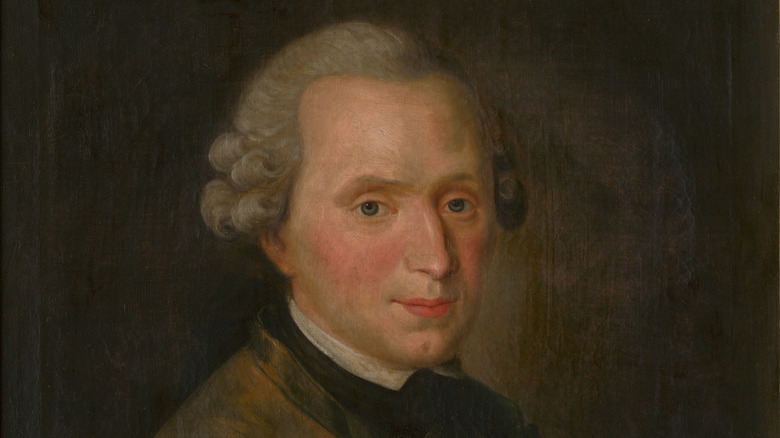
Immanuel Kant is one of the most famous figures in philosophy, and his writings have had a huge impact on the development of modern thought. Born in 1724 in Königsberg (now Kaliningrad, Russia), Kant was just 16 years old when he headed off to college and started studying philosophy. Eventually, he became a Professor of Logic and Metaphysics at the University of Königsberg, and went on to pen dozens of published works. While many of Kant's beliefs are outdated now, others remain keenly relevant.
His concepts made Kant one of the most important philosophers of the 18th century. To put it simply, Kant believed in universal ethical laws that should always be followed. He also argued that these laws needed to be established by collecting data and applying critical thought without letting emotion get in the way. Much of Kant's belief system revolved around how one should perceive things and think about them. And that's why Kant's thoughts about thinking itself are today's quote of the day.
Quote of the Day by Immanuel Kant
"Thoughts without content are empty, intuitions without concepts are blind. The understanding can intuit nothing, the senses can think nothing. Only through their unison can knowledge arise." Immanuel Kant shared this point in his 1781 book "The Critique of Pure Reason."
Notably, this text is considered one of Western philosophy's core works. "The Critique of Pure Reason" revolves primarily around knowledge itself, dissecting how humans learn, and how human understanding actually relates to fact. Naturally, it still holds true even all these years later.
Deeper meaning of Immanuel Kant's quote — Truly understanding something requires observation and thoughtful analysis
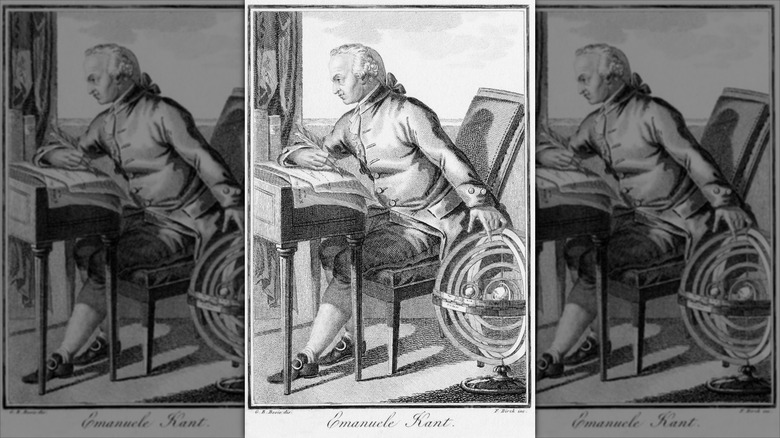
Learning isn't a one-step process. You need to start by using your senses to take in new information and then consider the new information you've gained on a deeper level. To really learn, it's necessary to observe the world around you and then apply critical thought to it afterwards. This is a core element of Immanuel Kant's philosophy. In "The Critique of Pure Reason," he delves into the concept of analytic and synthetic judgments. An analytic judgment is one that speaks for itself. For instance, the statement "a school teacher teaches at a school" is an analytic judgment, since the notion that this individual is a school teacher automatically proves that they teach at a school, and there is no need to need to collect further data to prove it.
"A school teacher teaches math," on the other hand, is an example of a synthetic judgment. Since the example doesn't specify that the teacher is a math teacher, this statement isn't necessarily true. There are thoughts we all interact with regularly, which revolve around synthetic judgment. If an idea we hear about doesn't speak for itself, or we haven't been able to readily apply data we have personally collected to it, there is a possibility that it isn't true. This quote acts as a reminder not to take everything we hear as fact and, instead, to always apply our own judgment. In a world of artificial intelligence and so-called "fake news," it certainly rings true.
More quotes from Immanuel Kant

- "Act so as to treat humanity, whether in your own person or in that of another, at all times also as an end, and not only as a means."
- "Have courage to use your own understanding."
- "We are not rich by what we possess but by what we can do without."
- "Live your life as though your every act were to become a universal law."
- "Rules for happiness: Something to do, someone to love, something to hope for."