

Quote Of The Day By Epictetus: 'If You Tell Me That You Desire...'
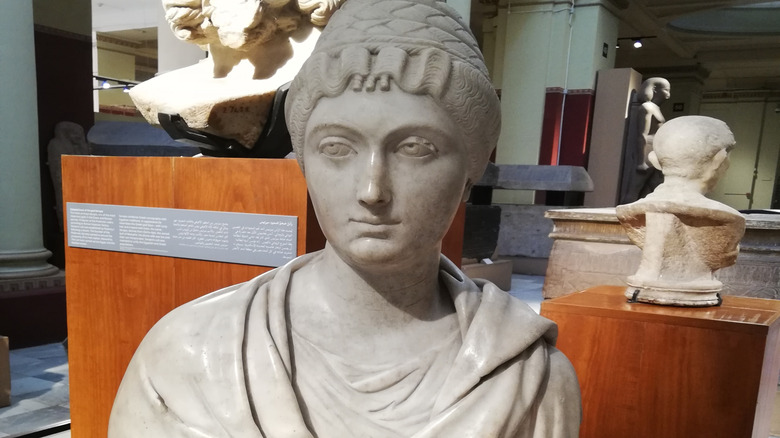
While you've almost surely heard of stoicism, what about all of the philosophers behind it? Epictetus was born around AD 55 in Hierapolis, Phrygia (now Turkey). He was born into slavery, and when Epictetus was finally released, he committed to pursuing philosophy. As a result, his thoughts helped create stoicism. But the negative way stoicism was viewed in the tyrannical society where Epictetus lived prompted the young man and several of his fellow philosophers to be banished from Rome. He relocated to Greece where he opened a school of stoicism and taught lectures. It is believed that while Epictetus himself didn't write, his teachings were documented by Flavius Arrian, one of his students.
Through those texts, Epictetus' teachings have lived on, and continue to be studied to this day. These teachings revolved around several ideas. One important element is that we don't have control over anything but our own thoughts. Therefore, it is important to accept and be grateful for what happens around us that we can't control. Epictetus believed that emotions can guide us down the wrong path. Instead of letting our feelings control us, we must aim to be virtuous and not sink our time and effort into things we won't really be able to affect. These ideas made Epictetus one of the most well-known and significant stoic philosophers in history. And that's why he gave us today's quote of the day.
Quote of the Day by Epictetus
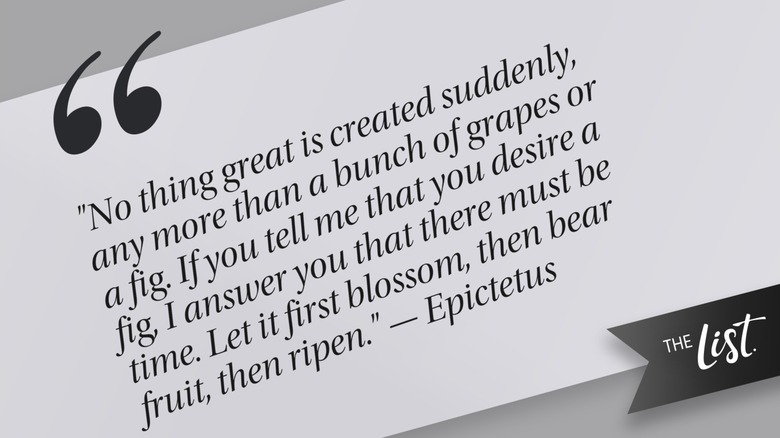
"No thing great is created suddenly, any more than a bunch of grapes or a fig. If you tell me that you desire a fig, I answer you that there must be time. Let it first blossom, then bear fruit, then ripen." This quote comes from "Discourses," a collection of Epictetus' lessons, likely transcribed by his aforementioned student, Flavius Arrian. This quote reminds us that not everything can be instant gratification, as many things take work, patience, and time. As a result, we need to slow down, take note of our surroundings, and stop rushing through our lives hoping to just get everything we want immediately.
Deeper Meaning of Epictetus' Quote — Many things you may want require time and patience

As the famous saying goes, "Good things take time." And, as Epictetus' quote points out, no one would simply plant a seed and expect a plant to immediately grow and bear fruit (we hope). When it comes to other projects we pursue, it's easy to think of it differently. Many of us tend to seek out immediate rewards. And, when we find that something is taking more time and effort than we expected, it can be easy to give up before we get the outcome we were seeking in the first place. Epictetus' beliefs revolved around letting go of what we can't control, and not letting our emotions define our actions.
He did acknowledge that this hardly comes naturally for most people, though. Epictetus believed that it was worth putting in time and work for certain things. Because of this, he encouraged his students to stay the course when it came to mastering his way of thinking. In the world we live in today, instant gratification is easier than ever to get. Yet, there are many things you can't get quickly. We shouldn't shy away from hard work and dedication. Instead, this quote should encourage us to put work into things that might take time and consistency. It can make the outcome even better when you finally get there.
More Quotes From Epictetus
- "Circumstances don't make the man, they only reveal him to himself."
- "We are not privy to the stories behind people's actions, so we should be patient with others and suspend judgement of them, recognizing the limits of our understanding."
- "It is impossible for a man to learn what he thinks he already knows."
- "Freedom is the only worthy goal in life. It is won by disregarding things that lie beyond our control."
- "First learn the meaning of what you say, and then speak."