

Quote Of The Day By Susan Sontag: 'I Envy Paranoids; They Actually Think People Are...'

Susan Sontag knew how to capture the human condition in her writing, and she wasn't afraid to show her own vulnerability at times too. Born on January 16, 1933, in New York City, Sontag grew up to become a renowned essayist, screenwriter, and novelist. After completing master's degrees in English literature and philosophy at Harvard University, Sontag started teaching before becoming a full-time writer. She was a child prodigy who lost her father when she was only five years old. Her mother was an alcoholic, and both of her parents were mostly absent from her childhood. After her father's death, her mother re-married, but the situation at home didn't change, and Sontag and her sister, Judith, were raised by their housekeeper.
Her exceptional intelligence (she set up a chemistry laboratory in the garage when she was just nine), made Sontag a total outlier. With no parents to dote on her, she attempted to make friends with the neighborhood kids by trying to get them interested in her projects, to no avail. So, she turned to books instead. During her lifetime, Sontag penned several acclaimed works, both fiction and non-fiction. For someone who felt overlooked all her life, her writing gave Sontag plenty of the attention she once acknowledged she craved.
Quote of the Day by Susan Sontag
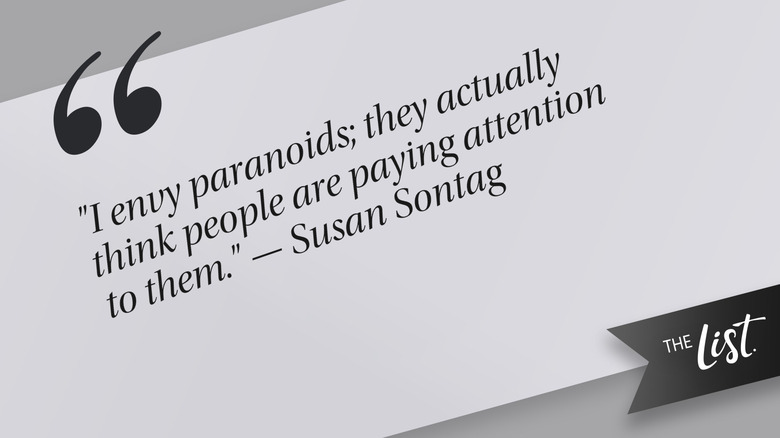
In a 1992 interview with The New York Times, Susan Sontag shared, "I envy paranoids; they actually think people are paying attention to them." For context, she was discussing her love-deprived childhood, which left the famed author feeling overlooked by her parents. "I think a childhood like that breeds a great talent for stoicism," Sontag opined. "If you're going to survive, you say, 'I can take this; it's bearable.' Otherwise you're lost."
While often appearing nonchalant, she clearly craved some recognition. Sontag wanted to be seen, to be appreciated. It's the human condition. As such, it's no wonder she envied those who constantly worry about what others think of them. After all, at least they believe they're being thought about.
Deeper meaning of Sontag's quote — Being worried about people's perception of you is better than being ignored entirely

Susan Sontag knew what it was like to feel abandoned, unseen, and unloved, therefore she envied those who felt their lives were of some significance to others in a way that would have them talking or thinking about them. We might worry about how we are perceived and what others are thinking and saying behind our backs, but Sontag argued that this is a blessing rather than a curse. In order to be paranoid about others' perception of you, you first need to believe that you matter enough for them to think about you at all. It makes total sense that the prolific writer was never someone who felt she was being thought about. Her parents were never really around, either physically or emotionally.
"My mother was a very withholding woman. You have no idea," she told The New York Times. "I would put my report card by her bed at night and find it signed at the breakfast table in the morning. She never said a word." She admitted to feeling "abandoned." Having such a tough, lonely childhood, made Sontag stronger and became the driver of her career, likely influencing how she handled multiple cancer diagnoses over her lifetime too.
Sontag's view on paranoia is worth sitting with. The next time you worry about what someone thought of your clothes, your speech, or your performance at work, remember that, in the end, the delusion that people are thinking of you in their spare time is more of a blessing than a curse, because deep down, you believe you make an impression on others.
More quotes from Sontag
-
"All photographs are memento mori. To take a photograph is to participate in another person's (or thing's) mortality, vulnerability, mutability. Precisely by slicing out this moment and freezing it, all photographs testify to time's relentless melt."
-
"To paraphrase several sages: Nobody can think and hit someone at the same time."
-
"Depression is melancholy minus its charms."
-
"Interpretation is the revenge of the intellectual upon art."