

Quote Of The Day By Jane Hirshfield: 'Like A Lover, Your Life Bends Down And...'
We may receive a commission on purchases made from links.
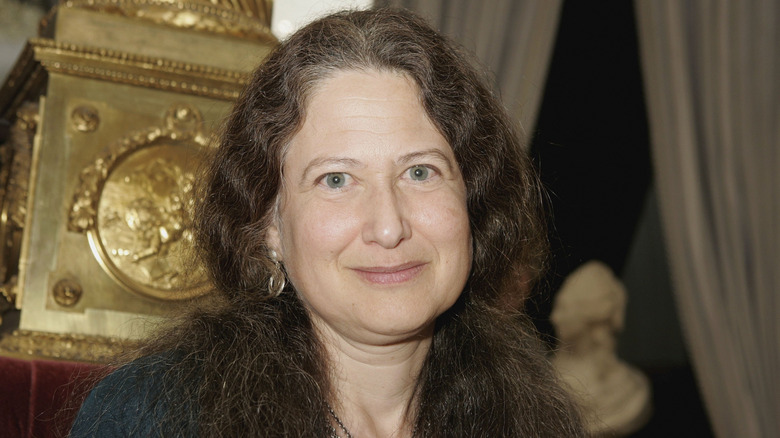
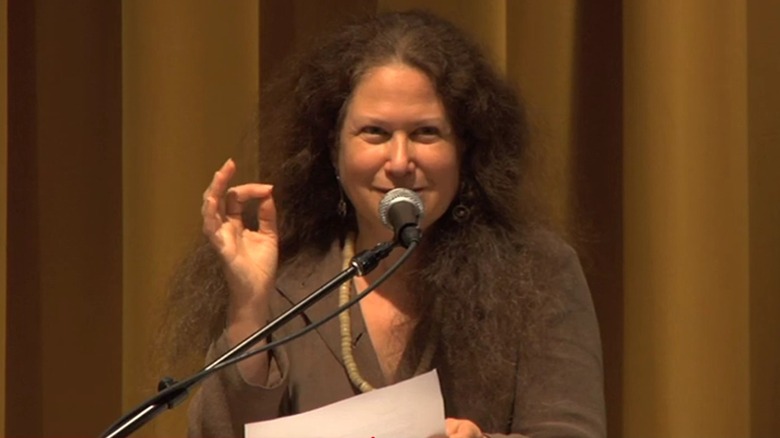
Jane Hirshfield has had a lifelong affinity for poetry. Born in New York City in 1953, she fell in love with haiku around the time she was eight. Simultaneously, she also expressed her ambitions for pursuing a writing career. It didn't take long for her to realize that dream, and Hirshfield began publishing professionally as a student at Princeton University. However, her life took a very different turn soon after she graduated, when she spent eight years studying Zen Buddhism.
Although she wasn't writing while she lived in a monastery, those experiences became an essential part of Hirshfield's creative output. "The ability to stay in the moment, to investigate it through my own body and mind, was what I most needed to learn at that point in my life," Hirshfield explained to AGNI in 2006. "You cannot write until you know how to inhabit your own experience."
Hirshfield went on to publish poetry and essays, teaching and traveling the world. Although she's won numerous awards, Hirshfield's clear that the process of writing poetry takes a lot of trial and error, whether in the form of numerous revisions or rejections from publishers. Hirshfield takes it in stride, since she believes that writing is a part of living. "I write a poem to find something," Hirshfield informed Mind & Life Europe in 2025. "The poems are the music existence sometimes makes through me." Her readers are on that journey of discovery right along with her, as can be seen in today's quote of the day.
Quote of the Day by Jane Hirshfield
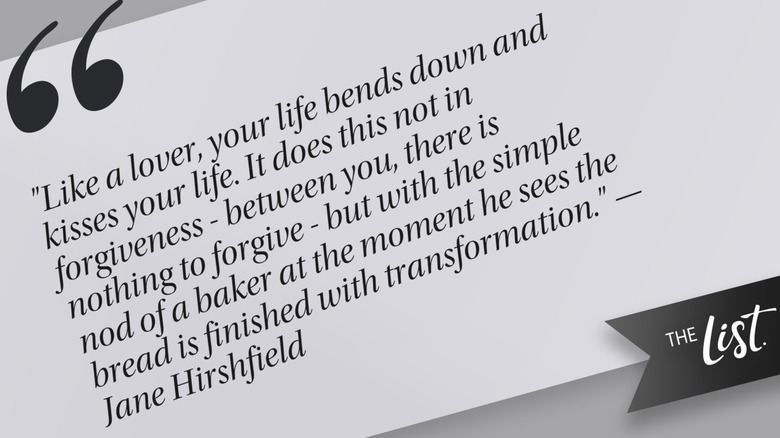
"It Was Like This: You Were Happy" is the final poem in "After," Jane Hirshfield's 2006 poetry anthology. The poem starts with the see-saw of emotions and actions we all experience throughout life. Midway through the piece, Hirshfield delves into a poignant meditation on approaching mortality, writing, "Like a lover, your life bends down and kisses your life. It does this not in forgiveness — between you, there is nothing to forgive — but with the simple nod of a baker at the moment he sees the bread is finished with transformation."
The piece was also published three years earlier in The New Yorker. In each instance where it appears, that first line of this quote stands alone in its own stanza, providing the striking image of a person's life kissing itself goodbye forever. The next words of the quote form their own stanza. By comparing the ending of a human life to a loaf of risen bread, Hirshfield takes something complex — the inevitability of life and death — and grounds it in everyday imagery.
Deeper Meaning of Jane Hirshfield's Quote — Life is brief yet transformative
In this quote from Jane Hirshfield's poem "It Was Like This: You Were Happy," her mention of forgiveness being unnecessary brings a feeling of peace; instead of the end of life being heavy, it's just another part of the process. Additionally, her use of the word "transformation" shows how much can change over one lifetime, while also providing a tantalizing glimmer of the possibility of something more once this earthly journey is completed. However, what that next step might be is up to the reader to decide according to their own spiritual beliefs. While Zen Buddhism is often ambiguous about death and its aftermath, it focuses instead on the inevitability of endings. "A central teaching of Buddhism is that nothing lasts. Not love, not monasteries, not life itself," Hirshfield informed AGNI, around the time the anthology containing this poem was published.
After giving readers this captivating image of their life kissing itself in some kind of farewell or blessing, Hirshfield seems to indicate in the poem's later lines that only we will know ourselves in this intimate way. In the penultimate stanza, Hirshfield notes that when retelling someone else's life, people inevitably insert their own biased worldviews.
Grief and dying is a topic Hirshfield has explored in other poems, and this topic was particularly on her mind when she was writing the "After" anthology. "I began writing about one loss, but the poem grew to encompass them all," Hirshfield wrote on Poets.org, responding to a reader of "It Was Like This: You Were Happy."
More Quotes From Jane Hirshfield
- "A work of art is just this kind of liberation: something that changes everything and yet is perfectly useless in any usual sense."
- "Trust the words, listen to the words, let them come into you. Give your life to them, and see what presents itself."
- "It helps if you enter a poem with your ears and your heart, not just your mind. The text on the page, the shape of the lines, is a score for conducting inside yourself a piece of experience that needs your voice, your life's own experience and knowledge and response, to be played."
- " ... the author doesn't always know what the poem says. The author is not the total authority on what a poem means."
- "Poems are the pollinating bees of interconnection."