

Quote Of The Day By Jane Kenyon: 'So It Is When We Retreat In Anger: We Think We...'
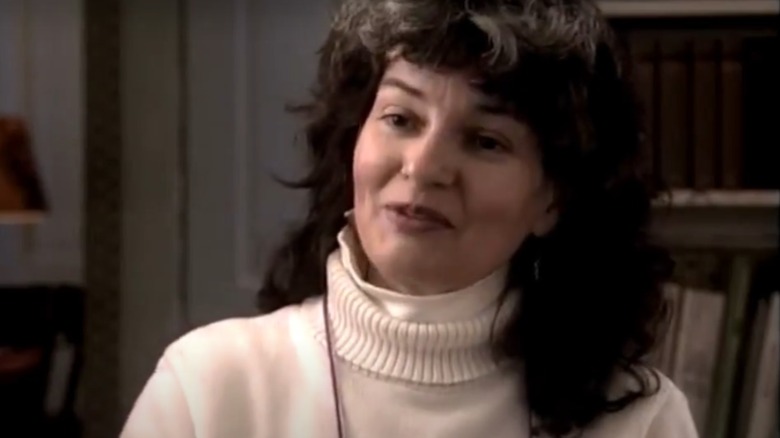
Jane Kenyon, the American poet who spent two decades putting her thoughts and observations into resonant words from a New Hampshire farmhouse, found weight in things we often overlook. She wrote about a garden going dark, a barn at evening as the light climbs the hay bales and passes away, and a dog whose steady breathing is full of unexpected comfort. And in one poem, she followed a woman fleeing her own fury, to show her finding calm where she least expected it.
Kenyon was born in Ann Arbor, Michigan, on May 23, 1947. She took her lessons in a single-room country schoolhouse until fifth grade, an experience she later turned into a poem. The biology major went to the University of Michigan for a year, though she later returned to sign up for a big introductory poetry lecture run by Donald Hall. Teacher and student married in 1972, and by 1975, they'd traded Ann Arbor for Eagle Pond Farm in Wilmot, New Hampshire.
The farmhouse became the workshop for nearly all the work she's remembered for now. Kenyon's first book of poems came out in 1978, and between that year and 1993, she published three more. She also translated twenty of Russian poet Anna Akhmatova's poems into English. Her honors include a 1992 Guggenheim fellowship and the 1994 Pen/Voelcker Award. Kenyon's poems often found small mercies tucked inside hard moments, which is the reason we've picked her as the voice behind today's quote of the day.
Quote of the Day by Jane Kenyon
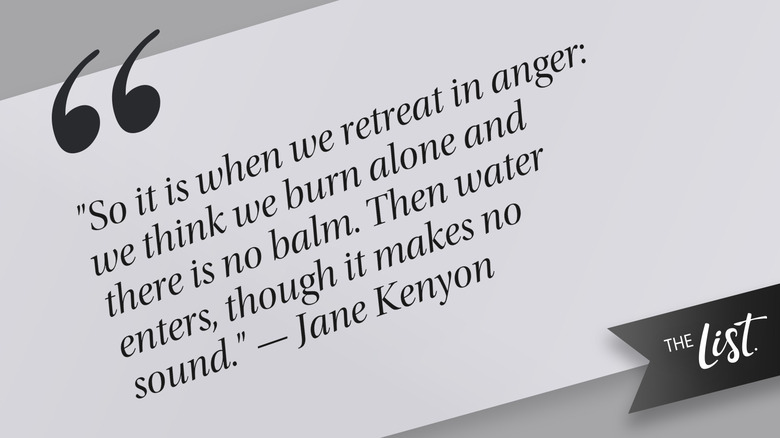
Jane Kenyon wrote: "So it is when we retreat in anger: we think we burn alone and there is no balm. Then water enters, though it makes no sound."
The words appear in "Portrait of a Figure Near Water," a poem from her 1986 collection "The Boat of Quiet Hours." It depicts the scene of a woman running uphill to an old barn after being "rebuked," with her fury running hot like a furnace. The woman stands in the empty barn and, staring at a stone trough full of water, gradually cools down. It's a powerful reminder that healing can arrive imperceptibly and unbidden, smothering fires that we thought would consume us.
Deeper meaning of Jane Kenyon's quote — Calm finds you where you least expect it
Anyone who has ever been so angry that finding words was difficult and the only reasonable option left was to walk out knows the feeling Jane Kenyon captures in her poem. In the heat of the moment, it's easy to believe nobody else has ever felt this way and nothing could possibly make the hurt go away. But Kenyon, who starts the poem in third person, narrating the woman's actions as an outside observer, switches to a first-person plural point of view in the last stanza. In using "we" for this tail end of her poem, she suggests that the anger isn't a personal feeling for the woman; everyone has their own version of that barn.
Anger needs to feed on something active, whether it be an accident, an altercation, or a careless word spoken at the wrong moment. Relief isn't like that, and it won't work if you're trying to force it. The calm seeps in quietly, like how water finds its way into soil, cracks, and roots — or in this case, blazing fury. What relieves you is often random and unassuming, until you realize you've stopped shaking and the worst of it is behind.
So, the next time you're overcome with anger, don't demand that the hurt vanish on command or wallow in it. Go for a walk. Stand near a window and look out, or pay attention to the mug of tea cooling in your hands, and let calm do its slow work. Anger shrinks the world down to a single point of focus, but as soon as you start noticing everything else again, you will have outlasted it. We're always less alone and helpless than we feel.
More quotes from Jane Kenyon
- "There really is consolation from sad poems. And it's hard to know how that happens. There's the pleasure of the thing itself, the pleasure of the poem, and it works against the sadness somehow."
- "Be a good steward of your gifts. Protect your time. Feed your inner life. Avoid too much noise. Read good books, have good sentences in your ears. Be by yourself as often as you can."
- "For me, poetry comes out of silence."
- "There's just no account for happiness, / or the way it turns up like a prodigal / who comes back to the dust at your feet / having squandered a fortune far away."
- "Let it come, as it will, and don't / be afraid. God does not leave us / comfortless, so let evening come."