

Inside Sylvia Plath's Chaotic Marriage To Ted Hughes
We may receive a commission on purchases made from links.
The following article includes allegations of domestic abuse and discusses suicide.
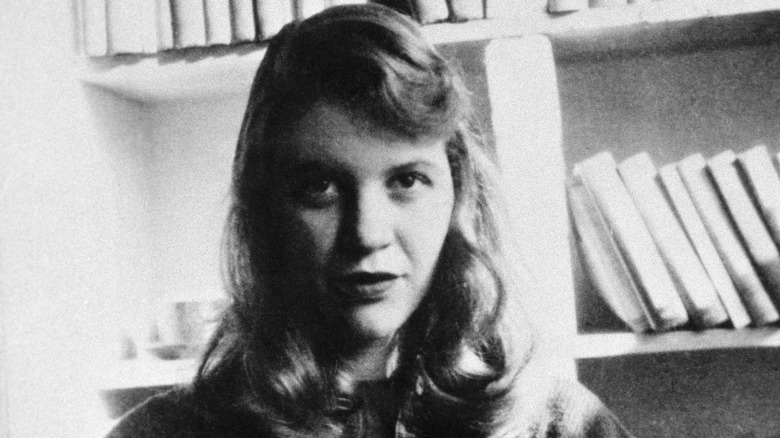
Sylvia Plath's literary legacy continues to capture readers' imaginations. Sadly, Plath didn't live to see some of her greatest success, including a Pulitzer Prize for poetry that she received almost two decades after her 1963 death. Plath was just 30 when she died by suicide, and the last years of her life were particularly difficult, in part due to her marriage to a fellow poet, and eventually Britain's Poet Laureate, Ted Hughes.
Plath and Hughes met in 1956 at a party in England to celebrate the publication of some of Hughes' poetry. Even before she saw him, Plath liked Hughes' style on the page. Once they got to talking, sparks flew in a surprisingly violent way. Plath wrote in her journal: "And when he kissed my neck I bit him long and hard on the cheek ... " (via Poets.org). They eloped just four months later.
While an exchange of poetry served as a dialogue during their dating days, they started using their talents to help each other further their writing careers. In the meantime, to pay the bills, they moved to the U.S. and worked as college professors. Unfortunately, the trajectories of their careers were not in sync. Although Plath and Hughes both celebrated his first professional win with the 1957 collection "The Hawk in the Rain," Plath was soon struggling with creative frustration and self-doubt. According to her journals, the aggression that marked their first encounter reportedly continued, like when she alleged that Hughes was unfaithful to her early in their marriage and recounted a physical altercation between them.
If you or someone you know is struggling or in crisis, help is available. Call or text 988 or chat 988lifeline.org
Hughes had an outsized impact on Plath's literary estate
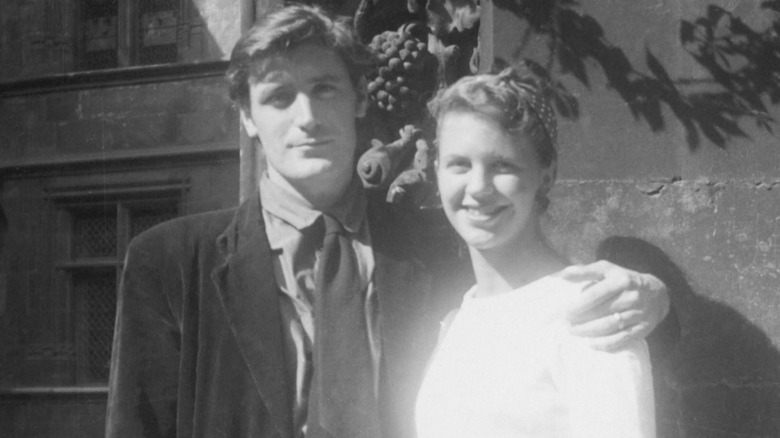
Ted Hughes and Sylva Plath relocated back to the U.K. months before their first child, Frieda Hughes, was born in April 1960. Tragically, Plath had a miscarriage less than a year later. In addition to the grief of pregnancy loss, Plath reportedly accused Ted of domestic violence in letters from this time period (via The Guardian). However, when these claims appeared in 2017, Carol Hughes, Ted's widow, denied them.
In 1961, Plath was using a room in the home of poet W.S. Merwin as office space. Although her work was apparently going well, the then-wife of W.S., Dido Merwin, claimed Plath had once wrecked Ted's progress by destroying his most-recent manuscript (per The New Yorker). Things didn't improve after the couple's second child, Nicholas Hughes, was born in 1962. Later that year, Plath found out that Ted was in a relationship with their friend Assia Wevill, and by September 1962 they separated.
However, despite all this personal turmoil, Plath was particularly productive as a writer. She finished her popular novel "The Bell Jar" and wrote numerous poems that became part of the poetry collection "Ariel." Just like they had offered input on each other's writing during their marriage, Ted continued to exercise influence over Plath's unpublished work. While his efforts to publish her work led to Plath's Pulitzer, his editorial decisions with "Ariel" seemed to be contested by Frieda when a new version of the poetry collection was released in 2004. In addition, Ted's decision to destroy some of Plath's final private writings left unanswered questions about her mindset at the end of her life.
If you or someone you know is dealing with domestic abuse, you can call the National Domestic Violence Hotline at 1−800−799−7233. You can also find more information, resources, and support at their website.