

Quote Of The Day By Pythagoras: 'Do Nothing Evil, Neither In The Presence Of Others, Nor Privately; But...'

We may receive a commission on purchases made from links.
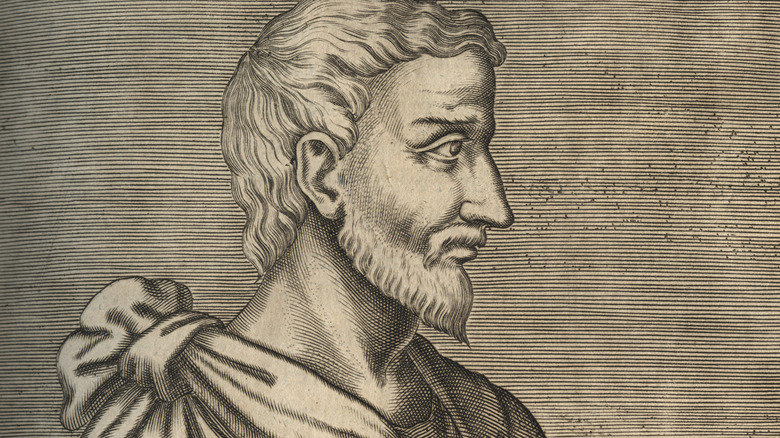
Pythagoras is quite the enigma. Most people first encounter the Greek philosopher in math class when they learn about the Pythagorean theorem in geometry. But, while it's logical to assume Pythagoras was the one who proved the theorem (since it's named after him), this has been disputed by scholars, who believe that he might have come up with the idea but never actually proved it himself. Either way, he had a keen interest in math and philosophy and even formed the Pythagorean brotherhood, which consisted of a group of likeminded individuals who, in the end, continued his work following the philosopher's death in 500 B.C. None of Pythagoras' original writings exist today, which is a great historical loss and part of what makes it hard to confirm what he did and didn't say or invent.
Because the brotherhood continued his work and built on it, it's tough for scholars to figure out where Pythagoras' ideas end and his disciples' begin. It's widely believed that his followers built on many of the philosopher's central ideas and created well-known applications like the Pythagorean theorem, as well as other theories that apply to astronomy, music theory, and acoustics. While none of his writings survived, much of the wisdom Pythagoras shared has lived on in some shape or form. Quotes attributed to the Greek philosopher have been published in the "The Golden Verses of Pythagoras and Other Pythagorean Fragments," which is where today's quote of the day is from.
Quote of the Day by Pythagoras
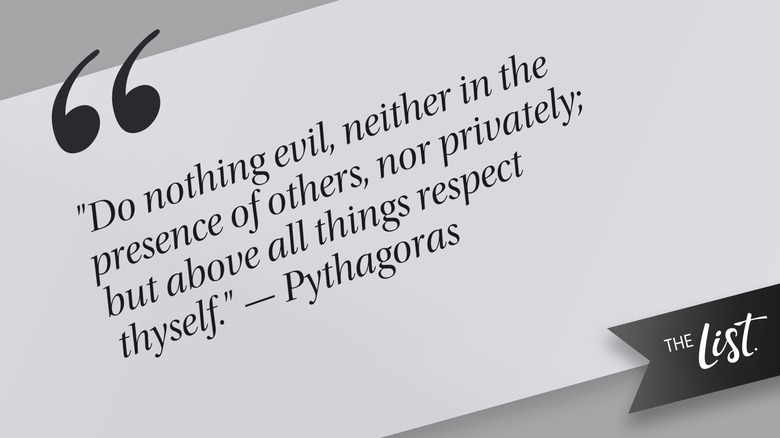
One of the quotes attributed to Pythagoras in "The Golden Verses of Pythagoras and Other Pythagorean Fragments" reads as follows: "Do nothing evil, neither in the presence of others, nor privately; But above all things respect thyself." This quote is meant to make one pause and do some introspection. Is the life you live in public also the life you live in private? And if the two don't align, do you really respect who you are as a person?
Deeper Meaning of Pythagoras' Quote — What you do in private matters as much as what you do in public
It's entirely possible to put on a respectable facade in public while, behind closed doors, your real self is someone you don't want anybody else to see. You might do all the right things when you're among other people, but what you do when you get home and close the door behind you after a long day is the real you. The question you need to ask yourself is whether that person is someone you respect, because that is what's most important — not the reverence of the people who only see your perfectly-curated image. That means very little when you don't respect yourself.
Pythagoras clearly valued self-respect and discipline. According to the Stanford Encyclopedia of Philosophy Archive, the Greek philosopher's life embodied a "moral discipline," which inspired those who witnessed it. Today's chosen quote of the day is a stark reminder that we should always strive to be our best selves, in each and every setting, and do good in the world around us. But even more crucially, our outer works should be a reflection of what's inside us. Our private lives translate to our public lives, and self-respect can only be gained when those two align.
More Quotes From Pythagoras
-
"Be silent or let thy words be worth more than silence."
-
"No one is free who has not obtained the empire of himself."
-
"Educate the children and it won't be necessary to punish the men."
-
"Rest satisfied with doing well, and leave others to talk of you as they please."
-
"We ought so to behave to one another as to avoid making enemies of our friends, and at the same time to make friends of our enemies."