

Quote Of The Day By Philosopher Marcus Aurelius: 'And, Generally Speaking, A Man Must Have Learned Much Before He Can...'

Few philosophers in history could practice what they preached on the scale Marcus Aurelius did. The Stoic philosopher ruled the Roman Empire amid war and turmoil. Yet the book he left behind is about a man constantly reminding himself to slow down and reflect on his life.
Marcus Aurelius was born on April 26, 121 CE, in Rome. He lost his father in his youth and went to the care of his grandfather, one of the most powerful senators at the time. In 138, Antoninus Pius, the heir Emperor Hadrian had chosen, adopted Aurelius as his own son. He took the throne in 161, and then the troubles began. A deadly plague ravaged the empire, and people blamed soldiers returning from the eastern front for carrying it home. As for Aurelius himself, he spent much of that time of his life in army camps, fighting campaigns against the Marcomanni, the Quadi, and other tribes along the Danube. At one point, a general revolted to claim the throne after hearing, wrongly, that the emperor had died, though the coup ultimately failed.
All the while, Aurelius kept a private journal, much of it likely composed while he was on the march with his armies. The "Meditations," as it's now called, is a collection of those writings, a treasure trove of wisdom and common sense, and a grounded study of Stoicism as a guide to living. That's the reason Marcus Aurelius is still read millennia after his time, and why he's back again as today's quote of the day.
Quote of the Day by Marcus Aurelius
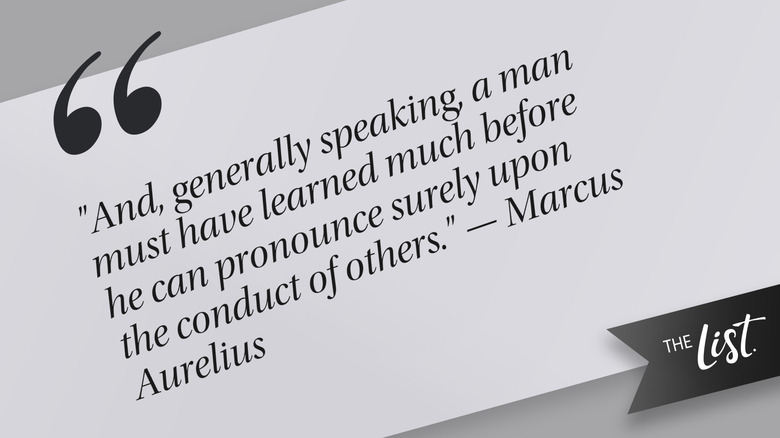
Marcus Aurelius wrote, "And, generally speaking, a man must have learned much before he can pronounce surely upon the conduct of others." The line comes from Book 11 of the "Meditations."
In that section, Aurelius listed suggestions for the moments when someone offended him. The wording is George W. Chrystal's, a Balliol College, Oxford, scholarship student and translator who published his rendering of the 1742 edition by Robert Foulis in 1902. Aurelius reminds himself he's done plenty wrong too, and from a man who could have simply had people who disagreed with him or offended him punished, it's a striking bit of humility and self-awareness.
Deeper meaning of Marcus Aurelius' quote — Why we rarely know enough about others to judge
It's impossible not to have opinions about other people, just as it's impossible to stop yourself from comparing and judging when something doesn't go the way you expected. Marcus Aurelius acknowledges the inevitability of this very human tendency, but he reminds us that being certain about someone is something you have to earn, and most of the time, you haven't done the homework. When you judge someone because of what they did, you see only the action, but almost never the reason behind it. A friend stops answering your texts, and you begin to wonder why. It could be rudeness or laziness. Or maybe they were really busy at the time and couldn't manage to get back to you.
We usually don't have enough data to judge matters properly, so it pays to sit back and think about the reaction you're having for a moment. This aphorism also hints that it takes great wisdom and understanding to be able to properly judge people based on their actions — even if you do know everything there is to know about a case. We tend to judge others more harshly than we judge ourselves.
When you make a mistake, you already have all the facts, and they go a long way towards letting you off the hook. With others, we usually just have the one fact and make everything else up in our minds, and then get angry about it. It isn't just about being fair to others, but also about buying yourself a measure of peace when things go wrong, because the moment you admit you don't know the whole story, your temper begins to lose its grip.
More Quotes from Marcus Aurelius

- "The best revenge is not to copy him that wronged you."
- "Seldom are any found unhappy from not observing what is in the minds of others. But such as observe not well the stirrings of their own souls must of necessity be unhappy."
- "The character of your most frequent impressions will be the character of your mind."
- "Order not your life as though you had ten thousand years to live. Fate hangs over you. While you live, while yet you may, be good."
- "It is truth that I seek; and truth never yet hurt any man. What does hurt is persistence in error or in ignorance."