

William Shakespeare's Wife Anne Hathaway Was Given A Highly Specific Item In His Will

We may receive a commission on purchases made from links.
Few writers in history have managed to capture the essence of love as exquisitely as William Shakespeare. The man, after all, found it in himself to come up with Sonnet 18, a poem that weighs a lover against a perfect "summer's day," and concludes his beloved wins, being "more lovely and more temperate," (via the Poetry Foundation) And yet, as far as his own romance was concerned, the Bard of Avon had only a handful of words to say, and they amounted more to a man taking inventory than an ode to everlasting love. The notorious words sit at the end of a will Shakespeare signed on March 25, 1616, just 29 days before his death on April 23.
They concern his wife Anne Hathaway, marking the only spot she appears in the final document, and even then she goes unnamed. You'd expect the line to be romantic, like those pithy Shakespearean aphorisms people reach for when their own poetic sensibility falls short. Alas, it's anything but, reading: "Item I gyve unto my wiefe my second best bed with the furniture," (per The National Archives) The "furniture," in this case, meant the bed's drapes and covers. Anne Hathaway was 26 when she married an 18-year-old Shakespeare in November 1582.
The couple also shared three children. The image of a husband of 33-plus years bestowing just a bed has understandably struck generations of readers as odd, if not a cruel cold shoulder. It's a truly fascinating footnote in Shakespearean lore. Katherine West Scheil, the author of "Imagining Shakespeare's Wife: The Afterlife of Anne Hathaway" who has studied many Annes from different writers since a 1709 biography first introduced her, explained it like this on the "Shakespeare Unlimited" podcast: "Most interpretations of her rest on how you interpret that bequest."
The case for why the runner-up bed may have meant the most
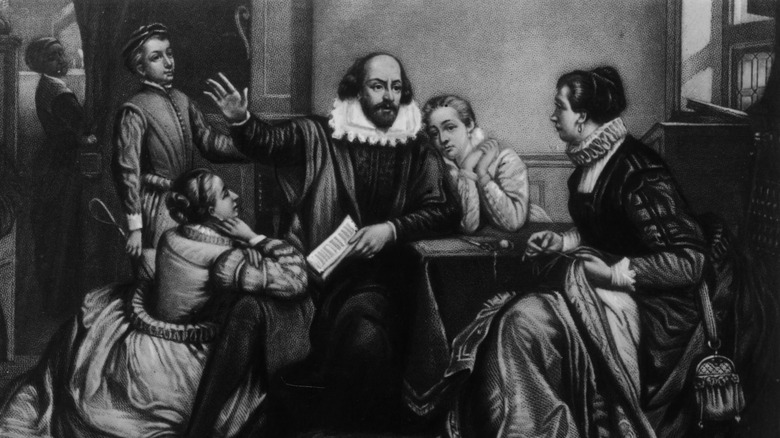
It's true that a husband's will in this particular era typically spoke warmly of the widow-to-be, but that's not all there is to it. In William Shakespeare's England, a good bed was an important purchase. A household's grandest bed was a showpiece, placed on the ground floor in full view of company and graciously given to whoever stayed over. That made the second-best bed, the one bestowed upon Anne Hathaway, the same she and Shakespeare likely slept in each night. The bed might also have meant more to the Bard than we think.
Research by the National Archives, which looks after the original document, revealed that multispectral scans carried out in January 2016 indicated more than one ink had gone into the pages. Amanda Bevan, a senior archivist, concluded the bed was among some last-minute changes added to the will. That same batch of additions, as Shakespeare's health got worse, also included mourning rings for several of his friends. "These are tokens of affection from a man facing the prospect of his death," Bevan wrote in a 2016 blog post.
There are no records of what happened to the bed after the legendary playwright died, but it's worth noting a will didn't need to specify it for an English widow of the era to hold a lifelong claim to one-third of what her husband owned. As for love, Shakespeare argued both sides. In "The Two Gentlemen of Verona," Julia insists "they do not love that do not show their love," only for her maid to fire back, "O, they love least that let men know their love." A will is about bestowing property, not showing feelings, so it ultimately proves little.