

The Two Last Living Stars From The Original Star Trek Series Have Both Made History
We may receive a commission on purchases made from links.
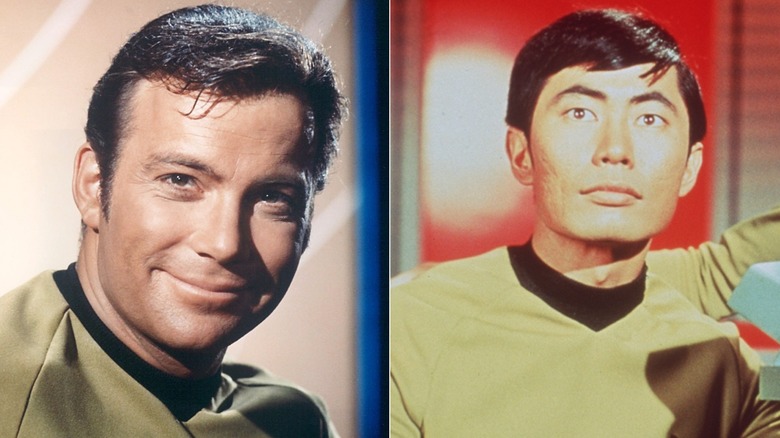
In late October 2026, the "Star Trek" franchise's year-long 60th anniversary celebrations abruptly became a rather somber affair. First, Walter Koenig, famous for his role as Ensign Pavel Chekov in "Star Trek: The Original Series," sadly passed away at the age of 90. Then, just a few days later, Patrick Stewart, known for playing Captain Jean-Luc Picard in "Star Trek: The Next Generation," also died at the age of 86. And while all of Stewart's "TNG" co-stars are thankfully still with us today, Koenig's death was particularly heartbreaking for fans, as it meant only two main cast members from "TOS" are still alive: William Shatner and George Takei (Captain James T. Kirk and Lieutenant Hikaru Sulu, respectively).
With that in mind, we thought it fitting to honor and celebrate the ways both men made history while they're still here. Takei, for example, was a trailblazer specifically because of his portrayal of Sulu. According to the National Air and Space Museum, when "Star Trek" premiered in 1966, the Los Angeles-born actor — who notably spent much of his early childhood in a Japanese internment camp during World War II — became the first Asian-American to play a "major, nonstereotyped" role on American television. While other Asian-American actors — such as the legendary Anna May Wong — had enjoyed starring roles prior to Takei's voyages aboard the U.S.S. Enterprise, Sulu's characterization represented a major challenge to the status quo of the time.
"[It was] the first time that I was being asked to portray a character that was fully developed," Takei, who began his acting career in the 1950s, proudly informed the AARP in May 2026. "It was a human being, not a cartoon or a stereotype, a comic buffoon or a villain, Fu Manchu," the beloved actor continued.
William Shatner set a spaceflight world record
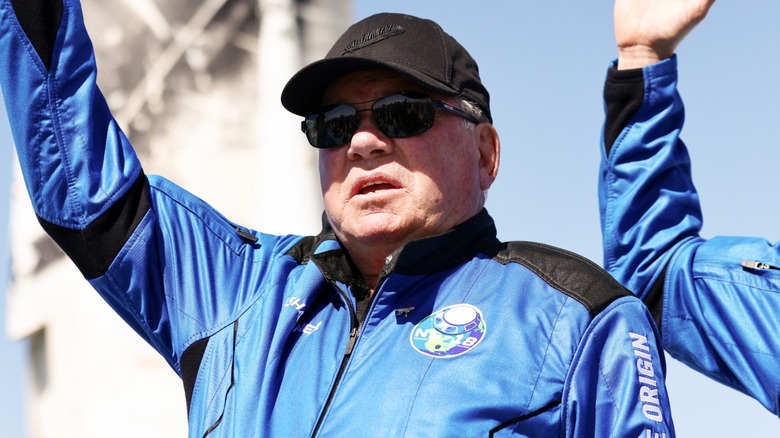
In stark contrast to George Takei, William Shatner's history-making moment occurred decades after his time as the face of the "Star Trek" franchise had come to an end. We are, of course, referring to October 2021, when Shatner embarked on a real-life "Star Trek" by boarding a Blue Origin rocket bound for the edge of outer space. When all was said and done, the Canadian-born actor, who was 90 years old at the time, became the oldest living individual in history to cross the Kármán line. A man by the name of Ed Dwight later broke Shatner's record when he boarded a separate Blue Origin space flight in 2024.
Regardless, Shatner's own trip to the doorstep of the cosmos left a profound impact on the legendary actor, who spent years traveling throughout universe on TV and in movies. "I'm so filled with emotion about what just happened. [...] It's extraordinary. I hope I never recover from this. I hope that I can maintain what I feel now. I don't want to lose it," a visibly choked-up Shatner gushed immediately upon his return to Earth (via NBC News). The "Star Trek" icon later reflected on the experience in his 2022 book "Boldly Go: Reflections on a Life of Awe and Wonder," describing it less as an achievement.
Instead, he saw it more as a cosmic memento mori. "The contrast between the vicious coldness of space and the warm nurturing of Earth below filled me with overwhelming sadness," Shatner wrote. "Every day, we are confronted with the knowledge of further destruction of Earth at our hands [...] It filled me with dread. My trip to space was supposed to be a celebration; instead, it felt like a funeral."