

Rev. Jesse Jackson, Civil Rights Activist And Former Politician, Dead At 84
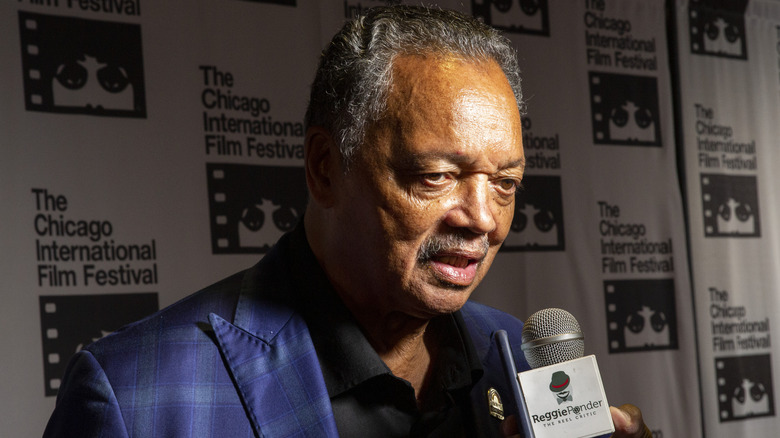
The Rev. Jesse Jackson, a beloved civil rights activist and politician who ran for president in the 1980s, has died at age 84, according to a statement from his family. "Our father was a servant leader — not only to our family, but to the oppressed, the voiceless, and the overlooked around the world," they noted (via NBC News). "We shared him with the world, and in return, the world became part of our extended family. His unwavering belief in justice, equality, and love uplifted millions, and we ask you to honor his memory by continuing the fight for the values he lived by." A cause of death has not been announced yet, but the civil rights icon passed at home surrounded by his loved ones.
The Baptist minister had long championed equal rights for Black people in America; back in 1965, he marched with the Rev. Martin Luther King Jr. in Selma, Alabama, and assisted with his Southern Christian Leadership Conference. Jackson's work with the agency inspired him to found two organizations. In 1971, he founded Operation PUSH to improve Black Americans' economic well-being, and in 1984, he founded the Rainbow Coalition, which focused on the social issues affecting marginalized communities. They merged into the Rainbow PUSH Coalition in 1996.
Fellow civil rights leader Rev. Al Sharpton shared in a statement, "Reverend Jackson stood wherever dignity was under attack, from apartheid abroad to injustice at home. His voice echoed in boardrooms and in jail cells. His presence shifted rooms. His faith never wavered." The late social justice champion had health problems in his later years. In 2017, Jackson announced he was being treated for Parkinson's disease after receiving his diagnosis in 2015. In 2021, Jackson contracted COVID and was hospitalized, though he was vaccinated and released a few weeks later.
Jesse Jackson was a protégé of Dr. Martin Luther King
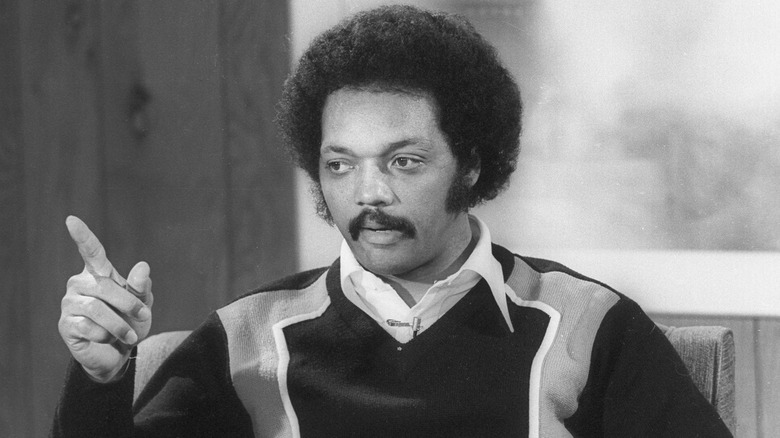
The Rev. Jesse Jackson was born on October 8, 1941, in Greenville, South Carolina, as Jesse Louis Burns. He changed his name as a teenager after his stepfather adopted him. The future civil rights leader was an athletic teen who was offered a football scholarship to the University of Illinois. He did not stay long as, after a year, he transferred schools and eventually graduated from North Carolina A&T State University in 1964. He then began his theological studies at the Chicago Theological Seminary.
In 2015, while reflecting on his youth, Jackson told The Guardian that his family taught him to remember he was valued and to know his worth amid segregation. "If you have a sense of dignity within you, your body may be on the back of the bus, but your mind is up front," he said. "Something in our household always had our mind in the front of the bus, and always taught us to never adjust to degradation."
Jackson left the seminary in 1965 to begin working for Dr. Martin Luther King Jr. at the Southern Christian Leadership Conference, though he was ordained as a Baptist minister. That year, he was part of the historic civil rights march from Selma to the state capital of Montgomery, Alabama. King named Jackson to the Operation Breadbasket economic program, meant to provide jobs for Black workers and to create opportunities for Black entrepreneurs.
The Rev. Jesse Jackson exercised political influence
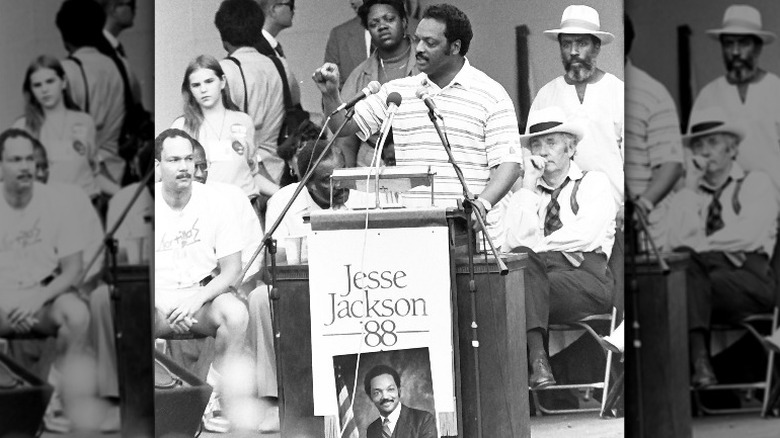
The Rev. Jesse Jackson's interest in politics led him to launch two campaigns for the Democratic presidential nomination, the first in 1984 — winning more than three million votes from across the nation — and the second in 1988. Those campaigns were credited with the success of registering millions of new voters. The civil rights leader was also known for traveling overseas to negotiate for the release of American hostages and prisoners who were held by hostile governments.
Jackson was the first Black man to make a notable bid for president of the United States, so it was understandably emotional for him when Barack Obama won the U.S. presidential election in 2008. As those who campaigned for Obama celebrated the night of his historic win, Jackson shed more than a few tears at the significance of the achievement. "I saw President Barack Obama standing there looking so majestic. And I knew that people in the villages of Kenya and Haiti, and mansions and palaces in Europe and China, were all watching this young African-American male assume the leadership to take our nation out of a pit to a higher place," he said (via HuffPost). "And then, I thought of who was not there ... the martyrs and murdered whose blood made last night possible. I could not help think that this was their night."
Jackson's own work at home and overseas didn't go unrewarded. The reverend had received numerous accolades throughout his life, including about 40 honorary degrees. He was made an Honorary Fellow of Oxford University's Regents Park College and was also given an honorary doctorate from South Africa's University of KwaZulu-Natal in 2010.
Jesse Jackson's personal life
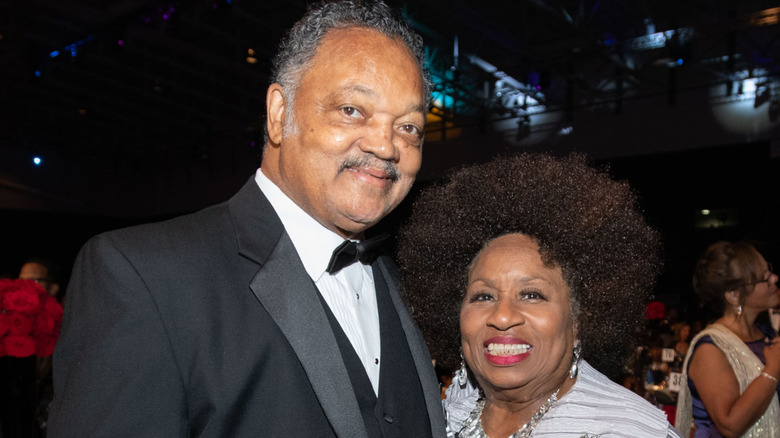
The Rev. Jesse Jackson married Jacqueline Lavinia Brown in 1963; the two had met in college. " He has an enthusiasm ... It's an infectious enthusiasm," Jacqueline Jackson told PBS. "He excites and incites and, you know, it's an emotional experience with him. You listen and you notice, you notice him. And you think about whatever he shares with you." The couple had five children: Santita Jackson, former Congressman Jesse L. Jackson Jr., Jonathan Luther Jackson, Yusef DuBois Jackson Esq., and Jacqueline Lavinia Jackson Jr.
Jesse Jackson's time in the public eye wasn't without controversy. In 2001, it was revealed that he had had an affair with his aide, Karin Stanford, who later became the director of Rainbow PUSH's Washington bureau. It was revealed that he gave her $40,000 from foundation funds to help her move to California and that the two had a child named Ashley Jackson, who is now an actor. In response to the news, Jackson issued an apology for his actions, took responsibility for what happened, and announced he would bow out of public life for a time in order "to revive my spirit and reconnect with my family" (via Salon).
Throughout his life, Jackson remained committed to fighting for civil rights. In 2015, the Guardian asked him how he felt regarding the Black Lives Matter movement. "There is a false narrative that the movement stopped and then started again," Jackson said, noting the fight was always ongoing. "We never stopped."