
Robin Williams' Will Included A Strict Rule For Hollywood Producers
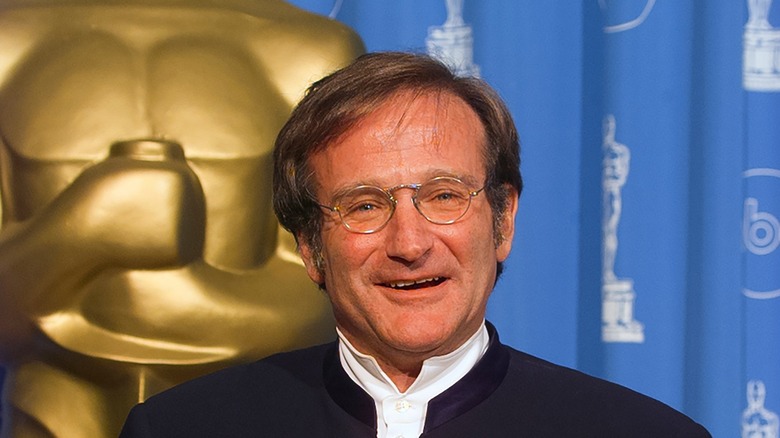
Celebrities plan their estate to keep money arriving long after the funeral. Robin Williams, whose net worth at the time of his death was in the tens of millions, decided to do the opposite, and there was a cold logic behind his decision. After struggling with mental health issues and rare physical ailments like Lewy body disease, the comedian took his life in August 2014. He had last rewritten his living trust in January 2012, well before the decline that underlined Williams' final year of his life. Williams signed over every commercial right to his persona to the Windfall Foundation, a nonprofit set up through his lawyers.
He then added a condition barring anyone from monetizing those rights for 25 years. That meant no one could use Williams for endorsements or on print ads. (And yes, that includes using a computer to bring him back in a film.) The freeze runs until August 11, 2039, but that's not even the most remarkable thing about it. Forbes has tried to roughly estimate how much Williams forfeited by his decision, and it might go as high as eight digits. Since Williams left no explanation, his motive remains ambiguous. The Hollywood Reporter, reviewing the trust, laid out three readings. One pertains to the use of CGI and other digitally-created cameos.
One, according to estate attorney Laura Zwicker, might be a "privacy issue." Lastly, we have the fiscal explanation: a former Disney exec once told The Sunday Times (per Independent) that the idea was to avoid IRS scrutiny and "incurring estate penalties due to his posthumous earnings." Ultimately, it ended up costing the studio further sequels to "Aladdin," even though they had the means to make it work without resorting to deepfake technology.
Disney had 16 hours of Genie tape it couldn't touch
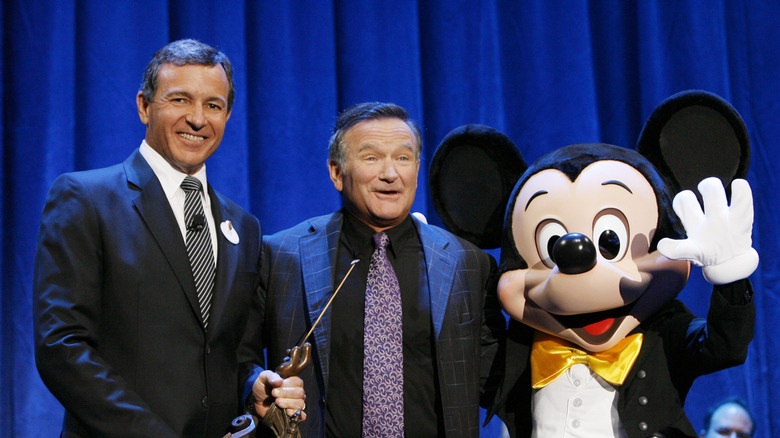
Between the original "Aladdin" film and the threequel "Aladdin and the King of Thieves"the unused Genie material — amounting to 16 hours of recorded voice lines — could theoretically be edited into a whole feature. That's no doubt orders of magnitude better than hiring another actor to replace Williams or even resorting to deepfake technology to recreate his voice and likeness.
The freeze clause, unfortunately, stopped Disney in its tracks, with a former exec claiming the plan collapsed the moment someone read the trust. Disney owns the recordings, and though outtakes can surface as bonus features, they can't be stitched into a new film he never agreed to make. Williams had showcased such sensitivities before. He took the minimum union rate (around $75,000) for "Aladdin" on the condition that Disney not sell the picture on his name. He even specified that the Genie could occupy no more than a quarter of the poster. When the character merchandise appeared anyway, he fought with the studio — and publicly, at that. "I want to make movies, not sell stuff," he once told a crowd while attending a promo event for "The King of Thieves." (per Mouse Planet)
For Disney's 2023 centenary short "Once Upon a Studio," animators managed to salvage a few usable Genie lines, and approached Williams' estate for permission, which was granted. For all his foresight, though, Williams could only delay the inevitable for so long. His idea wasn't to build a wall that separated people from his talent forever, but a timer — and the clock is ticking.