

Quote Of The Day By Emily Dickinson: 'Hope Is The Thing With Feathers That...'
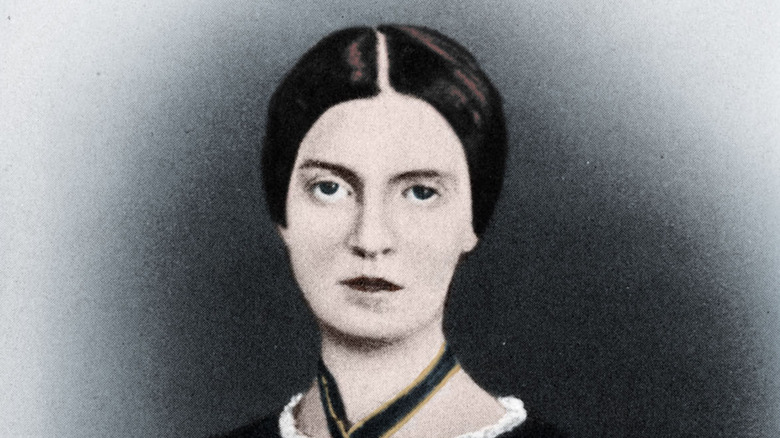
Emily Dickinson wrote about 1,800 poems, and she is now recognized as one of America's most famous poets. However, she only had 10 poems published during her lifetime — all anonymously. There was some question as to whether or not she'd actually wanted her work published, but there is no question that Dickinson was immensely talented.
Dickinson was born in Amherst, Massachusetts in 1830, and she had an older brother and a younger sister — fun fact, Dickinson and Taylor Swift actually share a common ancestor. Dickinson discovered a love of writing when she was a teenager, and she became particularly prolific between 1855 and 1865. She wrote more than 1,000 poems during that time, and she put 800 of them into small, handbound books now known as fascicles. As Dickinson got older, she developed problems with her eyes, and she became more reclusive, spending much of her time at the family home in Amherst. Despite this, she was still writing. Dickinson died at home in 1886 after being ill for more than two years.
After Dickinson's death, her sister later found many of her poems tucked away in her bedroom, including the fascicles. There was a years-long family drama over the publication of her work, where Dickinson's sister and sister-in-law were at odds with her brother's mistress. But the world did eventually get to read Dickinson's poems. The first collection of her poems was published in 1890, and by 1955, her complete works were published in an unedited form. Dickinson's poetry contains a lot of metaphors and imagery, a lot of dashes, and detailed, insightful observations. She wrote about the human condition — pain, love, art, loneliness, joy — in a way that has resonated with readers for decades. That's why she's The List's quote of the day.
Quote of the Day by Emily Dickinson
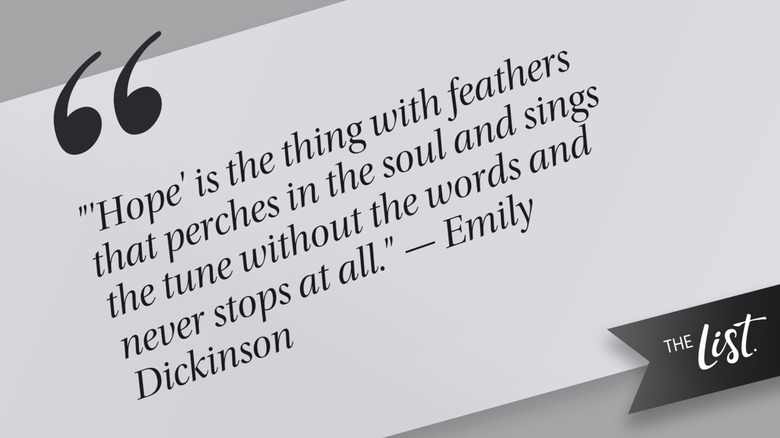
Emily Dickinson once wrote, "'Hope' is the thing with feathers / That perches in the soul / And sings the tune without the words / And never stops at all," via the Poetry Foundation.
This is the first stanza of a poem in one of Dickinson's handmade fascicles found after her death, and it was presumably written in 1861. It has become one of her most famous poems, and it's all about the resilience of the human spirit as embodied in a bird.
Deeper Meaning of Emily Dickinson's Quote — Hope never abandons us
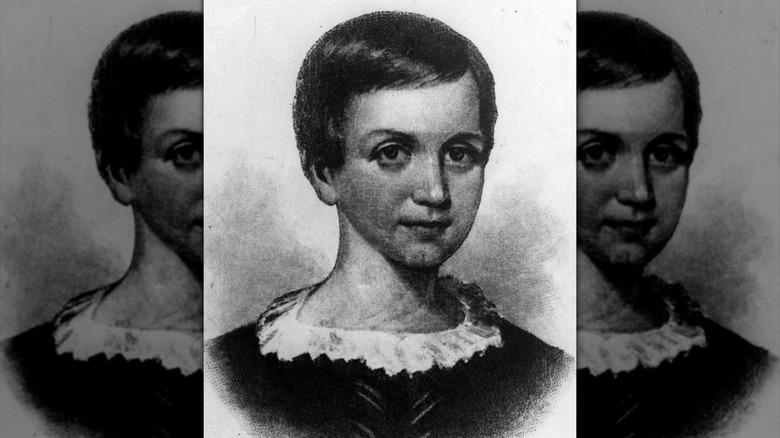
The idea behind Emily Dickinson's famous opening stanza is that there is an ongoing hope and persistence inside all of us that keeps on going without us having to do anything. There are no words to the song of hope within us and there doesn't need to be. It is more of a feeling and deeper than language.
This feeling of hope that Dickinson describes may not be something that's always easy to access, but it's a perpetual feeling that we can tap into. It's not something that will abandon us; Dickinson is saying that we have hope living within us even in dire times.
She didn't focus on what someone might be hoping for or whether or not we'll get it, simply that hope itself can and does persist. With hope, we're able to move forward. Even if it does not always seem like it, we have to trust that the hope is there within us to fall back on.
More Quotes From Emily Dickinson
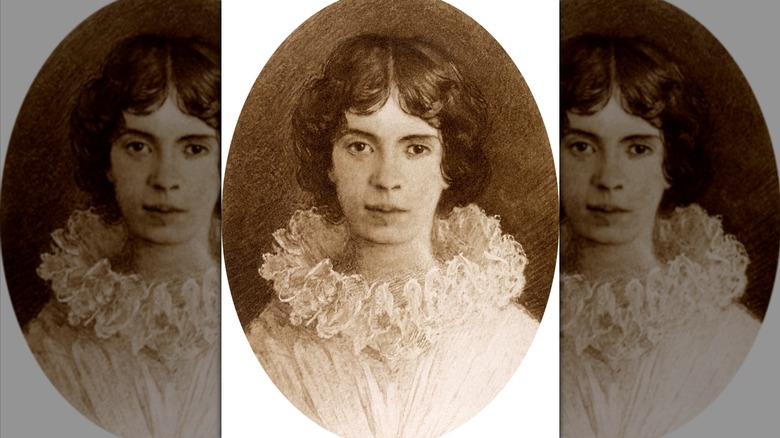
- "If I read a book and it makes my whole body so cold no fire can warm me I know that is poetry. If I feel physically as if the top of my head were taken off, I know that is poetry."
- "If I can stop one heart from breaking / I shall not live in vain."
- "I find ecstasy in living — the mere sense of living is joy enough."
- "I dwell in Possibility."
- "Forever is composed of Nows."