

Mary Oliver & Molly Malone Cook: Their Real-Life Love Story
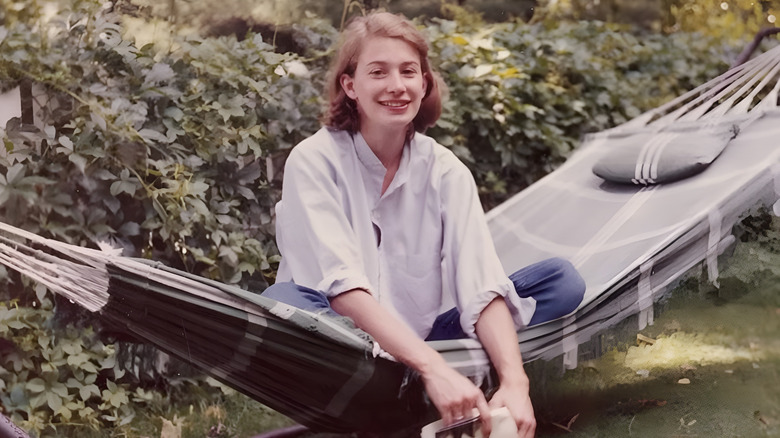
The late Mary Oliver wrote about many things, but above all, her poems focused on the natural world. She also wrote about what it means to pay attention to those phenomena, a habit that her partner Molly Malone Cook helped cast in a new light. Millions of readers have read Oliver's words about geese and daisies, or her words on life itself, but few know the woman standing just outside the frame. Oliver valued her privacy so much that even fans could miss Cook's presence, yet for more than 40 years, the photographer sat at the center of the poet's world, and inspired her to approach her craft differently.
Their story began at Steepletop, which was poet Edna St. Vincent Millay's estate in New York. Oliver went there at 17 when she was fresh out of high school, and helped the poet's sister put her papers in order. In 1959, the 24-year-old walked in and spotted a 34-year-old photographer in the kitchen. "I took one look and fell, hook and tumble," Oliver wrote in "Our World" (via The Marginalian). In that moment, Cook decided to feign indifference, reaching for her glasses and striking a pose that seemed to say the attraction was one-sided. Cook later denied it, of course, but that's how Oliver remembered the interaction.
And even if it weren't for that chance meeting, fate had other plans in store. Away from Steepletop, Oliver and Cook learned that their apartments in the East Village were only steps apart. Romance slowly took root, and the years that followed produced some of the poetry collections that are essential reading today. The couple made their home in Provincetown, Massachusetts, where they stayed together until Cook's death in 2005.
Molly Malone Cook taught Mary Oliver how to pay attention
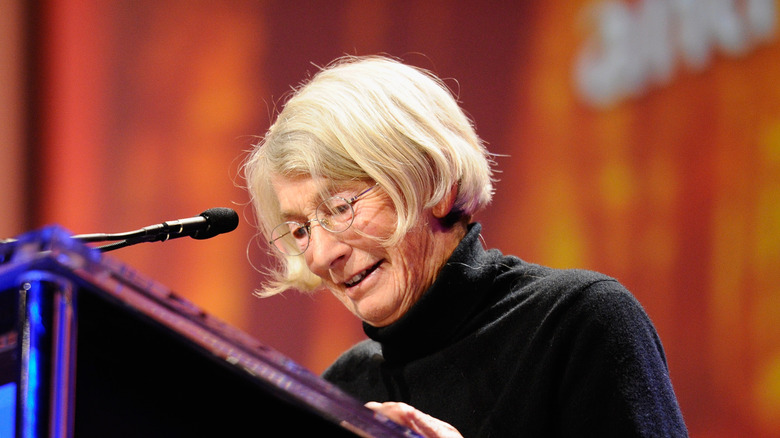
Born in San Francisco in 1925 and placed for adoption as a newborn, Molly Malone Cook shot for The Village Voice in its early years, and there she photographed high-profile individuals like Eleanor Roosevelt and Walker Evans. She's also credited with opening the first gallery devoted to photography on the East Coast. She eventually pivoted to the East End Bookshop along with Mary Oliver, and they kept it going until 1969. When money was tight, the forest and shoreline became their pantry, and they foraged to make ends meet.
Oliver once said that she "got saved by poetry," and the craft pulled her out of a difficult childhood and into a life where she noticed the beauty. Cook, who had a remarkable resume before ever meeting Oliver, had spent years training her own eye on that same beauty, only instead of words, she did it from behind the camera. Observing her partner behind a camera and with other people, Oliver came to believe that noticing the world wasn't enough. "Attention without feeling, I began to learn, is only a report," she wrote in "Our World" (via The Marginalian). "An openness — an empathy — was necessary if the attention was to matter."
In 2006, the year after Cook passed away, Oliver published "Thirst," a book of poetry that centers around dealing with sorrow and her first reckoning with faith. She then compiled a series of Cook's prints and negatives and put them in her book "Our World" the year after. Its prose poem "The Whistler" catches Cook whistling through the house one day after three silent decades. It was proof for Oliver that the person you know best and pay attention to can still astonish you after decades.