

Quote Of The Day By Epictetus: 'Men Are Disturbed, Not By Things, But By The...'
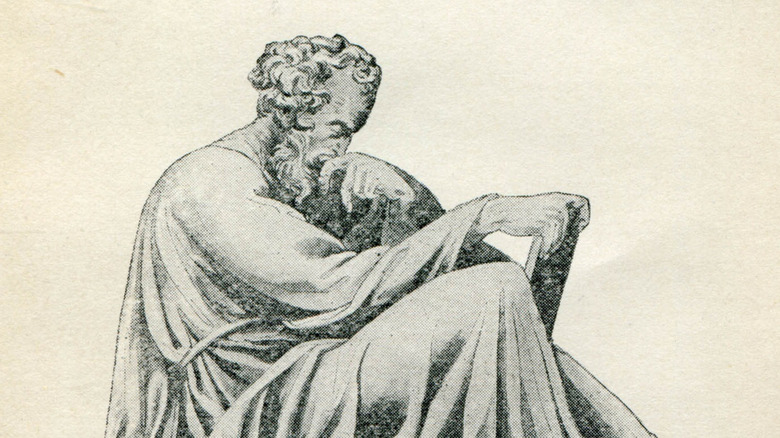
A thief once walked into Epictetus' house and made off with his iron lamp. The philosopher later told his students that he didn't curse whoever took it. He genuinely believed that the thief had come off worse, because he'd traded his honesty for a lamp. That sense of Stoic detachment informed much of the philosophy of Epictetus, who believed how we conceive the world matters more than what the world does to us.
The Greek philosopher was born in Hierapolis, in Asia Minor, during the A.D. 50s. As a child, he was a slave, the property of Epaphroditus, himself a slave of Emperor Nero but a man of stature at his court. According to one account, his master once wrenched his slave's leg while Epictetus stayed perfectly calm. The philosopher told him with a smile that he was about to break the leg. Once the bone gave way, he reportedly said, "Did I not tell you that you would break it?" And whether that story actually happened, he did walk with a limp, and the cause of it is debated.
As a slave, he took lessons from the Stoic Musonius Rufus and taught in Rome when he was set free, but in time Emperor Domitian ordered philosophers out of Italy. He moved to Nicopolis and started a school of his own. What survives of his teaching comes from his pupil Arrian, and it is claimed that in their own lifetimes, Epictetus drew a bigger following than Plato. Despite being a child slave, suffering exile, and, perhaps most tragically of all, losing a perfectly good iron lamp, Epictetus kept insisting that it's all about how we judge misfortune, not misfortune itself, which is why he's today's quote of the day.
Quote of the Day by Epictetus
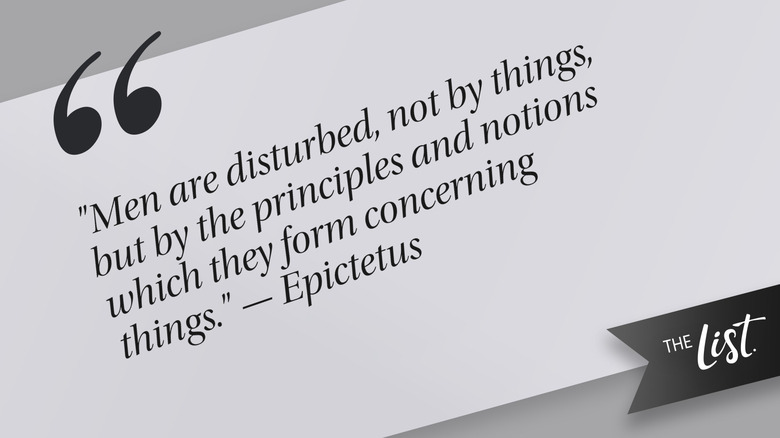
Epictetus is quoted as saying, "Men are disturbed, not by things, but by the principles and notions which they form concerning things."
You can find the line in Section 5 of "Enchiridion," which is a smaller book of anecdotes Arrian pulled together from "Discourses." Epictetus believed that our response to distress was not due to the event itself but due to how we interpret and judge the event. He even gave the most extreme example he could think of: death, and claimed that what frightens people most about it is not death itself, but the belief that death is something terrible.
Deeper meaning of Epictetus' quote — Misjudging a situation can hurt more than the situation itself
To understand what Epictetus is telling us, consider this analogy. Picture two people at an airport who are just informed that their flight is delayed. One goes red in the face and starts shouting at no one in particular, causing a scene. The other sighs and texts their friend to say they'll be late. If it were the delayed flight causing the anger, then why wouldn't they both be reacting the same way? Epictetus argues that something else is at work here.
The person who gets angry perceives the delay as something unbearable, perhaps something that shouldn't be happening to them, maybe even something that ruins the whole trip and their carefully laid plans. The other person, meanwhile, treats it as a minor hiccup. As a Stoic, Epictetus isn't exactly saying that you shouldn't feel anger or that one of these people is wrong. He's pointing out that the difference you see in their reaction has to do with how they perceive the situation in their heads. Annoyance is no trivial matter, and pain isn't imaginary. A broken leg hurts no matter what you think about it. Epictetus simply points out that while the event is often out of our hands, it matters how we approach it.
Epictetus also points out that blaming yourself and other people for how badly things are going is pointless. A wise man blames nobody. In other words, while blaming others is somewhat futile, blaming yourself is even worse. The next time something rattles you, separate what happened from what you're telling yourself about it, and you might see that most of the hurt is coming from the story you're telling yourself.
More Quotes from Epictetus
- "Don't you know that a good and excellent person does nothing for the sake of appearances, but only for the sake of having acted right?"
- "Remember, that not he who gives ill language or a blow insults, but the principle which represents these things as insulting. When, therefore, anyone provokes you, be assured that it is your own opinion which provokes you.
- "Everything has two handles, the one by which it may be carried, the other by which it cannot. If your brother acts unjustly, don't lay hold on the action by the handle of his injustice, for by that it cannot be carried; but by the opposite, that he is your brother ..."
- "I must die. Must I then die lamenting? I must be put in chains. Must I then also lament?"
- "Don't demand that things happen as you wish, but wish that they happen as they do happen, and you will go on well."