

Robert Frost's Real Life Wasn't Free From Tragedy
This article discusses mental health and suicide
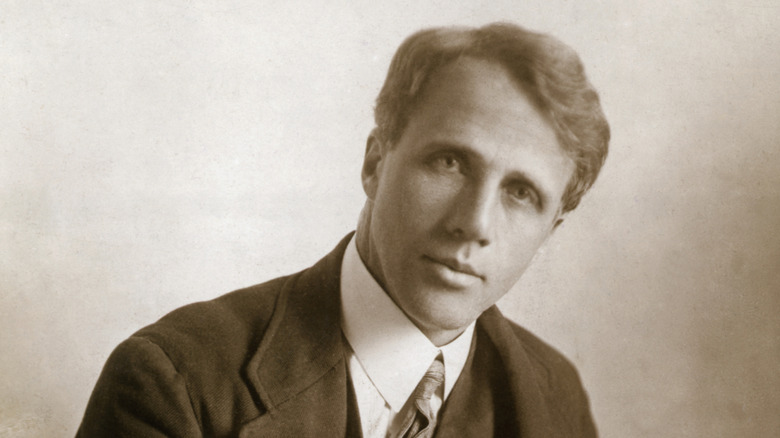
One of the most celebrated poets of all time, Robert Frost used his pen to share his view of the world. Frost chose to write as people spoke, reflecting what he most often heard in and around his New England home. Frost's ability to capture both the pain and beauty of life made him a giant in his profession, but the success did not come without tragedy. Sadly for Frost, tragedy was a common occurrence in his life.
The first time the writer felt the sting of loss — the death of his father – he was just 11. In high school, Frost found his two great loves: poetry and Elinor White. Frost's pursuit of education would take him away from Elinor, as he headed to Dartmouth and she to St. Lawrence for college. He soon dropped out of school, and the two wed in 1895, hoping for a life of happiness, but instead finding one filled with hardship.
Success as a poet evaded Frost, with only a few of his pieces accepted for publication while the couple struggled to make a living. To make ends meet, he worked as a teacher, and his family ran a poultry farm, but times were tough.
In 1900, Frost faced two tragedies. First, his son, Elliot, died of cholera at just 4 years old. Four months later, his mother, Isabelle, died. Frost and his wife would lose a second child, Elinor Bettina, seven years later. The poet wrote of the pain they experienced in the poem "Home Burial": "Can't a man speak of his own child he's lost?"
Robert Frost outlived four of his children and his wife
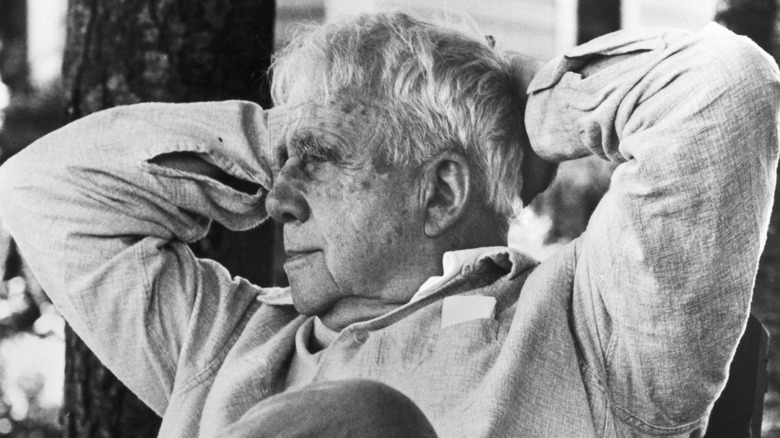
Robert Frost was nearing 40, and his work had only appeared in a few magazines. Facing two roads in his life, he sold the farm and moved his family to London, hoping that British publishers would be more open to his writing. The plan worked, and his first book of poems, "A Boy's Will," was soon available in stores.
But tragedy once again struck in 1920 when Frost was forced to put his sister, Jeanie, into a mental hospital. While the specifics of Jeanie's mental health issues are unknown, severe depression and anxiety were common in the family. Jeanie died in 1929 and, in 1934, Frost's daughter, Marjorie, would pass away shortly after giving birth. Frost wrote about losing his daughter in a letter: "Marge always said she would rather die in a gutter than in a hospital. But it was in a hospital she was caught to die after more than a hundred serum injections and blood transfusions."
Four years later, Elinor Frost suffered a fatal heart attack at 64, which Robert blamed himself for. The final tragedy in Frost's life happened in 1940 when his son, Carol, who struggled under the shadow of his father, took his own life. Frost later wrote (per WSHU), "I took the wrong way with him ... Something in me is still asking for the chance to try one more. That's where the great pain is located." In 1954, on his 80th birthday, Frost spoke with journalist Ray Josephs. When asked what the most important lesson he had learned about life was, the poet gave a simple but heartbreaking three word answer.
If you or someone you know is struggling or in crisis, help is available. Call or text 988 or chat 988lifeline.org
If you or someone you know needs help with mental health, please contact the Crisis Text Line by texting HOME to 741741, call the National Alliance on Mental Illness helpline at 1-800-950-NAMI (6264), or visit the National Institute of Mental Health website.