

Robert Frost & Elinor White: Their Real-Life Love Story
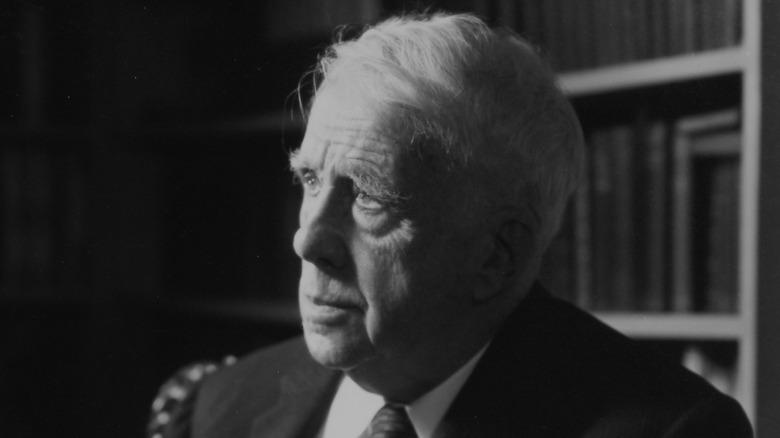
Robert Frost, the poet we revere for giving depth to snowy woods and the roads that diverge before us in life, spent his late teens on a courtship that had bitter setbacks and a brush with disaster. Before there was a "Collected Poems" bearing his name, and before celebrated works like "The Road Not Taken" and "Acquainted with the Night," Frost was a quick-tempered teenager in Lawrence, Massachusetts. And he was fixed on a young woman who kept telling him to slow down.
He met Elinor Miriam White at Lawrence High School, where a study-hall seating assignment put them side by side. A shared love of poetry took care of the rest, and the two found themselves swapping favorite verses and now and then meeting after class at the Lawrence Public Library. They were a close intellectual match, since they were named co-valedictorians in their 1892 graduating class. By one account, Elinor's final grades even nudged ahead of his. In those days, Frost was captivated by Percy Bysshe Shelley and his disregard for social convention, so he talked White into a private ceremony of their own, a betrothal sealed with an exchange of gold rings.
Frost was 18, and he wanted to marry at once. White, a bit older, wanted her degree first and left for St. Lawrence University in upstate New York. The long distance gnawed at him, and he believed that college and the young men in it were pulling his beloved away. Frost was unrelenting, and in 1894, he proposed only to face rejection. White's answer was the same: the degree came first. Only once she graduated in 1895 did she agree to the proposal, but the year before, a lovesick Frost did something drastic and desperate that might have ended his life before it truly began.
The rejection that drove Robert Frost down a dark path
Robert Frost was determined to prove his devotion, so he asked a printer to bind a volume of his poetry. He had two copies made — a book he called "Twilight" — one for keeping and one for gifting to Elinor Miriam White. In fall 1894, he carried her copy to Canton, New York, and appeared at her boarding house unannounced. She wouldn't let him inside and sent him off to catch a train back.
The dismissal really hurt him. Frost, who would summarize everything he knew in life in three words — and often explored heavy themes such as isolation and emotional exhaustion in his poems — couldn't bear the thought of a future without her. On the way to the station, he ripped his own "Twilight" apart and sent the fragments flying across the tracks. Back home, a letter from White dashed his hopes further, so he went down to Norfolk, Virginia, and set out on foot toward the hostile wilderness of the Great Dismal Swamp. He would later admit to Lawrance Thompson, the biographer he'd handpicked: "I was trying to throw my life away" (per Dartmouth Alumni Magazine). He went a little ways before thinking better of it and was then picked up by a steamer's crew. Frost eventually found his way home.
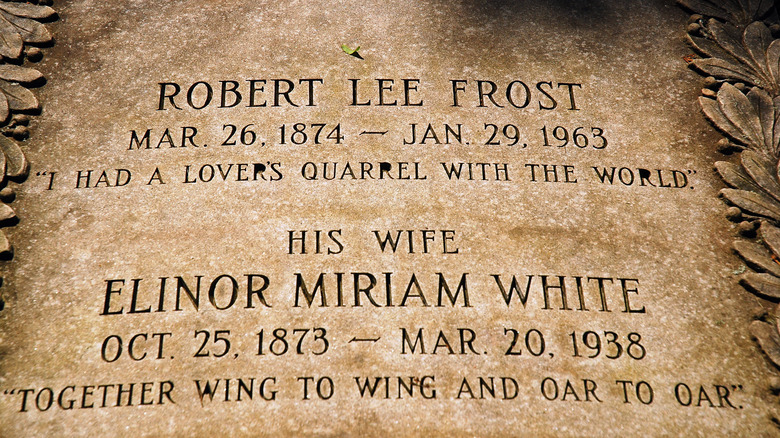
In 1895, White married him after all. The union lasted more than four decades. While life wasn't always easy for the couple, Frost's love for his wife couldn't be denied. She died of heart failure in 1938, only months after surgery for breast cancer. Frost's grief was visceral, enduring for years until his own death in January 1963. He never remarried.