

Why 1992 Became Known As The 'Annus Horribilis' For The British Royal Family
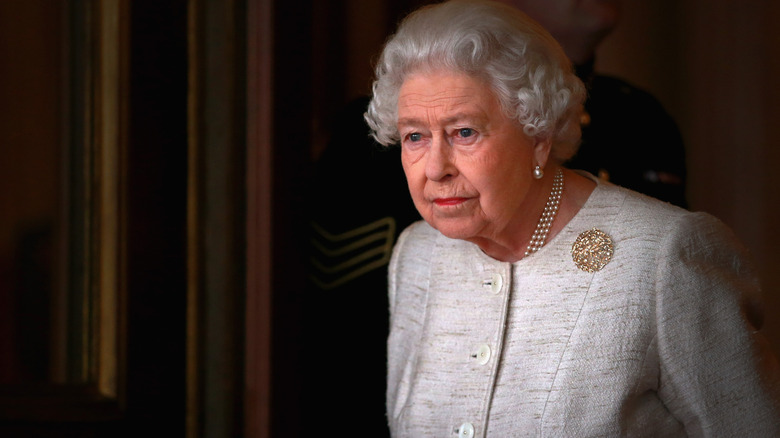
"1992 is not a year on which I shall look back with undiluted pleasure" (via the official royal family website). These were the words of Queen Elizabeth II during her 40th anniversary Accession speech at Guildhall in November 1992. She continued, "In the words of one of my more sympathetic correspondents, it has turned out to be an 'Annus Horribilis.'" For those not fluent in Latin, Her Majesty basically said that she'd had a royally sucky year.
Everything that could go wrong did. Royal secrets were blasted across the front page, certain members of the family behaved in an exceptionally unroyal way, and the press got hold of highly confidential phone call recordings. Said phone calls still find their way into royal correspondence three decades later (thanks, internet!), and scandalous pictures of a certain royal that made the front page that year are still in circulation. The horrors of 1992 were immortalized by the press, and now, the internet archives. It was the year of the royal family's biggest PR disasters, and it might be safe to say that, while many unfortunate incidents followed in the years after, 1992 still holds the record for yielding the most within a 365-day timespan.
Aside from all the jaw-dropping scandals, several divorces rocked the royal family that year. Princess Anne and her husband, Captain Mark Phillips, officially divorced. King Charles III and Princess Diana announced their separation, and then-Prince Andrew, Duke of York, and Sarah Ferguson declared that their marriage was over as well. The only child of the queen who didn't separate from his spouse that year was Prince Edward, and that's only because he was unmarried. Needless to say, it was a horrible year indeed.
Royal secrets were laid bare in Princess Diana's biography
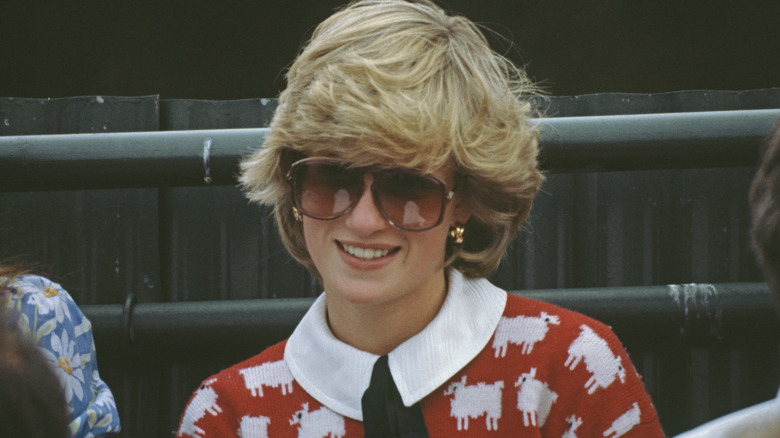
Forget Prince Harry's bombshell memoir "Spare"; Andrew Morton's biography of Princess Diana, published in 1992, arguably served much hotter (and utterly scandalous) tea. "Diana: Her True Story" was released in June 1992, and it resulted in a media firestorm that likely had Queen Elizabeth II burying her face in her hands in utter despair. For the first time in the monarchy's history, its deepest, darkest secrets were laid bare for all to read, and even worse, they came from the princess herself (even though Morton initially cited his sources as palace insiders to protect Diana).
The princess spoke candidly about then-Prince Charles' affair with Camilla Parker Bowles, how she suffered from an eating disorder, attempted suicide five times, and engaged in self-harm, sometimes in front of Charles, who she claimed dismissed her and didn't take her problems seriously. During one such incident, the princess (who at the time was pregnant with Prince William) threw herself down a staircase, which resulted in her needing medical attention. Charles called a doctor, but Diana claimed he didn't stick around to see if she was alright. Instead, he went horseback riding.
One can understand why these claims completely shattered the perfect image the public had of the royal family. As royal expert Tina Brown wrote in her book, "The Diana Chronicles," Morton's tome proved that the royals were just regular people with normal problems. "If the royal family was as imperfect as every other family in the kingdom, it might as well be treated as such—an idea that had implications beyond the soap opera of the moment," Brown penned (via Time).
If you or someone you know is struggling or in crisis, help is available. Call or text 988 or chat 988lifeline.org
It was the unfortunate year Tampongate leaked to the press
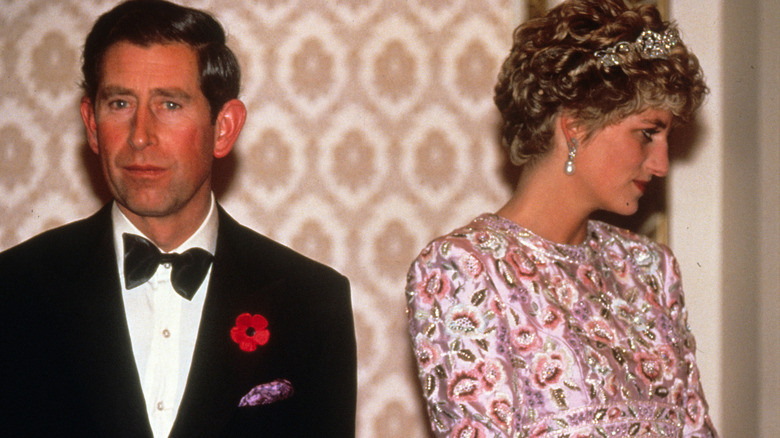
Nothing with the word "gate" attached to it is good. Ever. And in the case of Tampongate, it was as bad as it sounds. Because what could possibly be worse than the future king of Britain telling his mistress that he'd like to live in her pants? Not much, we suspect. We can't even imagine Queen Elizabeth II's face when she first heard the call.
The late-night conversation in 1989 between then-Prince Charles and Camilla Parker Bowles was somehow recorded and sold to the Daily Mirror in 1992, according to Tina Brown's book, "The Diana Chronicles." The outlet summarily started hinting that it had hold of a bombshell story pertaining to the future king. The headline, "Charles's Secret Bedtime Phone Call," suggested that there was hot tea to be spilled, and while said tea was only poured in January 1993, the public was well aware that the heir to the throne had engaged in some scandalous conduct.
When the transcript was finally published in January 1993, royal pundits and experts had a hard time picking their jaws off the floor. During the call, Charles suggested he become a tampon so he could be as close as possible to Camilla. She retorted, "You are a complete idiot!" before adding, "What a wonderful idea." It got worse. Realizing it was a disposable item, she suggested Charles become "a box of Tampax, so you could just keep going," per Time. Royal expert Sally Bedell Smith told Vanity Fair in 2022 that the incident delivered a horrendous blow to Charles' reputation. "His popularity plummeted and people were questioning his fitness to be king," she noted.
It was also the year of Squidgygate
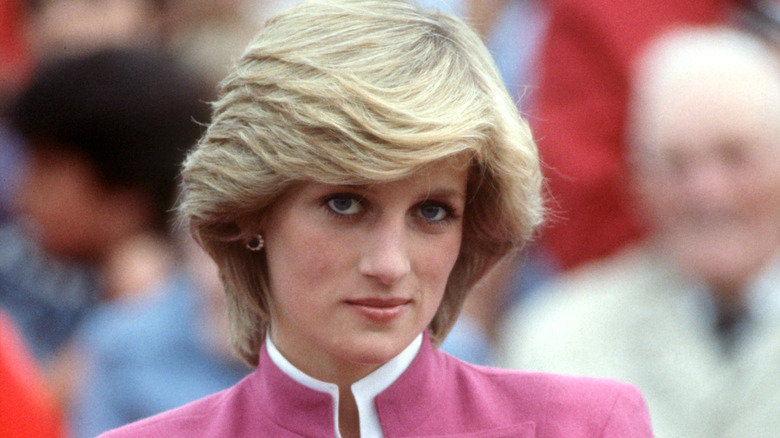
Squidgygate made its grand debut in August 1992. Who said 'Squidgy,' you might ask? Well, that was salesman James Gilbey's nickname for Princess Diana. The two were having a candid chat on New Year's Eve in 1989, and for some reason, the recording was released smack in the middle of the monarchy's worst year yet.
The recording (which the public could pay a fee to listen to) included Diana and Gilbey kissing through the phone. He referred to her as his "darling" and on 14 occasions called her "Squidgy." Cyril Reenan, a home radio amateur, claimed he recorded the call and sold it to The Sun. The publication's royal correspondent at the time, Stuart Higgins, later said, "The content was so explosive we knew we had a major, major story," per News.com.au. For reasons not entirely known, The Sun refrained from publishing the contents of the recording, and the Enquirer got the scoop in 1992. Diana and Gilbey reportedly knew it was out there and that it was only a matter of time before the press ran with it.
There were rumors that Diana was afraid of Queen Elizabeth II, and in this instance, she had reason to be. The queen was said to be furious over the leaked call and told Diana how displeased she was with the tape and its contents (and, we suspect, her conduct). Former royal protection officer Inspector Ken Wharfe revealed during an inquest that the queen was "unhappy" about the whole affair, per The Standard. Diana, meanwhile, was said to be embarrassed and distraught.
Then there was the toe-sucking incident
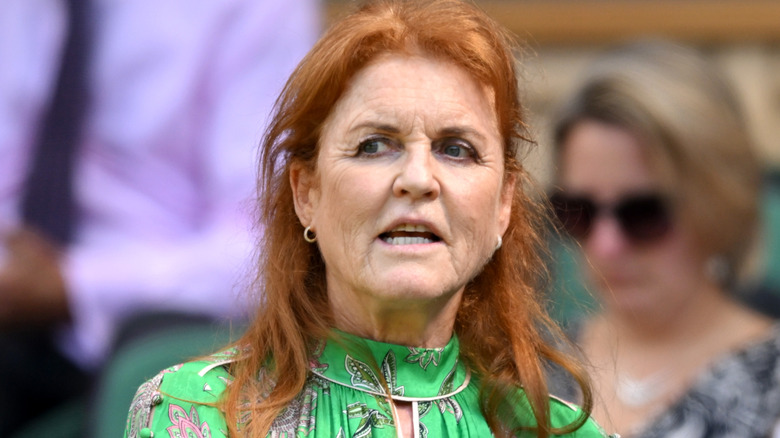
This scandalous incident was dubbed Toegate, and it was a mortifying scandal for the royal family. Aside from dealing with multiple divorces throughout 1992, the tell-all book about Princess Diana in June, and Squidgygate in August, the royal family found itself staring down another scandal in the eighth month of that year: Sarah Ferguson's dalliance with Texas millionaire John Bryan; or, should we say, Bryan's dalliance with Sarah's toes. Bryan was photographed sucking the toes of the then-duchess (who was still very much married at the time) while they were vacationing in St. Tropez. Sarah, at one point, was photographed without her bikini top, and it was smeared across the front page of the Daily Mirror.
At the time, Daily Mail correspondent Richard Kay likened the scandal to the "Abdication Crisis of almost sixty years earlier." It didn't help that the duchess' two daughters, Princess Eugenie and Princess Beatrice, were present for the whole affair. Queen Elizabeth II was reportedly beyond herself when she got hold of a copy of that morning's newspaper. Unfortunately, Sarah was at Balmoral when the scandal broke, and she had to look the queen in the eye — as well as Prince Philip.
Some reporting indicated he went a bit easier on Sarah, telling her, "There but for the grace of God go I," per Nine.com.au. But he was still disappointed. Sarah told royal diarist and historian Kenneth Rose that Philip wrote her a letter in which he expressed his dismay at the photographs, telling her that she had "let down The Firm," per Express. She was not allowed back at Balmoral until 16 years later.
Charles and Diana's South Korea tour put their strained marriage in the international spotlight
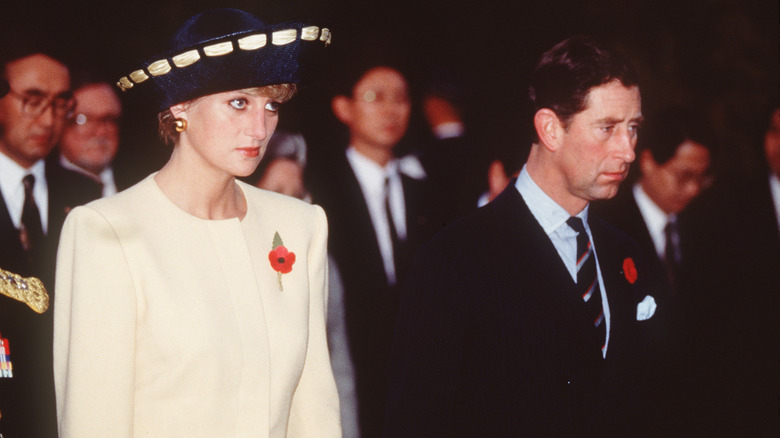
The truth about King Charles III and Princess Diana's marriage is that it was never truly a happy one. While they managed to pretend they were living the fairy tale everyone assumed for a few years, they stopped pretending entirely during their royal tour of South Korea in November 1992. Diana told Andrew Morton for his book, "Diana: Her True Story," that she'd become an expert at faking it. "However bloody you're feeling you can put on the most amazing show of happiness," she told him, adding, "Because I had a smile on my face everybody thought I was having a wonderful time. That's what they chose to think—it made them happier thinking that," per E! News.
But during the couple's tour to South Korea, the princess didn't bother to put that smile on her face. According to Jonathan Dimbleby's book, "The Prince of Wales: A Biography," Diana told Charles three months prior to the trip that she didn't want to accompany him on what was set to be called the "Togetherness Tour" (the irony wasn't lost on anyone). It took Queen Elizabeth II intervening to convince Diana to join her husband, but at this point, she had no plans to pretend she was happily married.
Former royal press secretary Dickie Arbiter told the Daily Mail that he quickly realized the couple wasn't going to put on a show of unity or love when they arrived in Seoul. "As the door to the aircraft opened, I turned to the protection officer and said: 'We've lost this one,'" he recalled. The couple looked so unhappy during their stay that the British press resorted to calling them "The Glums."
Queen Elizabeth II was replaced as the head of state in Mauritius
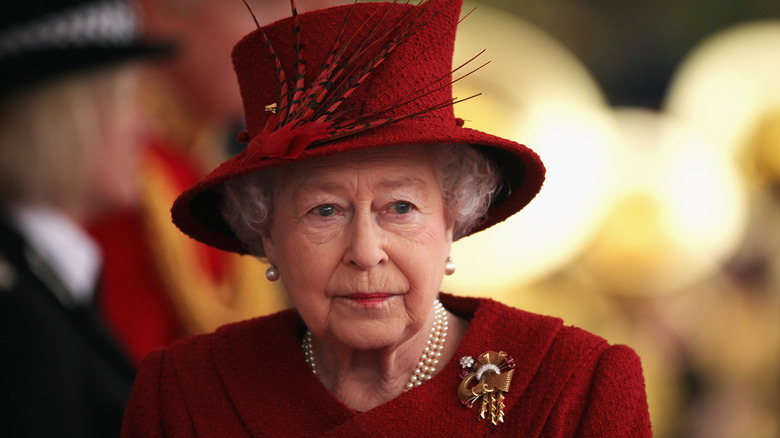
In another blow to the monarchy, a Commonwealth country amended its constitution in 1992 to become a republic, renouncing Queen Elizabeth II as its head of state. Said country was Mauritius, and the decision had been in the making for a few years. In 1968, the island became independent from Britain, but it still recognized the queen as its head of state. Its decision to become a republic meant that this was no longer the case, and the monarchy was completely abolished within its borders. However, the timing was purely coincidental, as the move had more to do with Mauritius' political advancement than the reign and scandals of the royal family.
The Mauritian parliament appointed the country's first president, Sir Veerasamy Ringadoo, and put the queen and her family firmly behind them. Given the turmoil The Firm had endured that year, which saw its family drama play out in the press and its popularity decline, this move added another dent to the royal image.
The royal family's home literally went up in flames
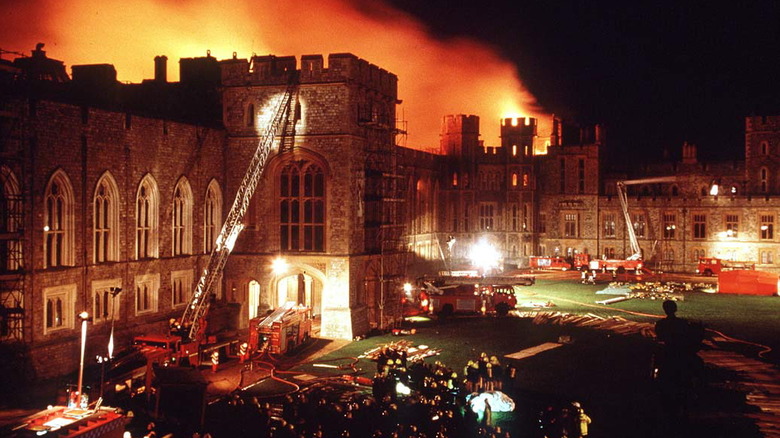
If you think the royal family's 1992 problems couldn't possibly get any worse, you'd be wrong. Because it could, and it did. When Windsor Castle went up in flames on November 20, 1992, we suspect Queen Elizabeth II started contemplating whether her family might be cursed. If it wasn't one thing, it was another, and in this case, the misfortune that befell them was catastrophic. The start of the fire was an accident. The castle was undergoing construction at the time, and a 1,000-watt spotlight in the Queen's Private Chapel was said to be the culprit. It was determined that the light overheated and ignited nearby curtains.
Something most didn't know about Windsor Castle became abundantly clear that day — it wasn't properly fireproofed. The roof had no insulation to slow the spread, so the blaze raced through the castle at breakneck speed, damaging 115 rooms. The tragedy could have been worse, however. Then-Prince Andrew, Duke of York, was at the castle when the blaze started, but he got out safely and helped staff rescue some of the precious artifacts in the building.
While the fire was still raging, Andrew told the press of his reaction to the disaster. "Horror. Shock and horror, and the fact that it took hold so quickly," he said, per RadioTimes. He added that the queen was "shocked." Miraculously, only two pieces of art were turned to cinders because most of it had been removed from the castle during the construction work. The blaze injured multiple firefighters and raged for about 12 to 15 hours (depending on who you asked).
The year ended with the royal family's finances receiving sharp criticism
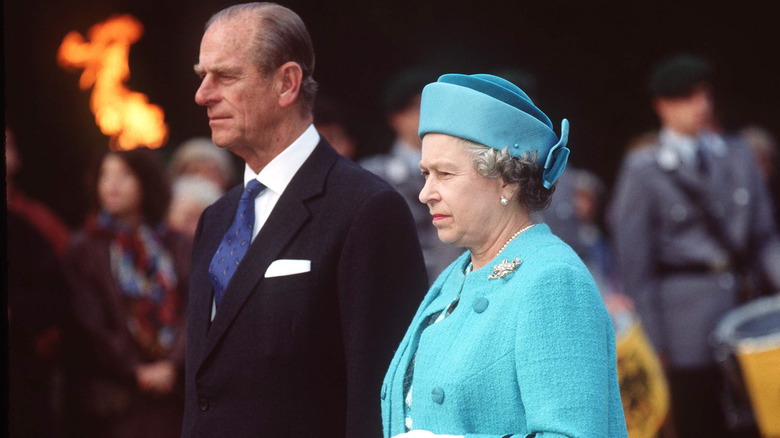
The royal family's riches had been a hot topic for years, and the 1992 Windsor Castle fire and the millions it would cost to repair it put the family's finances in the spotlight. Former Prime Minister John Major offered to put Parliament's finances at the royals' disposal to repair the historic building, but neither the British public nor the media was amused by this proposal. Believing that the royals had more than enough money at their disposal to foot the bill, it was agreed that they should bear the costs. As a result, Queen Elizabeth II opened Buckingham Palace to the public for the first time, and the admission fees covered 70% of the project. In a show of goodwill, she also pledged £2 million in personal funds to help with repairs; the rest came from private donations. The total repair cost at the time added up to £36.5 million, though initial estimates put it at £60 million.
The increased scrutiny of the royal family's finances that year led to the queen making the decision to finally become a taxpayer like the rest of the British public. From 1993, she started paying income tax, and this has continued ever since. The royals have become increasingly transparent about how much money they make and how they fund the work they do. The official royal family website provides pundits with a comprehensive overview of their income and expenses that visitors can download for their perusal.
The British Prime Minister officially announced Charles and Diana's separation
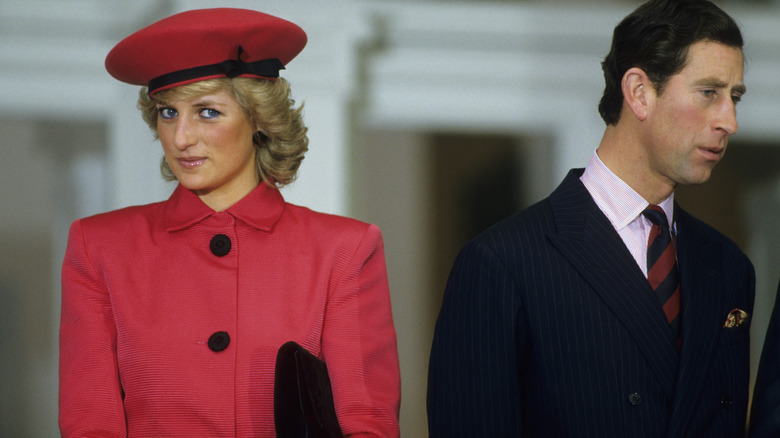
1992 held one more tragedy in store: the official announcement of then-Prince Charles and Princess Diana's separation. The task of relaying the news to the public fell on former British Prime Minister John Major, who read from a statement provided to him by the palace. He reiterated that Charles and Diana were not divorcing, simply separating, and that the Princess of Wales still had a chance of becoming queen when Charles ascended the throne, despite the couple living separate lives.
The Cayman Compass noted in its reporting of the prime minister's announcement that polls showed the British public was choosing Diana's side, placing most of the blame for the breakdown of the couple's marriage firmly on Charles' shoulders. Former Prime Minister Edward Heath declared it "one of the saddest announcements made by any prime minister in modern times." Labour MP Dennis Skinner thought the separation a disaster. "We could now be witnessing the end of the monarchy and the reigning Queen could possibly be the last," he said, adding that allowing Charles and Diana's separation was equivalent to the queen hitting "the selfdestruct button." Of course, little did they know that Charles and Diana's messy divorce was still on the horizon.
Behind the scenes, Queen Elizabeth II was reportedly utterly distraught by the relationship misfortune hitting the family all at once. In his book, "Queen of Our Times," Robert Hardman noted that insiders told him Her Majesty didn't take it well and was in "despair." A former royal staffer told Hardman: "It distressed her much more than she let on. One shouldn't underestimate the pain she's been through" (via Time).
The queen's Christmas message was leaked
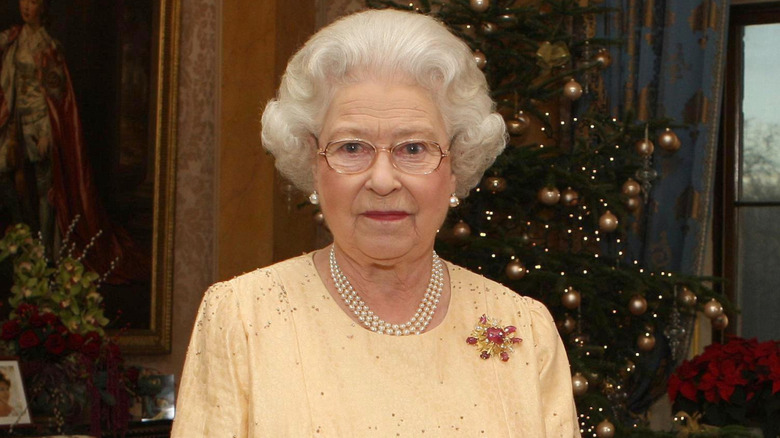
Even as 1992 sped to an end, the royal family's no-good, horrible year refused to depart gently. Instead, it went out with one last bang — the leaking of Queen Elizabeth II's Christmas speech. One would think that she had been through enough. Alas, the universe had other plans.
Her Majesty had recorded that year's address at Sandringham, and after copies of the tape were distributed to the BBC, a leak occurred, and The Sun published the full speech on its front page. In that wry manner popular among the British, the queen called the leak "very regrettable," per The Tampa Bay Times. Assuming that some curse words were flying within Sandringham's walls when the news broke is probably not very far-fetched. The BBC, having been thoroughly embarrassed by the ordeal, launched an investigation. The Sun's assistant news editor, Leaf Kalfayan, however, insisted the publication had gotten hold of the speech by legal means, citing "good, old-fashioned techniques," per the BBC.
Interest in the queen's speech that year was particularly high, given all that had conspired, and pundits were eager to hear what she had to say about all the royal drama. The original speech, as published by The Sun, addressed the family's turbulent year. "Like many other families, we have lived through some difficult days this year. The prayers, understanding and sympathy given to us by so many of you in good times and bad have lent us great support and encouragement. It has touched me deeply," the queen said, per the Tampa Bay Times. She voiced her optimism for the year ahead, noting that Christmas is as good a time as any to start fresh and look forward with renewed hope.