

62 Years Ago Today, Jean-Paul Sartre Snubbed The World's Most Exclusive Club
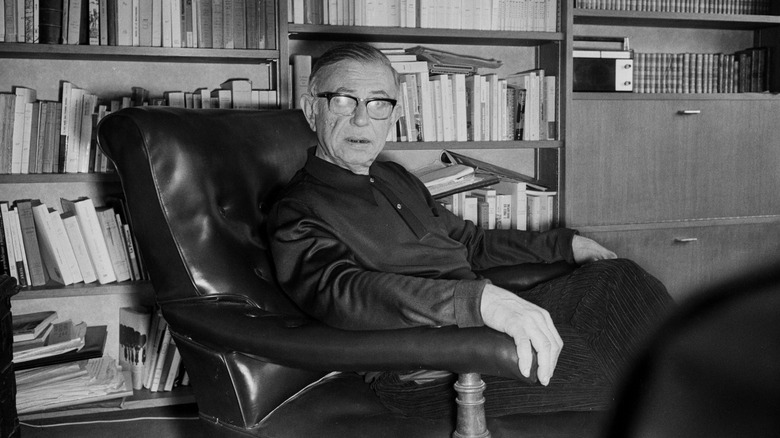
Many of us go through our day to day life thinking things that don't have a major impact on the world around us, much less help propel major schools of thought. But when it came to Jean-Paul Sartre, he was a major influence on philosophy during the 20th century, musing on everything from love to freedom, truth, and even what it meant to be human. Sartre was particularly connected with existentialism, following in the footsteps of the likes of Danish philosopher Søren Kierkegaard, "The Father of Existentialism." For those non-philosophy majors, existentialism is a philosophical movement that essentially says we alone are responsible for finding and creating our own meaning and happiness in life.
Sartre was also a prolific writer. Along with his books and essays on philosophy, he also wrote plays and novels. For his work, he won the Nobel Prize in Literature in 1964. Or rather, he was awarded it. Sartre famously did not accept. The first Nobel Prize in Literature was awarded in 1901, and it's only given out once a year. There are also Nobel Prizes in physics, chemistry, economic sciences, peace, and physiology or medicine. It's quite the prestigious group of wildly accomplished thinkers and doers; however, Sartre was adamant that he would not accept it.
The Frenchman's refusal caused a scandal at the time. In September 1964, word leaked that the Swedish Academy was strongly considering Sartre as that year's winner. Once he found out, the existentialist wrote a letter to them to decline the offer. But it was too late, and Sartre was named the winner. According to the official Nobel website, once the prize has been "announced, it cannot be revoked, shared, or transferred to others."
Why Sartre turned down the Nobel Prize in Literature (and other awards along the way)
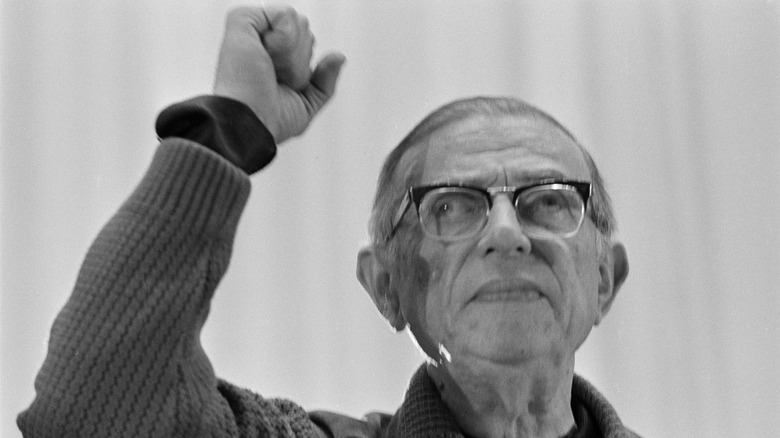
In a public statement published in "Le Figaro," a French daily newspaper, on October 23, 1964, Jean-Paul Sartre outlined why he wouldn't be accepting the Nobel Prize in Literature. "The writer who accepts an honour of this kind involves as well as himself the association or institution which has honoured him," the philosopher reasoned, adding, "The writer must therefore refuse to let himself be transformed into an institution, even if this occurs under the most honourable circumstances, as in the present case," (via The Guardian). Basically, he wanted his ideas to stand alone without needing the backing of a prestigious award. Notably, this was not the first or only time that Sartre declined an accolade. His letter pointed out that he had turned down other awards over the years, including the French Legion of Honour.
One of Sartre's issues with accepting the Nobel Prize was that it came with a $53,000 prize, and he had moral and political qualms about accepting the money, which the existentialist felt should be donated to a worthy cause instead. It was in the midst of the Cold War, and Sartre wasn't interested in publicly taking a side; he wanted to remain independent as an intellectual and a writer. Sartre appears to be the only person who has chosen to not accept the Nobel Prize in Literature. In 1958, Boris Pasternak, who wrote "Doctor Zhivago," won it; however, he was pressured by the Soviet government to turn it down. In 1925, George Bernard Shaw got the award; but he turned down the money. Instead of going to Shaw personally, he gifted it to the Anglo-Swedish Literary Foundation to support translating Swedish literature into English.