

Unspoken Royal Marriage Rules Queen Elizabeth And Prince Philip Followed For Decades
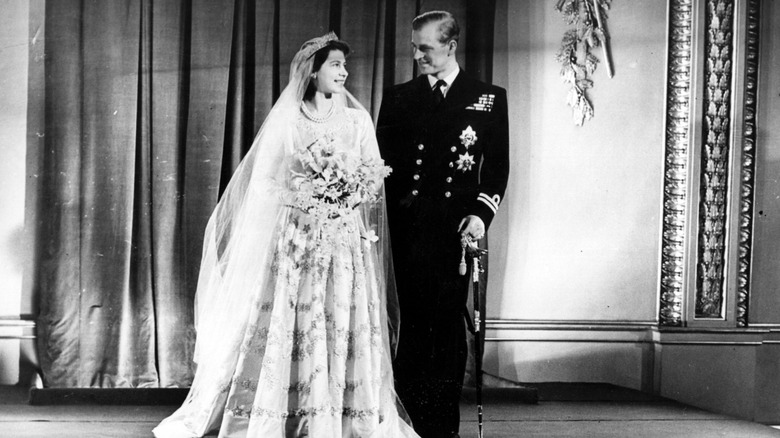
For 73 years, they weathered the ups and downs of the British monarchy, saw the rise and fall of several British prime ministers and U.S. presidents and, before their marriage, endured World War II. Queen Elizabeth II and Prince Philip's love story is one to marvel at. They were married longer than some people have the privilege to be alive, and they stuck it out until the very end, only parting ways when Philip died in 2021.
In front of the cameras, they were the most senior members of the British monarchy, but behind closed doors, Philip called the queen "cabbage," per The Sun, and she called him her "strength and stay," per Al Jazeera. Royal biographer Sir John Wheeler-Bennett told The Sun, "This was the man with whom Princess Elizabeth had been in love from their first meeting." And he loved her, giving up his royal Greek titles to marry the then-princess in 1947. Not only that, but he also quit smoking from the moment he said "I do." Now, that's true love.
According to royal historian Hugo Vickers, Philip "was an interesting figure." While he knew he had a bunch of royal protocols to follow in public, he didn't mind stirring the pot. "What I think he was doing was trying to get a rise out of people," Vickers told The Sun. "When in public, he was a bit of a nightmare because he could upset people." Case in point, Philip once jested to a Scottish driving instructor, "How do you keep the natives off the booze long enough to pass the test?" per Al Jazeera. No doubt Her Majesty often had her hands full with her husband's gaffes, but for the most part, they followed the unwritten royal rules of marriage to a T.
Prince Philip always kept a respectable walking distance from the queen
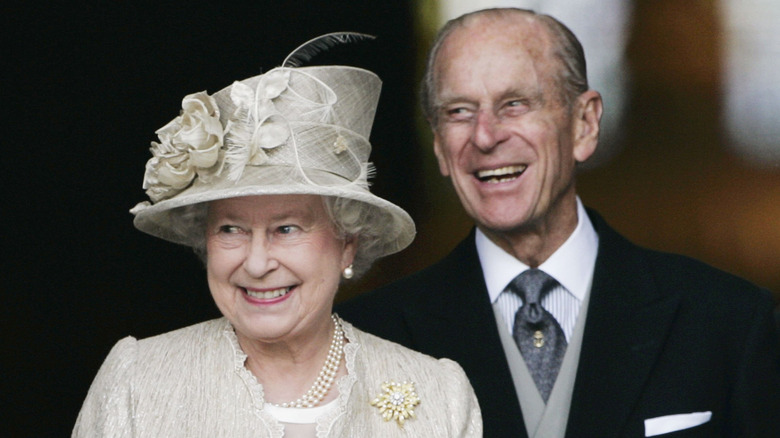
When Queen Elizabeth II ascended the throne, certain things in her marriage with Prince Philip had to change, and how they walked together in public was one of them. It was one of those strange facts about Queen Elizabeth's marriage that everyone simply accepted without question. Once she wore the crown, Philip always walked a few paces behind her. Some have described it as two, some as three, but either way, the Duke of Edinburgh never walked in front of his wife and always kept a respectable distance behind her in public to signal his respect for her position as the monarch.
Philip might have been submissive to his wife in public, as is required of the sovereign's consort, but that didn't necessarily mean his personality followed suit. King Charles III's friend, Sir Nicholas Soames, told The New York Times in 2021 that the queen knew whom she married and what it took for Philip to be her second. "The queen must have understood from the beginning that this was a very, very strong character with a ramrod-straight backbone, and he wasn't going to be buggered about," Soames said. And yet, Philip was a stunning example of what a supportive spouse should be.
The queen, knowing how much her husband valued his independence, gave him the same space in private that he afforded her in public. Royal expert Ingrid Seward told the Radio Times in 2019, "She was very conscious of the fact that he had to walk two steps behind her, and I think as a result she was very forgiving of any of his little misdemeanors. You know, when he got drunk at the Thursday Club and when he came home late."
Prince Philip always sat behind the queen on flights
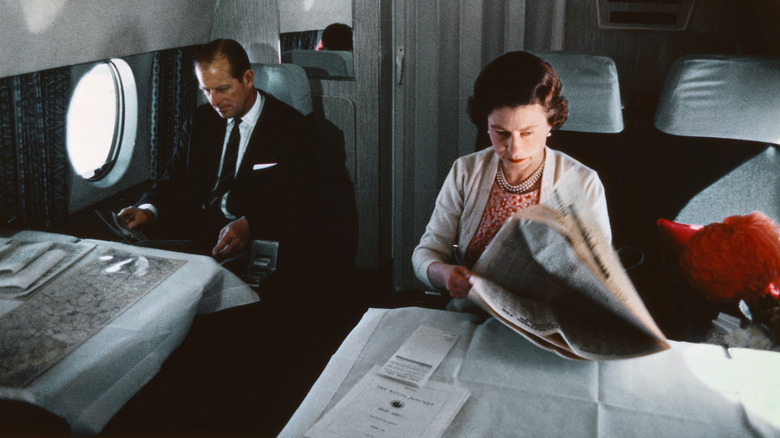
Prince Philip's habit of keeping a distance of about two steps behind Queen Elizabeth II also seemed to extend to when they were traveling. Even though the public couldn't watch them with a hawk's eye while they were in the confines of an airplane, it would appear that this unwritten rule still applied. Add that to the list of strange travel rules the British royals abide by.
In his book "Queen of the World," Robert Hardman revealed that whenever the queen and Philip traveled together on an airplane, the prince would take his seat behind her. "[Cabinet Minister] Jack Straw was struck by the fact that, on a long flight, the duke would sit in the row of seats behind the queen, too," Hardman penned (via Express), surmising that this was either an extension of Philip showing respect to the queen as the sovereign while they were surrounded by other people, or because her entourage took up most of the seats next to her. Philip might have shown his submission to the monarch, but he was anything but timid. "His temper could keep things cracking along quite nicely," a royal household insider disclosed to Hardman.
Philip might have always kept a respectful distance from Her Majesty, but his protective side never backed down. Aside from ensuring things went as it should during their flights, Philip also famously made sure the press kept their distance from the queen when they were together in public, and if he felt they were overstepping, he would utter the reprimand, "Don't jostle the queen!" per The New York Times. We're sure Her Majesty appreciated her husband's protective side during such times.
Prince Philip never pursued his own ventures, serving as support to the queen only
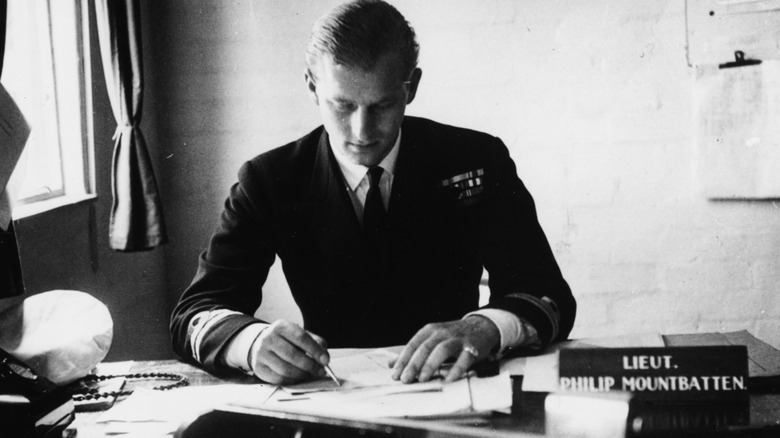
These days, plenty of royals work regular jobs, but Prince Philip didn't have the privilege of being one of them. As Queen Elizabeth II's husband, certain responsibilities — and very hard sacrifices — fell to him. Philip was a military man, and he served his country during World War II as a member of the Mediterranean and Pacific fleets.
Amid celebrations for the queen and Philip's 70th wedding anniversary, royal commentator Richard Fitzwilliams noted, "Philip would have far preferred a naval career than to be in a supporting role," per Yahoo. Royal expert and creator of "The Crown," Peter Morgan, shared this sentiment with Time, surmising, "Philip, I think, had made the mental calculation that he would enjoy 20 years of married life before this dreadful crown business would happen." Alas, things did not pan out that way, and because senior working members of the royal family aren't allowed to work regular jobs, Philip had no choice but to give up his naval career, despite being well on his way to becoming First Sea Lord. As Vanity Fair's royal correspondent Katie Nicholl told Vogue, working members of the family don't hold regular jobs. "[T]here's simply too much conflict," she said. And Philip had duties as the queen's consort. He couldn't balance his own career on top of that.
Philip didn't make a secret of the fact that he'd rather not be "the world's most experienced plaque unveiler," as he once put it. During a 1992 interview with the Independent, he said, " It was not my ambition to be president of the Mint Advisory Committee. I didn't want to be president of WWF. I was asked to do it ... I'd much rather have stayed in the Navy, frankly."
The queen headed the nation, while Philip headed their household
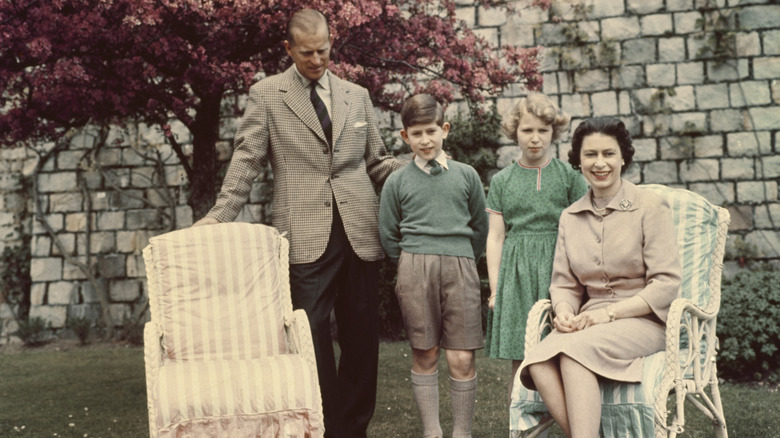
The case of Queen Elizabeth II and Prince Philip flipped traditional gender roles on their heads. She was the queen, the head of the monarchy and the Commonwealth. Philip was basically the stay-at-home husband who ran things behind the scenes to make his wife's life easier. However, reporting has indicated that, while the queen was the sovereign in public, she let her husband be the head of the household behind closed doors.
A 1960s documentary about the royal family, showed the queen doing the dishes while Philip did the cooking, just like in your typical family of that time. When out in public, Philip would go ahead of his wife, meeting with the people she was set to greet to warm them up for the coming interaction with the queen. Prince Harry once said in a 2012 interview that Philip was vital to the queen's successful reign. "[T]he fact that he's there, personally, I don't think she could do it without him," he said, per the BBC.
Aside from paving the way for the queen at royal events and engagements, Philip also managed the royal family's estates. When Buckingham Palace was refurbished after World War II, Philip oversaw the project — and made sure the historic building was given a modern touch-up. Philip also interceded in family drama. As then-Prince Charles and Princess Diana's marriage was falling apart in the '90s, he wrote Diana letters, empathizing with how hard she found royal life and citing his own experiences. He also offered Diana marital advice, though he conceded, "I have no talents as a marriage counselor!" per the CBC. Diana disagreed. "This latest letter of yours showed great understanding and tact," she penned in her response.
They didn't share a bedroom
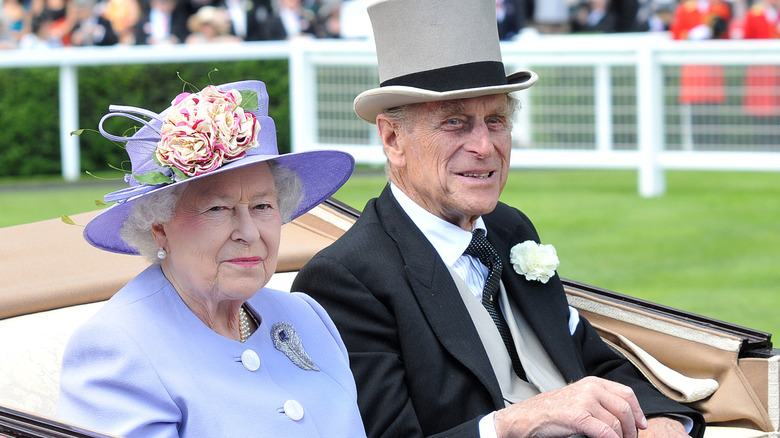
Queen Elizabeth II and Prince Philip were married for 73 years, and royal pundits never so much as heard a peep that the two were ever feuding behind the scenes, so naturally, it came as quite a shock when it was revealed that the couple didn't share a bedroom (perhaps this is why they had such a happy marriage). As it turns out, this was yet another unspoken rule they followed that was and remains commonplace among the upper class.
Philip's cousin, Lady Pamela Hicks, told royal biographer Sally Bedell Smith for her book, "Elizabeth the Queen: The Life of a Modern Monarch," that Her Majesty and Philip didn't share a bed — or a bedroom. "In England, the upper class always have had separate bedrooms. You don't want to be bothered with snoring or someone flinging a leg around. Then when you are feeling cozy you share your room sometimes. It is lovely to be able to choose," Hicks explained.
Philip and the queen reportedly embraced this arrangement, and it worked great, in part because of their vastly different tastes in bedroom decor. Philip reportedly enjoyed storing some of his gadgets in his room, and even installed some, like a suit dispenser, in his bedroom in Clarence House. Philip liked to tinker and invent new things, but the queen reportedly wasn't all that fond of him displaying his inventions in his room, nor did she particularly enjoy her husband preparing breakfast in the comfort of his sleeping quarters with his favorite electric frying pan instead of the kitchen.
Prince Philip and the queen never engaged in PDA
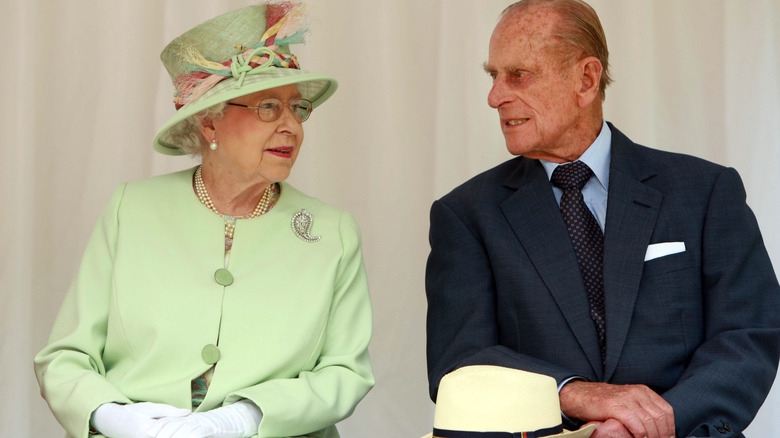
As far as we know, Prince Philip and Queen Elizabeth II loved each other dearly until the very end, but if you were looking for proof of that love while they were making public appearances, you wouldn't have found any. There are many royal rules and protocols that have become outdated, and the no-PDA rule is one that likely won't survive the modern monarchy. But the queen and Philip followed it to the letter. In fact, they set the precedent. "The queen rarely holds hands with her husband in public, and this seems to have set an unwritten precedent for the other royals," body language expert Robin Kermode told the International Business Times in 2018.
This was the case even when the two first started dating and were absolutely smitten with each other. In his book, "The Queen: 70 Chapters in the Life of Queen Elizabeth II," Ian Lloyd claimed that even those closest to the couple didn't at first realize they were in a romantic relationship because of the lack of PDA. He noted that this absence of public affection was likely, in part, because of Philip's upbringing in a home where he "had never been shown much affection from his parents" (via Marie Claire).
Royal courtier Mike Parker told Lloyd that he wished Philip would show more public affection to the queen, and he even once voiced this to the prince, who didn't appreciate the suggestion. "He just gave me a hell of a look," Parker told Lloyd. The author noted, however, that the queen preferred her husband's hands-off approach in public. "Elizabeth was emotionally controlled and the fact he wasn't all over her was something she quite liked," Lloyd explained.
Prince Philip's title as the queen's husband was an age-old rule the couple followed to the letter
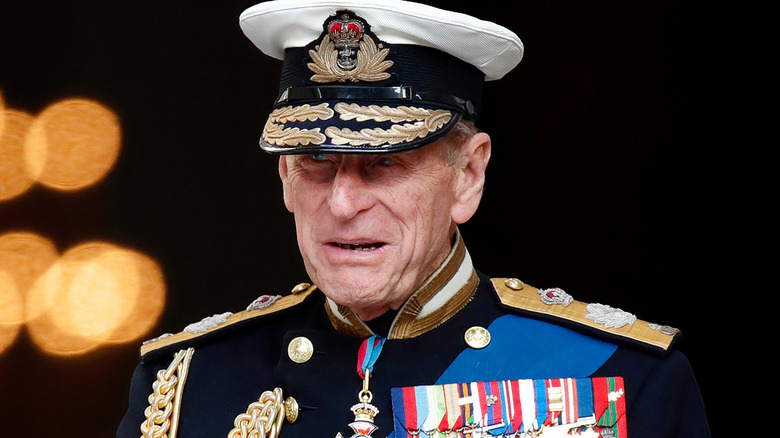
Prince Philip never bore the title of king, and that is because of an age-old rule he and Queen Elizabeth II followed when she became the monarch. Philip was not crowned alongside the queen at her coronation ceremony. Why? Because the title of king trumps the title of queen, and she was the sovereign by birth — not Philip.
That doesn't mean Philip didn't get an esteemed title — and the queen even made an exception when it came to his last name, so his legacy could be carried on through their children. Before the queen's coronation in 1953, Philip bore the title of the Duke of Edinburgh. In 1957, the queen granted him the title of His Royal Highness the Duke of Edinburgh. The queen was also aware of Philip's unhappiness with the fact that he couldn't pass down his last name, Mountbatten, to his children. Per BBC News, he reportedly complained, "I'm nothing but a bloody amoeba!"
This was rectified by Her Majesty when, in 1960, she conceded to using the last name Mountbatten-Windsor for her and Philip's descendants. Philip initially wanted the queen to take his last name, though her mother, Queen Elizabeth, The Queen Mother, and her grandmother-in-law, Queen Mary, along with then-Prime Minister Winston Churchill, were firmly against it. This angered Philip, who reportedly exclaimed, "I am the only man in the country not allowed to give his name to his children."
Queen Elizabeth II and Prince Philip never let any marital drama play out in public
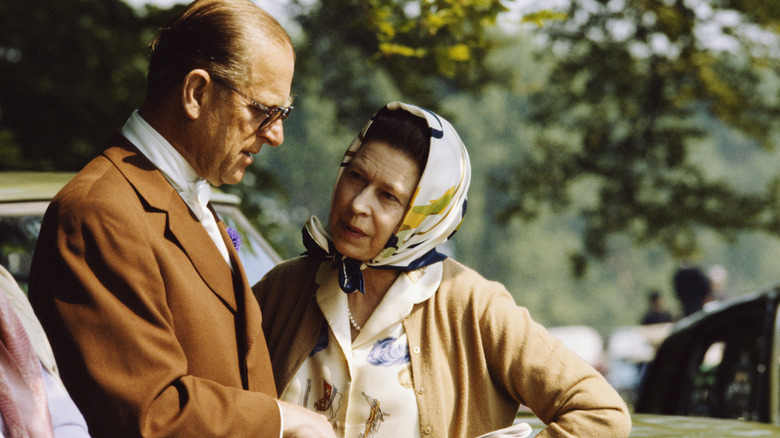
Queen Elizabeth II and Prince Philip upheld their marital vows, but they also firmly stuck to the royal protocol of never, ever airing out dirty laundry in public. The queen and Philip witnessed their fair share of royal divorces that rocked the British royal family, and most of them were all the more scandalous because of how said couples handled it publicly.
King Charles III and Princess Diana famously let their marital drama play out in tell-all interviews and bombshell books, as did Andrew Mountbatten-Windsor and Sarah Ferguson. But if the queen and Philip ever had nasty marital drama, we never knew about it. They followed the queen's rule of "never complain, never explain" to the very end, despite whispers that Her Majesty and Philip had some major problems in their marriage.
Philip's biographer and friend, Gyles Brandreth, told ITV News (via "Today") in 2021 that Philip followed a strict rule during interviews, which he also imparted to the rest of the royal family. "Don't talk about yourself, don't give personal interviews," Brandreth shared. The biographer told the Daily Mail that Philip wasn't against interviews but believed the subject matter should be about the royal family's work — not their personal lives. In his ITV interview, Brandreth said Philip feared that disclosing personal details in interviews would turn the monarchy "into a soap opera." It's therefore no surprise that Philip and the queen never spoke about their marriage or whatever problems they might have been dealing with behind the scenes. Much as he might have abhorred the press, Philip kept a collection of all the cartoons in the newspapers of which he was the subject matter, according to Philip Eade's book, "Young Prince Philip."
Prince Philip was loyal to a fault
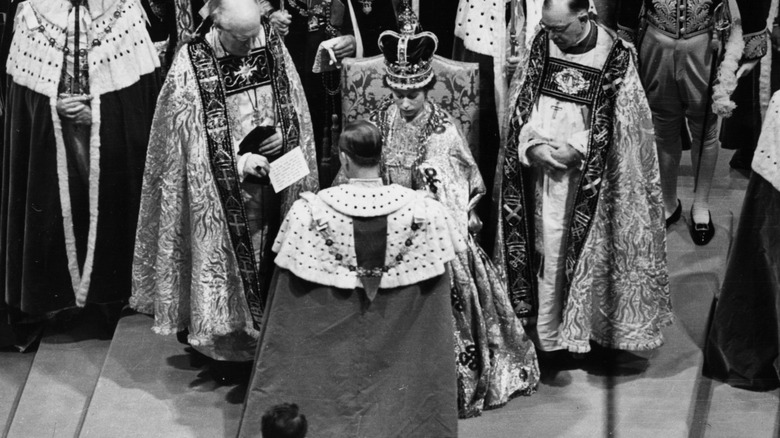
Prince Philip might not have been perfect, but he never wavered in his loyalty to the monarch, not even when he had to kneel before his wife during her coronation ceremony and pledge his allegiance to her. In Netflix's "The Crown," Philip is portrayed as incredibly upset about having to do this, but in real life, he had no qualms, according to royal biographer Hugo Vickers. "Prince Philip was actually perfectly happy to kneel before his wife, he was brought up as a member of the Greek royal family and he knew the rules from day one," Vickers told Business Insider. "And that sort of thing didn't concern him at all, he's a big enough man to take it in his stride."
Not only that, but Philip also headed the Coronation Committee, and he was the one who ensured the event was broadcast on TV. After his wife officially became the new queen of England, Philip did what was expected of him, and he channeled his own passions in the patronages he took on. "[Philip] resolved to support his wife while finding his own niche," Sally Bedell Smith wrote in "Elizabeth the Queen: Life of a Modern Monarch."
Philip did all of this despite being incredibly depressed by his new role, according to close sources who spoke to the Independent in 1992. Giving up the future he'd envisioned before Queen Elizabeth ascended to the throne was by no means easy for him, but he still did it. As he wrote in a letter to his mother at the time, per The Sun, "Lilibet is the only thing in this world which is absolutely real to me and my ambition is to weld the two of us into a new combined existence."