

'90s Rockstars Who Are Barely Recognizable Today
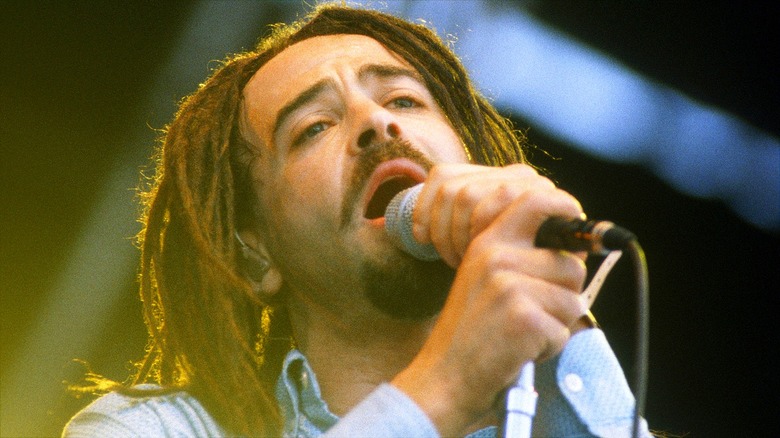
The 1990s was a decade of renaissance for rock music. By the end of the 1980s, punk had flamed out, new wave had played out, and once-groundbreaking artists such as Eric Clapton, Elton John, and Rod Stewart had steered straight to the middle of the road, churning out AOR pop hits that served as the sonic background for grabbing a latte at Starbucks. Then along came Nirvana, catapulting Seattle's underground grunge scene to the forefront of pop culture, while opening the door for a veritable army of bands following in their wake, a lengthy list including the likes of Soundgarden, Alice in Chains, Stone Temple Pilots, and more. Meanwhile, other genres blossomed, from hip-hop and alternative rock to Britpop and the riot grrrl movement. While grunge ultimately gave way to a tsunami of pop led by the Backstreet Boys and Britney Spears (and let's not forget Hanson's ubiquitous ear worm "MMMbop"), the legacies of revolutionary '90s rockstars live on.
Pearl Jam, for example, remains a top concert draw, as does Foo Fighters, the now-iconic group founded by Nirvana drummer Dave Grohl following the death of Kurt Cobain – one of the many celebs who sadly passed away before 30. In fact, many bands that came to prominence in the 1990s continue to record and perform — although, to be fair, anyone who'd last seen these groups back in their 1990s heyday may have a tough time pointing them out in a police lineup. For further proof, take a look at some '90s rockstars who are barely recognizable today.
Former Nirvana bassist Krist Novoselic
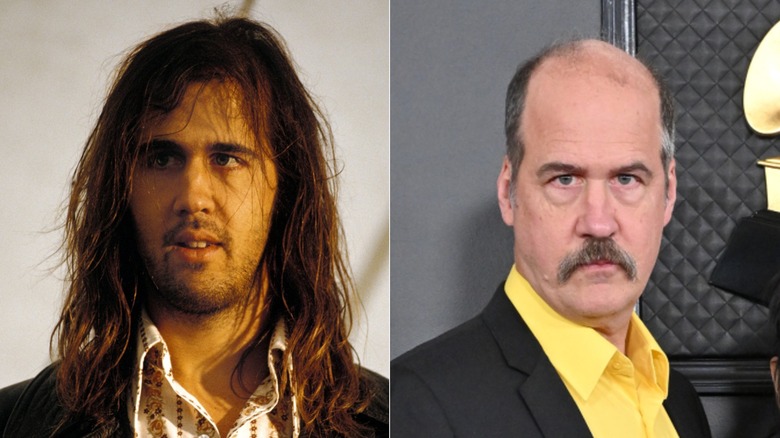
When Nirvana burst on the scene with the mega-hit 1991 album "Nevermind," the lineup consisted of Kurt Cobain on guitar and vocals, Dave Grohl on drums, and Krist Novoselic on bass. In the wake of Cobain's 1994 suicide, the success of Grohl's 1995 "Foo Fighters" album (on which Grohl played all the instruments) propelled him from drummer to frontman of one of the most successful rock bands in the world — all while Grohl struggled to cope with Cobain's death.
Novoselic moved on as well, following his own musical muse to form Sweet 75 in 1997. He shifted gears in 1998 to direct his first film, the quasi-documentary "L7: The Beauty Process," focusing on all-female rockers L7. In 2002, he returned to music with rock trio Eyes Adrift. "It's been fun for us to get back to playing music," Novoselic told Rolling Stone at the time. After Eyes Adrift folded, Novoselic joined another band, Flipper, in 2006.
Novoselic reunited with Grohl to play bass and accordion on the Foo Fighters' 2011 album, "Wasting Light," and joined Grohl in 2012 to back up Paul McCartney on his single "Cut Me Some Slack," which featured in the soundtrack of Grohl's documentary, "Sound City." (Novoselic jokingly dubbed the trio "Sirvana," riffing on Sir Paul's knighthood). Subsequent projects have included the band Giants in the Trees — which he founded in 2017 and disbanded a few years later — and another band, 3rd Secret, which released its second album in 2023. Through it all, Novoselic has been engaged in political activism; In 2024, he formed a new political party, the Cascade Party, and gathered enough signatures to launch a presidential campaign.
Smashing Pumpkins founder Billy Corgan
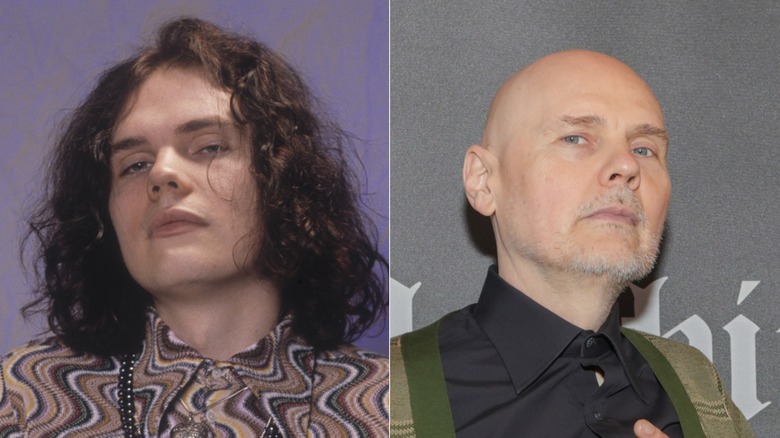
Billy Corgan founded Smashing Pumpkins in 1988, with the band breaking through into the mainstream on the strength of the 1991 debut album, "Gish," and its follow-ups, 1993's "Siamese Dream," and 1995's "Mellon Collie and the Infinite Sadness." Initially, the band consisted of Corgan on guitar and vocals, James Iha on guitar, D'arcy Wretzy on bass, and Jimmy Chamberlin on drums. As fans know, Corgan has remained pretty much the only constant in the band, which has seen a dozen members come and go throughout the past few decades.
Corgan has also altered his look over the years. He boasted curly, shoulder-length hair when the band first emerged in the early 1990s, but these days Corgan embraces a shaved-head style, not dissimilar to that of Uncle Fester in "The Addams Family." That said, Corgan told Spotify's "Best Advice" podcast that his physical appearance had never been a factor in the band's success anyhow. "For whatever reason, when I was younger, I was not considered good looking," he said (via Consequence.) "So, my looks were not part of anybody's formula as far as the success of the band ... Photographers would try to stick me in the back of photo shoots with the band."
In 2018, Corgan announced plans to reconstitute the original Pumpkins lineup (sans D'Arcy, with whom he'd been on the outs for years). In 2025, Corgan and the Pumpkins performed the "Melon Collie" album in its entirely, backed by a 60-piece orchestra. Meanwhile, Corgan took on a side gig in pro wrestling; in 2011, he co-founded the Resistance Pro independent wrestling league. He also became a senior producer for TNA Wrestling in 2015 and then purchased the National Wrestling Alliance (NWA) in 2017.
Trent Reznor of Nine Inch Nails
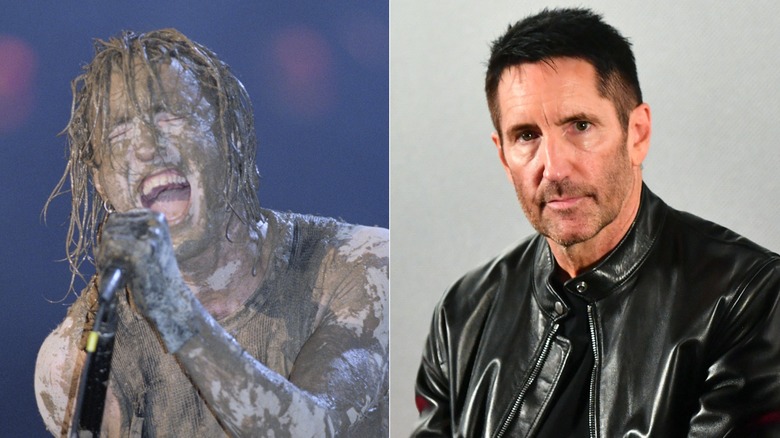
Since its formation in the late 1980s, the band Nine Inch Nails (NIN), led by frontman Trent Reznor, has popularized the industrial rock genre. Throughout the 1990s and 2000s, Reznor and NIN remained a musical force to be reckoned with, producing such critically acclaimed albums as 1992's "Broken" and the 1994 masterpiece, "The Downward Spiral." In 2009, Reznor announced that he'd decided that a hiatus was in order. "I've been thinking for some time now it's time to make NIN disappear for a while," he wrote in a now-vanished message posted on the band's website (via Pitchfork).
While Nine Inch Nails had been placed on pause, Reznor's musical pursuits had not. For his next project, Reznor launched a lucrative career as a movie composer, creating the score for the 2009 feature "The Social Network" in collaboration with NIN producer Atticus Ross. Other scores followed, including such films as "The Girl with the Dragon Tattoo," "Gone Girl," "Patriots Day," "Bird Box," and "The Gorge," along with Ken Burns' 2017 docuseries "The Vietnam War" and the acclaimed HBO series "Watchmen."
Meanwhile, Reznor and Ross have occasionally dipped back into the old band. For instance, Reznor announced his return to NIN in 2024, with the band going back on the road for the Peel It Back tour, which runs from 2025 through to 2026. He's also focusing on achieving a better work-life balance. "There's this romantic idea about living in your studio every minute of the day and just making art," Reznor told The Talks. "I've lived that life for a while, and I'll give you a spoiler: It doesn't lead to happiness."
Michael Stipe of R.E.M.
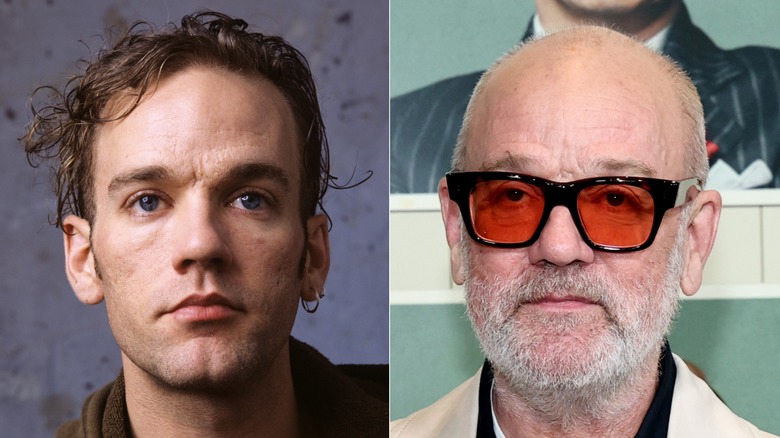
Emerging in the early 1980s, R.E.M. were darlings of the alternative music scene throughout the rest of the decade before hitting it really big in the late '80s with such hits as "It's the End of the World As We Know It (And I Feel Fine)," "Stand," and "The One I Love." That streak of success continued into the 1990s, growing even bigger with "Losing My Religion," and "Shiny Happy People."
R.E.M. maintained its popularity until disbanding in 2011. "It was very sad," R.E.M. frontman Michael Stipe told Classic Rock. "Of course, it was very bittersweet and not an easy decision for us to arrive at. But looking back, I can speak on behalf of everyone, we made the right choice and we did the right thing." After the band's breakup, Stipe recorded a few singles and has been working on a solo album — which, as of November 2025, has yet to see the light of day.
Like other '90s rockers, Stipe underwent a big change in his looks around 2017, when he grew a long, grey beard — a look he celebrated with a selfie of his bearded mug posing next to a photo of another bushy beard aficionado, David Letterman. Stipe subsequently abandoned that particular style and began keeping his beard neatly trimmed, while closely cropping his receding hair.
Red Hot Chili Peppers frontman Anthony Kiedis
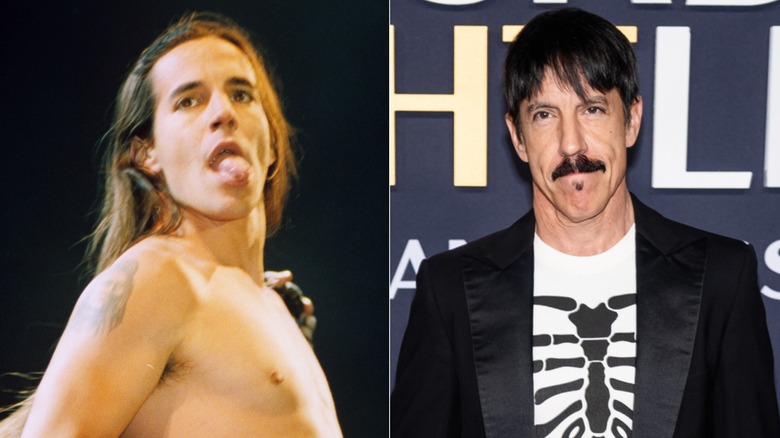
With a dance-friendly combination of funk and rock, Red Hot Chili Peppers entered the 1990s with a bang. The 1991 album "Blood Sugar Sex Magik" yielded the band's first No. 1, "Give It Away," followed by the ballad "Under the Bridge." The band exited the decade on a high note as well, courtesy of the 1999 "Californication" album. Throughout the entire decade, frontman Anthony Kiedis rocked the same look — typically shirtless (and occasionally sans pants), with long, blond hair that was often topped by a baseball cap worn backward. His signature look, however, changed radically at the end of the 1990s when he cut his hair, frequently styling into a mohawk.
A few years later, Kiedis' long locks made a comeback, but this time they were dark brown instead of beachy blond. By the start of the 2010s, Kiedis' hair returned to its '90s length, accompanied by a moustache, before he cut it short once again. That then morphed into what GQ described as a "reverse mullet," a short-in-the-back, shaggy-in-the front 'do that recalled Moe from The Three Stooges.
Through it all, the moustache — black as that of a silent film villain — remained a constant. In 2011, Red Hot Chili Peppers drummer Chad Smith noted that he and his fellow Peppers had become aware of a website devoted to convincing Kiedis to shave it off because it made him look like "a Mexican porn star," as he told 1Live, a German radio show. During the interview, Kiedis — his hair styled in an asymmetrical 'do of the type once favored by Kate Gosselin of "Jon & Kate Plus 8" fame — revealed his facial hair had a name. "It's called the Shaker Duster," he said, collapsing into laughter.
Tool singer Maynard James Keenan
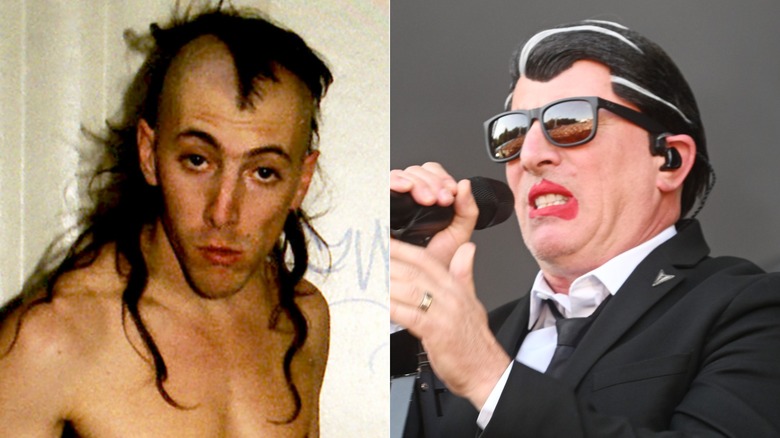
Formed in 1990, Tool was and continues to be fronted by singer Maynard James Keenan. Signed to a record label after just seven gigs, the band — which blended metal and prog-rock elements — went on to gain legions of fans via 1990s-era albums such as "Opiate," "Undertow," and "Ænima." It's fair to say that Keenan's look has changed considerably since the band first began, when the singer sported a hairstyle that was long in the back and shaved on the sides, with a shock of hair remaining in the middle. In the years since that, he's been prone to wearing outlandish costumes onstage. "It stems initially from an insecurity of just being able to express yourself and ... something to hide behind a little bit while you're trying to figure out who the f*** you are," Keenan told Consequence.
Of course, costumes aren't the only things that changed in Keenan's life. He also become a winemaker through his own winery, Caduceus Cellars. For Keenan, making wine provided an opportunity to engage his creativity in the same manner as music. "Possibilities. Flexibilities. Creating something from nothing. Thinking outside the box," he told Food and Wine Aesthetics in 2016, insisting that his wine actually captured his personality better than Tool's music in that his own personal musical tastes lean more toward The Byrds and Joni Mitchell than the music his band produces. "I think that shows in my wines," he added. "My wines are far more Pink Floyd than they are Metallica."
Chris Robinson of The Black Crowes
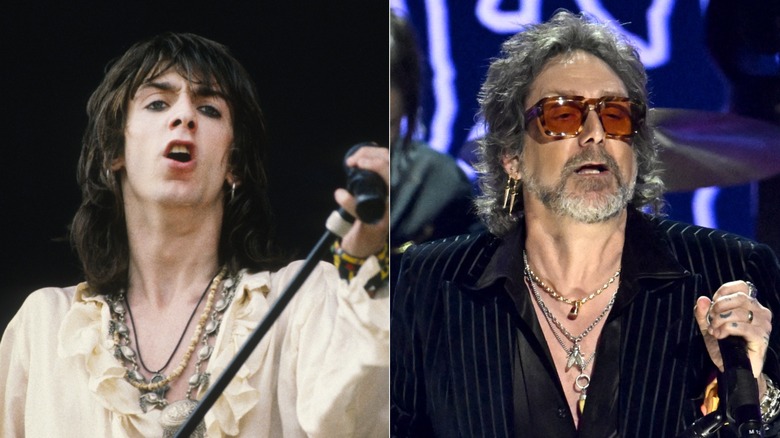
With Chris Robinson on vocals and his brother Rich Robinson on guitar, The Black Crowes announced themselves in grand fashion with their 1990 album "Shake Your Money Maker," a Stones-influenced collection of rock that could have easily blared from transistor radios 20 years earlier. The success they experienced during the 1990s, however, was offset by the brothers' bickering and battling, which ultimately led to the band's bitter breakup in 2015.
Chris had already experienced another breakup when his marriage to movie star Kate Hudson ended in divorce in 2007, seven years after they'd wed. (Chris and Hudson's son Ryder Robinson has undergone a major transformation since his parents' split). With The Black Crowes on ice, Robinson focused on his side project, Chris Robinson Brotherhood, which produced jam-band music more akin to the Grateful dead than the Crowes. During that period, the music was reflected in his style, with Robinson wearing his shoulder-length hair long and shaggy, accompanied by a thick, bushy beard. As for his stage attire at that time, it was typically casual and heavily denim-oriented.
When the Robinson brothers buried the hatchet and reunited The Black Crowes in 2019, fans who went to see them in concert witnessed a very different singer, now sporting dapper pin-striped suits, shorter hair, and a neatly trimmed beard. "We are The Black Crowes. Yes, we've survived all sorts of stuff," Chris told Spin of his tumultuous history with Rich. "But one thing Rich and I have in common is that we were both outsiders, and that rock and roll is the place that we found ourselves."
Adam Duritz of Counting Crows
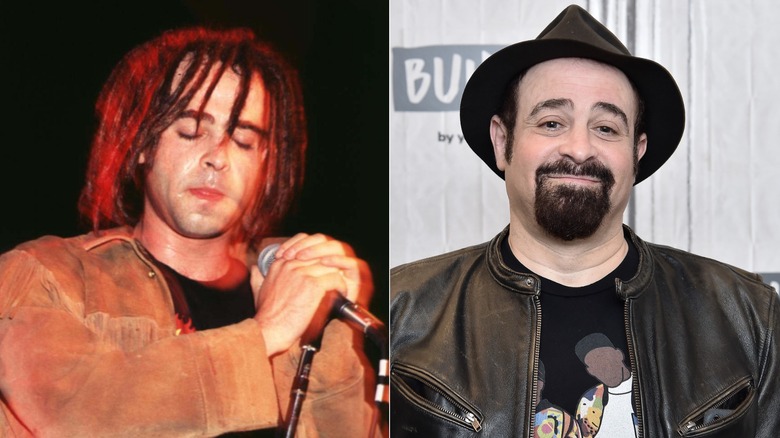
Released in the fall of 1993, Counting Crows' debut, "August and Everything After," became a monster hit. The album went on to sell in excess of 8 million copies on the strength of hit singles such as "Mr. Jones," "Rain King," and "'Round Here." Lead singer Adam Duritz was easy to spot, with his long dreadlocks sometimes spilling out of a hat or even piled atop his head. He was also quite the Hollywood ladies' man, holding the distinction of being the only rockstar to have romantic entanglements with two "Friends" stars – the smooth rockstar dated both Courteney Cox and Jennifer Aniston. Duritz also revealed
Duritz's dreads remained his signature hairstyle for decades — until 2019, when he abruptly chopped them off. "I'd been thinking about it for a while. I was just getting tired of it," Duritz told SiriusXM in 2019. While staying with a friend in London, he made up his mind, grabbing a pair of scissors and heading for the bathroom. His girlfriend asked him whether he needed any help. "I thought, 'No, I'm not sure how this is gonna turn out, and I don't want to blame anybody else,'" he recalled. He sliced them off entirely, and then revealed where his famed dreads now reside. "They're in a bag in his house," said Duritz, referring to his friend's U.K. residence. There was, however, one unexpected consequence: "The next morning, when I walked outside, my head nearly fell off from being cold."
Blur singer Damon Albarn
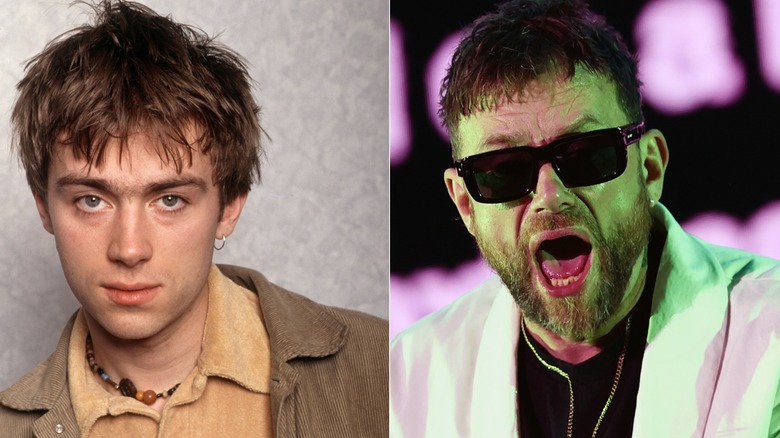
With the 1991 debut of "Leisure," Blur was one of the architects of the so-called "Madchester shoegaze" sound. Bigger success awaited, however, when the band propelled to stardom with a sound dubbed Britpop, exemplified on their trio of subsequent albums: "Modern Life Is Rubbish," "Parklife," and "The Great Escape." Singer Damon Albarn was at the forefront of the BritPop scene, a reaction to the sonic misery of grunge, burning bright before it, too, faded away. Albarn, with his shaggy hair and smart clothing, embraced a neo-Mod look before taking on a more casual appearance, gravitating toward skateboard style and streetwear.
Blur broke up in 2003 before reuniting in 2009, performing together on and off in the years that followed. Albarn then pursued a solo career and was the visionary behind Gorillaz, the virtual cartoon band responsible for hits such as "Clint Eastwood," "Dirty Harry," and "Feel Good Inc." These days, Albarn travels between his U.K. residences and his house in Iceland, where he was officially granted citizenship in 2021.
Albarn's style evolved when he hit middle age, leaning toward tailored suits and closely-cropped hair, which is accented by a short beard. He also prefers to keeps to a strict routine that varies little from day to day. "It's not very rock 'n' roll, is it?" he told The Guardian in 2014. "But I need routine. It's just the way I'm wired ... And I hate doing things that disrupt my routine. It's hard to get back into the swing if your day is disrupted."
Fred Durst of Limp Bizkit
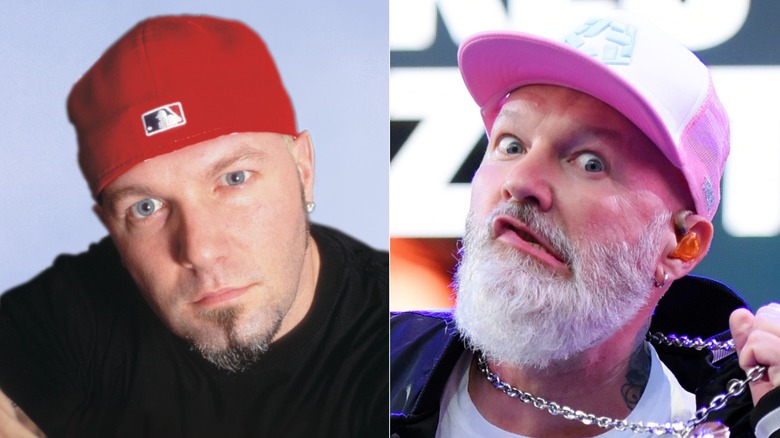
Limp Bizkit was at the forefront of the Nu Metal scene that emerged in the mid-1990s, melding heavy metal, alt-rock, and hip hop for a uniquely tantalizing sound that attracted millions of fans. Frontman Fred Durst, with his gold chains, baggy shirts and close-cropped hair, sang lead vocals on such fan favorites as "Nookie," "Rollin'," "N 2 Gether Now," and "Behind Blue Eyes." At the height of his fame, Durst reportedly even dated Carmen Electra, the '90s icon.
While still maintaining ties to Limp Bizkit, Durst went on to a successful side hustle as a movie director and actor. His onscreen credits include TV medical drama "House," as well as films such as "Sorry, Haters" and "I Saw the TV Glow." After directing numerous Limp Bizkit music videos, Durst took his skills behind the camera to Hollywood, directing "The Education of Charlie Banks," "The Longshots," and "The Fanatic."
Durst has since settled into middle age like the rest of his '90s contemporaries, but he returned to his Bizkit persona courtesy of the 2024 film "Y2K," in which he played the circa-1999 version of himself. When he was first approached about portraying his former self, Durst admitted he was dubious. "I go: 'How is that going to be possible? I don't look 29 years old, I'm 50 freaking four years old,'" he told Dazed at the time. However, the film's makeup artist, Christopher Milone, worked his magic. "Without giving too much away we shaved his facial hair into his iconic soul patch look from '99 and colored him in," Milone explained. "That alone can take years off."