

The Spiciest Celebrity Looks Of The 1970s
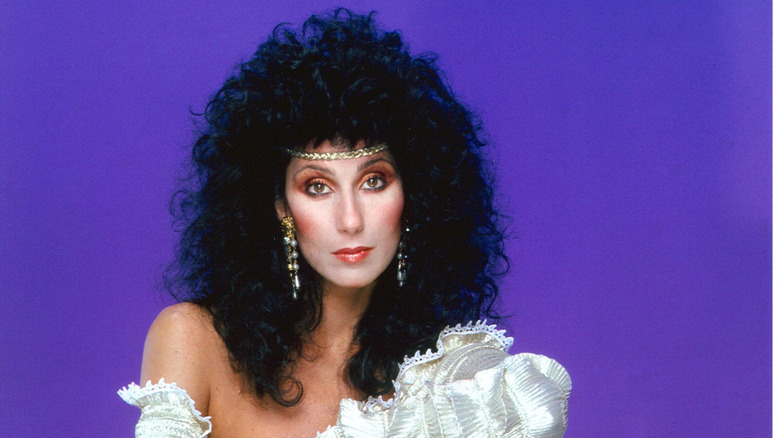
The 1970s were a deeply transformative — not to mention groovy — time in history. This decade brought us culture-defining moments like Roe v. Wade, the gay liberation movement, and the Watergate scandal. It also saw the rise of legendary music genres, including disco, punk, and new wave. In terms of fashion, the '70s completely rewrote the rules: Times were changing rapidly, and society no longer valued modesty the way it had in previous decades. Thus, fashion became more sexy, elaborate, and fun. Likewise, as more women entered the workforce, trousers and pant suits became popular womenswear staples. Spearheaded by couturieres like Halston and Stephen Burrows, '70s fashion was all about rich fabrics, bold patterns, and sparkly accents. And, much like today, style trends were heavily influenced by the celebrities who wore them best.
The '70s featured a cornucopia of celebrity-endorsed looks, from Farrah Fawcett's blonde blowout to Pam Grier's chic dagger collars. This truly was a decade of endless sartorial possibilities — as such, some celebrities saw it as a chance to push the boundaries of what was acceptable. In some cases, these zesty fashion moments became legendary in their own right, but many of the celebs involved faced serious backlashes over their risqué fashion statements. So, button up your hotpants as we revisit some of the spiciest celebrity looks of the 1970s.
David Bowie wore a revolutionary dress
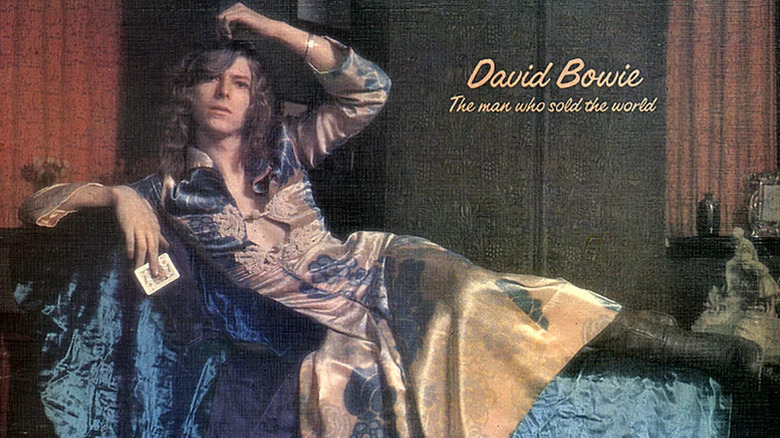
The 1970s marked a thrilling new era in fashion. Not only did the decade spawn trends like bellbottoms, peasant blouses, and platform shoes, but it also shattered old norms around fashion and gender. Modesty standards began to fade, granting women the opportunity to wear pants and show off their midriffs. Likewise, men's fashion gained a more androgynous edge as fitted silhouettes and ruffly garments rose in popularity. These changes didn't happen in a vacuum, though — they were boosted by celebrities like David Bowie, who helped introduce gender-fluid fashion into the mainstream.
In 1971, Bowie wore a grey A-line dress on the British cover of his album, "The Man Who Sold the World." David Bowie famously adopted numerous looks throughout his career, but this was undoubtedly one of his spiciest yet. It was also one of his most influential, having paved the way for other dress-wearing luminaries like Harry Styles, Lil Nas X, and Billy Porter. Unfortunately, heteronormative attitudes were prevalent and deep-rooted among many in the '70s, and Bowie faced backlash against his androgynous style. In 1971, a man reportedly threatened the singer and called him a homophobic slur when he wore a dress during a visit to the United States.
Despite being heralded as a style icon, Bowie was nonchalant about his wardrobe. "I never really had much of an interest in fashion," he told Complex in 2003. "I think that my fascination with clothes generally was motivated by trying to create the characters for the stage."
Mick Jagger's bodysuit left little to the imagination
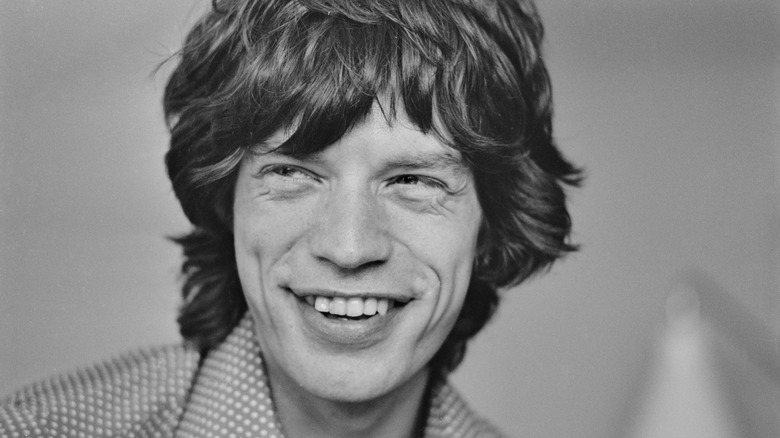
One thing that hasn't changed much since the 1970s is the concept of celebrity worship. Long before the rise of fandoms like Swifties and the Beyhive, rock legend Mick Jagger was one of the world's most fawned-over celebs. Jagger soared to fame in the mid-'60s alongside his band, The Rolling Stones — and in 1971, the rocker married his now ex-wife Bianca Jagger, with the pair instantly becoming one of the most iconic celebrity couples of the 1970s. Jagger was considered a fashion icon who relished in pushing the envelope with his bold outfits. And one of his spiciest fashion moments occurred in 1973, when the "Paint it Black" singer wore a head-turning bodysuit.
The infamous bodysuit comprised of white velvet and diamond-shaped patterns, and it featured a plunging neckline that opened across the chest and stomach. It was also so tight that it clung to his skin like masking tape. Being especially snug around the pelvis, it left spectators with a pretty detailed view of his crotch. Speaking with Another Man in 2018, Mick revealed that the velvet bodysuit was actually quite practical. "First, it was a really comfortable outfit to wear onstage," the singer shared. "It was like I had almost nothing on. It was really sexy and clingy, but it was very easy to move in."
Cher's naked dress was the talk of the Met Gala
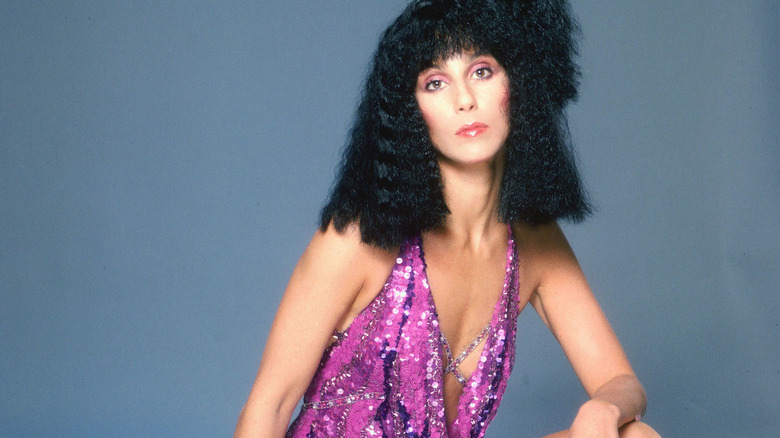
The stunning transformation of Cher started in the mid-'60s, when she co-founded the pop duo Sonny & Cher. Since then, the singer has continued to reinvent herself with each passing decade. From her chic maximalism in the '80s to embracing goth glam in the '90s, you might be inclined to think that Cher can do no wrong when it comes to fashion. In the 1970s, however, the pop diva wore a sheer naked dress that sent critics into a frenzy.
Cher donned the infamous naked dress, which had been created by legendary designer Bob Mackie, while attending the 1974 Met Gala. The barely-there frock was completely sheer with dramatic, feather-encrusted bell sleeves. On the bodice, swirls of gems and sequins served to (barely) cover up the singer's goodies. Speaking with Interview Magazine, Mackie recalled how the dress became the focal point of the evening. "The place went crazy," he said (via People). "I've never seen so many photographers just come out of the shadows at the Met and take her picture."
Nowadays, runways and red carpets are peppered with skin-flaunting naked dresses, but in 1974, Cher's "Full Monty" moment was deeply controversial. "People were horrified," Mackie explained. "They thought, that's not fashion, she's just naked at the Metropolitan." Ultimately, this nude ensemble went down in history as one of the most daring outfits ever worn by Cher.
This cutout dress was spicy and comedic on Mary Tyler Moore
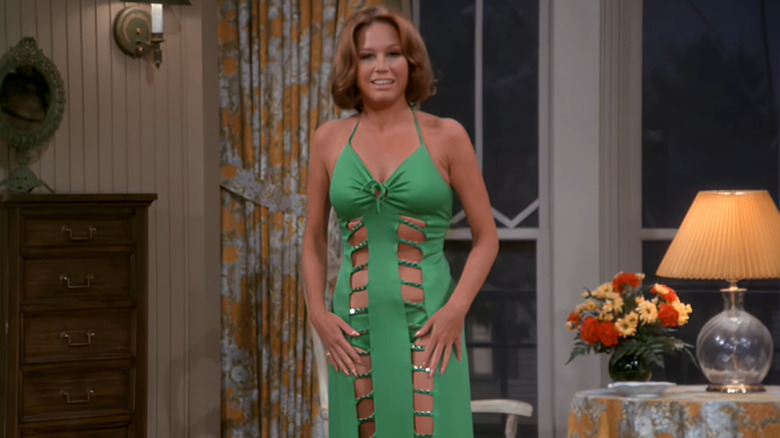
The 1970s were a pivotal time for women's rights. As more women opted to work outside of the home, feminists fought for access to job opportunities with equitable pay. When "The Mary Tyler Moore Show" premiered in 1970, the series quickly became a symbol of the feminist movement. Actor Mary Tyler Moore starred in the series as Mary Richards, a single woman with a thriving journalism career — a stark contrast to the barrage of mothers and housewives that populated TV shows at the time.
Feminist themes quickly became a throughline for "The Mary Tyler Moore Show," which broached such topics as dating, sexuality, and body image. Alongside these radical themes, the series also delivered one of the spiciest fashion moments of the decade. In an episode from 1975, Moore donned a green halter dress with a trail of cutouts from the bustline to the knee. She finished the look with a pair of matching panties that peeked through the cutouts. While this dress may seem tame by today's standards, it was quite shocking to viewers in the '70s. Production was clearly aware of this fact, too, as the dress was used as a comedic tool rather than a morsel for the male gaze. During the scene in question, Mary accidentally wears the dress in front of her older male co-worker and tries, unsuccessfully, to hide from him.
Tim Curry pushed boundaries in his Dr. Frank-N-Furter costume
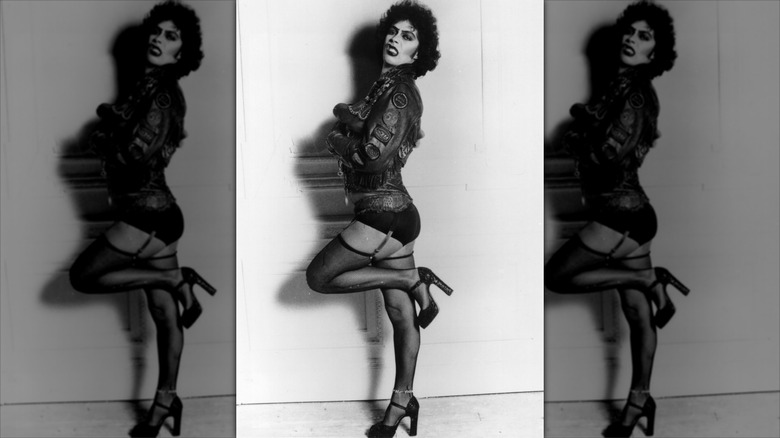
Back in 1973, British playwright Richard O'Brien launched "The Rocky Horror Picture Show." The play centered around an uptight couple whose lives get turned upside-down when they meet Dr. Frank-N-Furter, a demented, sexy scientist who hails from Transexual, Transylvania. The show quickly amassed a fanbase in London, and by 1975, it had been adapted into a motion picture. In the movie adaptation, Dr. Frank-N-Furter was portrayed by legendary actor Tim Curry, who was decked out in a glittery corset with matching underwear, a garter belt, and platform heels. He finished the look with full drag makeup that featured smoky eyes and a red pout.
Drag wasn't completely unheard of in the 1970s, but it wasn't exactly mainstream either. Heteronormative attitudes were also rife during this time, and some critics found Curry's drag performance to be shocking and obscene. Notably, at the time of its premiere, the movie was a total commercial failure. "The Rocky Horror Picture Show" experienced a renaissance in the early '80s, however, and it's now considered to be one of the greatest cult films in history. Speaking with CBS Morning News in 2025, Curry shared that he's incredibly proud of the film's legacy. "He had a lot of power, Frank," the actor explained. "He gave a lot of teenagers permission to be different, and I'm very happy that he did have that power."
Stevie Nicks raised eyebrows in this all-black ensemble
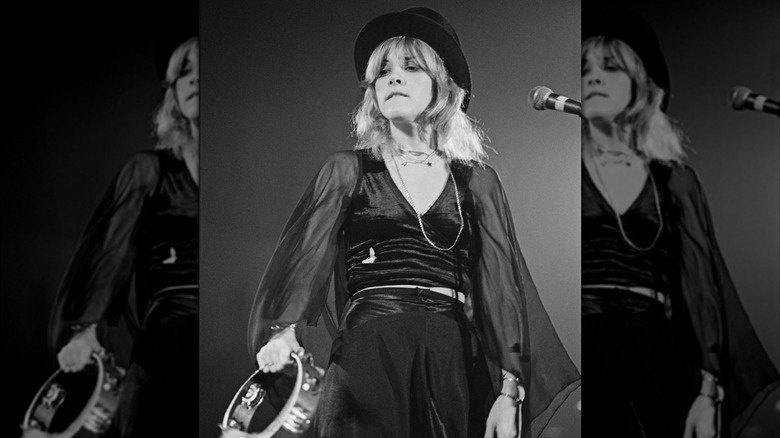
Some 1970s celebrities have managed to transcend time itself, and Stevie Nicks is undoubtedly one of them. The stunning transformation of Stevie Nicks began in 1974, when she joined Fleetwood Mac. In 1975, the group released their self-titled album, which catapulted them to stardom. Amid all the touring and songwriting, Nicks also honed in on her personal style, which included flowy dresses, wispy shawls, and hefty amounts of black fabric. Nicks' wardrobe landed her somewhere in the glorious space between boho and goth; according to critics, however, there was something spooky about her style of dress. After a while, rumors began swirling that Nicks might be an actual witch.
It didn't help Nicks' case when, in November 1975, she went full witch-glam while performing at Yale Coliseum. On this occasion, the singer donned a black velvet wrap top with sheer sleeves. She paired the look with a dark hat and dusky skirt. Speaking with the Los Angeles Times in 2014, Nicks explained that she only chose black clothing because it complemented her figure. "In the beginning of my career, the whole idea that some wacky, creepy people were writing, 'You're a witch, you're a witch!' was so arresting," the singer said. "I stopped wearing black for like a year. Then I was just like, 'OK, just bring it freaks. I'm not going to wear apricot. You think whatever you want because I'm going to wear my beautiful, long black dress.'"
The Tina Turner flame dress is a pop culture icon
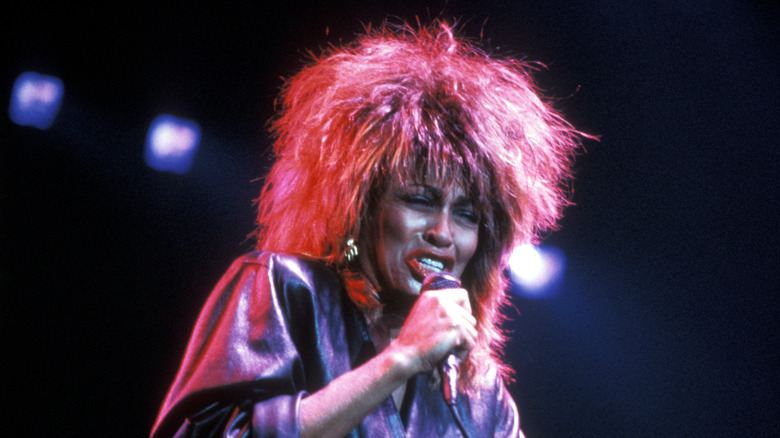
The 1970s were a golden age for rock and roll, and Tina Turner was at the forefront of it all. Dubbed the Queen of Rock 'n' Roll, Turner was known for her rich voice and charismatic stage presence. She was also a standout in the fashion world thanks to her elaborate costumes. Her signature style included bold dresses with asymmetrical hemlines that crept up to her hip crease, and during her dance numbers, the "Proud Mary" singer was a majestic blur of fabric and sequins. Turner worked closely with legendary fashion designer Bob Mackie, who helped the rock diva cultivate her iconic look. With Mackie's help, Turner pulled off one of her spiciest looks ever: a colorful, glitzy frock with a flamelike design. Dubbed the "flame dress," it featured a sheer bodice with dazzling red and orange panels.
Today, Turner's flame dress is so iconic that it continues to live on in pop culture, with stars such as Cher, Beyoncé, and RuPaul all paying tribute to Turner by wearing remakes of the dress. In a 2024 interview, Mackie revealed that Turner had played a major role in designing her wardrobe. "She would buy cheap evening gowns in Paris in these little shops. And they weren't great, but she'd like the fabric and bring it in," Mackie stated in the documentary "Bob Mackie: Naked Illusion" (via People). "And we would redo these funny inexpensive evening dresses into Tina Turner outfits."
Vivienne Westwood angered the media with her anti-monarchy shirt
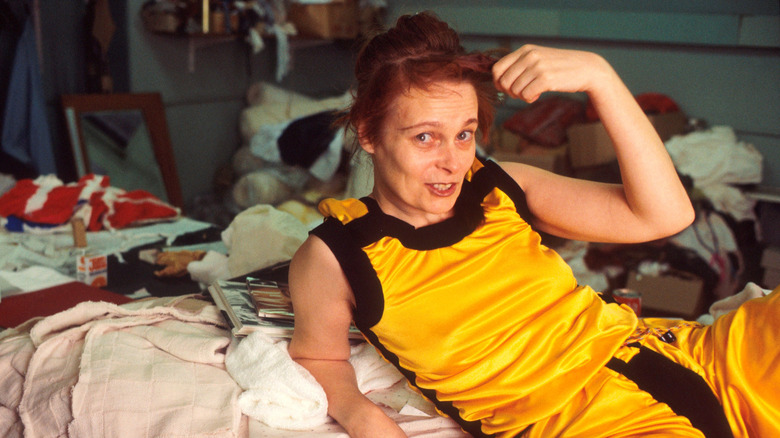
Vivienne Westwood joined London's punk scene in the 1970s when she became the unofficial designer for the Sex Pistols. While most fashion designers were creating sleek, clean-cut garments, Westwood leaned into subversiveness, experimenting with crude designs, distressed fabrics, and oddball accessories. Eventually, Westwood would go on to become one of the world's most prolific couturiers — but her designs didn't always resonate with the public. In 1977, the fashion mogul sparked controversy when she created a shirt based on the image of Queen Elizabeth II.
The offending garment was a gauzy, distressed t-shirt that featured a portrait of Queen Elizabeth with a safety pin imposed over her mouth. Around the image, Westwood had scrawled the lyrics from a Sex Pistols song: "God save the Queen, she ain't no human being." In response, the media slammed Westwood for her apparent anti-monarchy stance. Speaking with CBS in 2016, Westwood recalled, "For many years, the newspapers thought of me as unwearable, nothing to do with fashion." Over time, however, Westwood's worldview shifted, and she became more supportive of the monarchy. In 2006, she was even appointed a dame by Queen Elizabeth herself. "At one time, I thought of her as a symbol of all our hypocrisy," Westwood told CBS. "I think the queen is a wonderful asset and is like social cement."
Grace Jones had to improvise her outfit after her audience went awry
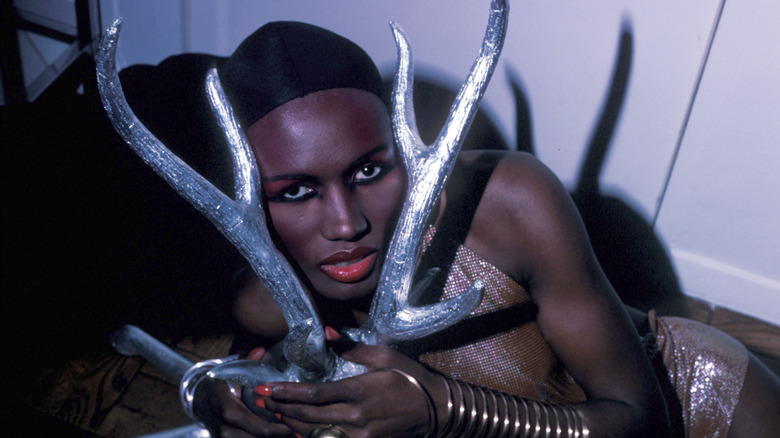
When it comes to entertainment, Grace Jones wears many hats. Not only is she an accomplished singer, but she's also a movie star, performance artist, and model. Her fashion legacy is unparalleled too, thanks to her penchant for bold silhouettes, artistic accessories, and subversive looks. Jones signed her first modeling contract in 1965 and quickly found her way into high society. By the end of the decade, her inner circle featured pop culture titans like Keith Haring, Andy Warhol, and fashion designer Yves Saint Laurent.
In 1978, Jones was performing at the iconic Le Palace in Paris when the crowd got aggressive. "The people were wild," she recalled to Interview Magazine in 1984. "The audience ripped off my clothes. I was stark naked." Luckily for Jones, Yves Saint Laurent was also in attendance that night, and he rushed to her aid. Jones' costume was destroyed, but Saint Laurent managed to scrap together a new outfit using some accessories he had on-hand. Jones recalled, "Yves took LouLou's [de La Falaise] scarf and wrapped it around my waist, and he took off his belt, put it around my breasts and carried me back out on the stage."
In a photo from that evening, Jones can be seen wearing the improvised outfit while finishing up her performance. A cinched across her chest and she wears a sheer, knitted scarf tied around her waist. In typical Jones fashion, the outfit looks abundantly spicy on her — yet also incredibly chic.