

What Is The 'Pentagon Pizza Index' & Why Does Pete Hegseth Care? The Theory, Explained

With elevated global tensions seemingly a never-ending feature of Donald Trump's second presidential term, which has led even MAGA diehards to turn on him, you may have noticed chatter online about the "Pentagon Pizza Index," which purports to be able to predict precisely when something big is about to go down. But how exactly does it work and, for that matter, why does U.S. Secretary of Defense Pete Hegseth seem to care so much about it? Well, the so-called "Pentagon Pizza Theory" suggests that an abnormally high amount of pizza orders (any food orders, really, but pizza is the most common) near major government buildings like the White House or the Pentagon itself can be a telltale sign that significant military action or some other newsworthy development out of Washington, D.C. is either imminent or actively playing out.
Typically, these large orders would imply an "all hands on deck" sort-of scenario. Examples of the Pentagon Pizza Index in action date back to at least 1983, when pizza orders in D.C. spiked ahead of the U.S. invasion of Grenada. Extraordinarily high pizza sales were similarly reported in 1990, as government agencies monitored Iraq's invasion of Kuwait, which led to the Gulf War. Modern examples include the more recent military operations in the Middle East and Latin America, while non-military examples comprise the influx of pizzas ordered to the White House amid the 1995-1996 government shutdown and the subsequent fallout of the Bill Clinton-Monica Lewinsky scandal.
These days, there's even a website where just about anyone can keep track of the pizza orders in and around Washington. But because he apparently has nothing better to do, Hegseth really wants to mess with it, just to spoil any potential good times.
Pete Hegseth wants to try and deliberately throw off the Pentagon Pizza Index
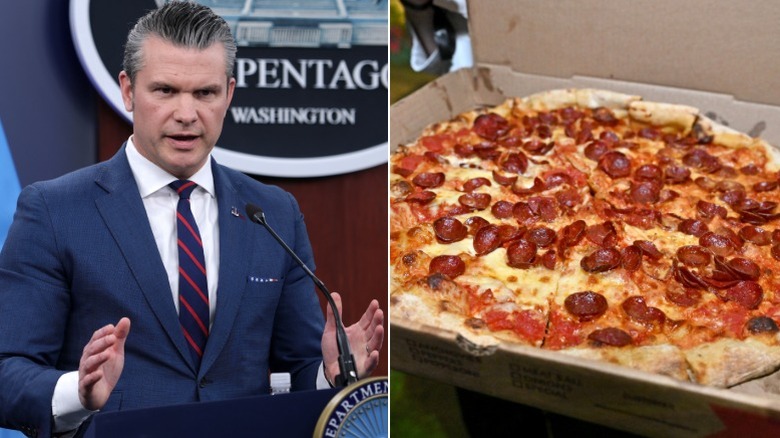
The Pentagon Pizza Index website uses online data to provide a real-time look at just how busy the various pizza restaurants around the Pentagon are at any given time. The site uses its own DEFCON system, cleverly named "DOUGHCON," to signal how likely a major military development is based on the volume of pizzas being ordered at any given time. As it further explains, "One place spiking doesn't raise DOUGHCON — it needs several places busy together, and that pattern needs to last a few hours. If this happens multiple nights in a row, DOUGHCON stays elevated longer because it looks like a real pattern, not just a random busy night."
The site also includes a separate "Gay Bar Report," which similarly tracks how busy the establishments around the Pentagon and the White House are. This is because another observed trend suggests that on nights when an "all hands on deck" scenario is playing out, traffic at local gay bars drops sharply. When Israel launched strikes against Iran in June 2025, the Pentagon Pizza Index showed that orders were unusually high, while gay bar attendance was surprisingly low.
At any rate, Defense Secretary Pete Hegseth apparently isn't a fan of regular citizens being able to track potential military activity like this. When asked about the Pentagon Pizza Index on Fox News in February 2026, Hegseth admitted that he was considering making random large pizza orders to try and "throw everybody off," (via The Hill). Whether this is a legitimate national security concern, Hegseth being characteristically paranoid, or simply yet another symptom of the second Trump administration being terminally online is tough to say. Perhaps it's simply all three?