

Controversies That Soured Bill Gates' Reputation Beyond Repair

In the world of billionaires, Bill Gates has often set himself apart as the philanthropist billionaire. With a net worth of over $100 billion, the former Microsoft CEO remains one of the richest people in the world. However, he's also among the top philanthropists in the world, donating almost $60 billion to his charitable foundation, the Gates Foundation, formerly known as The Bill & Melinda Gates Foundation. The portion of his life and wealth that he has dedicated to improving health and education and reducing global poverty has led some to wonder whether there is such a thing as a "good billionaire."
Over the years, though, Gates experienced several major hits to his reputation. The billionaire, who normally boasts a carefully curated public persona, found himself so embroiled in controversy that he apologized to his staff at the Gates Foundation, specifically for his ties to Jeffrey Epstein, which came to light upon the Department of Justice's release of a portion of the Epstein files. The Epstein scandal has also resurfaced his past controversies. Since his earliest days as Microsoft's CEO, the billionaire has been a polarizing figure with a history of problematic behavior.
A few scandals have risen above the rest, casting Gates in a new light and tarnishing his reputation in a way that he may never recover from, regardless of his apologies and philanthropic activities.
Bill Gates appeared multiple times in the Epstein files

In early 2026, the Department of Justice released another round of files connected to convicted child sex offender Jeffrey Epstein. The files included the names of several high-profile individuals, including Bill Gates. Gates' name cropped up in 2013 emails that Epstein sent to himself, with notes detailing his decision to resign from the Gates Foundation and from Gates' think tank, B3G. The disgraced financier cited Gates' extramarital affairs as one of the reasons for his resignation. He suggested that there was a "severe marital dispute" between Gates and his then-wife, Melinda French Gates, that led to the former seeking Epstein's aid and asking him to participate in activities that may have been "illegal."
Epstein's email notes insinuated that Gates contracted an STD from his extramarital affair, writing that he provided Gates with drugs "in order to deal with consequences of sex with Russian girls." He also claimed he had arranged Gates' "illicit trysts, with married women." Another email clarifies that the drugs the billionaire allegedly sought were antibiotics that he could give to his then-wife "surreptitiously" to prevent her knowledge of the STD.
Initially, Gates denied the allegations. In a statement obtained by PEOPLE, a Gates spokesperson stated, "These claims are absolutely absurd and completely false." However, the Wall Street Journal obtained a recording of remarks from Gates to the Gates Foundation staff in which he admitted to associating with Epstein, including after the financier's conviction on soliciting a minor for prostitution, though he denied doing or seeing anything illicit.
He admitted to having two affairs during his marriage to Melinda Gates
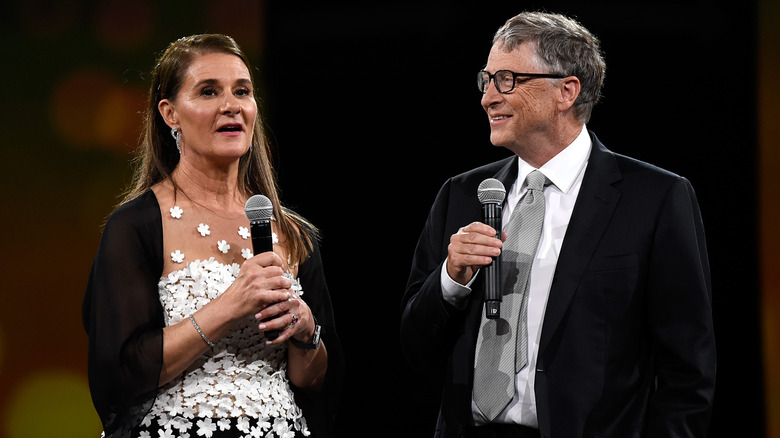
In his apology to the Gates Foundation staff, Bill Gates addressed the affair drama that destroyed his marriage to Melinda Gates after the affairs came to light in the Jeffrey Epstein files. The former Microsoft CEO confirmed two relationships with Russian women. In a recording obtained by the Wall Street Journal, he told the Gates Foundation staff, "I did have affairs, one with a Russian bridge player who met me at bridge events, and one with a Russian nuclear physicist who I met through business activities."
One of the women he had an affair with is believed to be Mila Antonova, whom the Wall Street Journal identified in 2023. She's a bridge player who met Gates around 2010 and played against him in bridge tournaments. Antonova also had ties to Epstein, whom she approached for funding to launch a business teaching people to play bridge. Later, the financier paid to put her through coding school.
The identity of the Russian physicist is unconfirmed, but it may be that of the woman whose work-related affair with Gates sparked a legal investigation. When Gates stepped down from the Microsoft board, the Wall Street Journal reported the board was investigating his relationship with a female Microsoft engineer who alleged she had a romantic relationship with the billionaire. The board hired an outside law firm to probe concerns about the relationship. At the time, a spokesperson for Gates confirmed the work affair but denied it was related to Gates' decision to step down from the board.
Microsoft co-founder Paul Allen claimed Bill Gates betrayed him
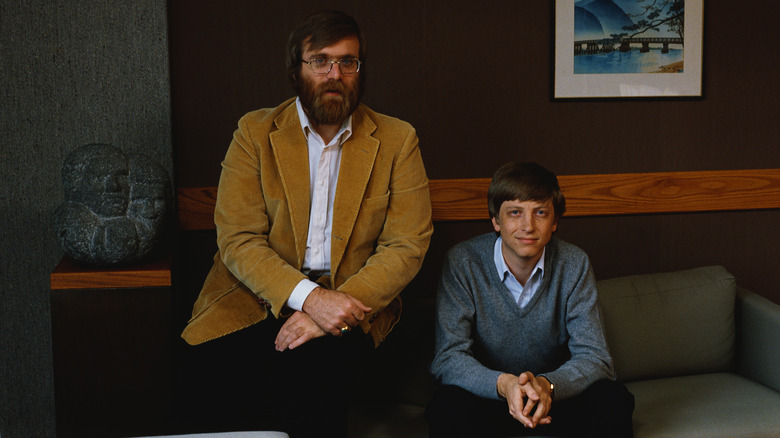
Bill Gates and Paul Allen co-founded Microsoft in 1975, but their paths within the company diverged significantly. While Gates remained CEO for 25 years, Allen left Microsoft in 1982, stepping away from day-to-day operations, though he remained on the board until 2000. His departure was partially due to health reasons, as he received a diagnosis of Hodgkin lymphoma. However, it was also partially due to his co-founder.
In the 1980s, Gates and Allen seemed like the dream team: two brilliant childhood best friends who made it big. Behind the scenes, though, things were not so ideal. In 2011, Allen published his memoir, "Idea Man: A Memoir by the Cofounder of Microsoft," providing insight into his relationship with Gates. The memoir does not paint Gates in a positive light, instead depicting him as a bully who betrayed Allen when he was at his most vulnerable. Things were precarious from the start, with Gates insisting on a 64-36 split despite Allen's initial assumption they would split the company 50-50.
The co-founders' working relationship deteriorated further when Gates brought Steve Ballmer into the business, and the pair allegedly began conspiring against Allen. After his diagnosis of Hodgkin lymphoma, Allen claims he overheard Gates and Ballmer scheming to dilute his equity in the firm. He resigned after this, prompting Gates to try to buy his shares at a very low price, which Allen refused, though he felt betrayed and forced out of the company by his once childhood best friend.
He earned scrutiny for his rude handshake with the South Korean president
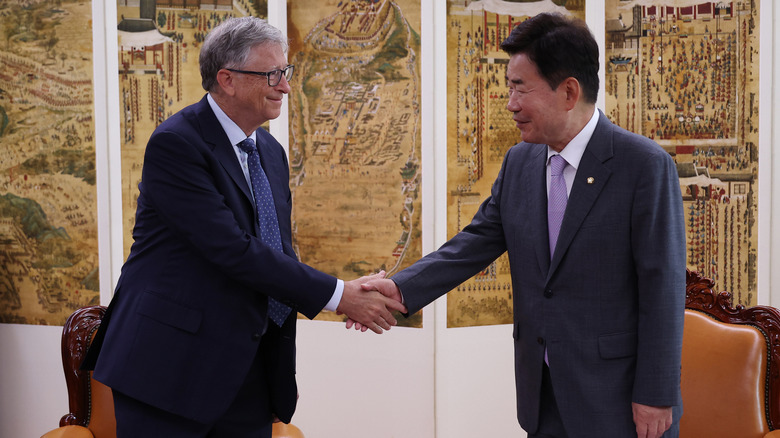
In 2013, Bill Gates earned scrutiny for his handshake with then-Korean President Park Geun-hye. Gates has deep-seated business and philanthropic ties to South Korea, and his 2013 trip was to discuss nuclear energy plans. Instead, many South Koreans found themselves discussing his conduct. News spread quickly that the Microsoft co-founder used one hand to shake Park's hand, keeping his other hand in his pocket.
However, he may not have known that a single-handed handshake is very casual in South Korea. It is common to do a two-handed handshake to show respect, especially when shaking hands with someone older or of higher authority. According to Korean media outlets like The Korea Herald, a single-handed handshake with one hand in a pocket is considered rude and disrespectful. On the matter, the Korean National Assembly's Secretary General Chung Jin-suk stated, "Perhaps it was his all-American style, but an open jacket with [one] hand in pocket? That was way too casual. It was very regretful." (via ABC).
Internet users debated the handshake incident, with some excusing his behavior as a result of unfamiliarity with South Korean customs. In contrast, others criticized him for his rudeness, and some even accused him of being purposefully rude to Park, South Korea's first female president. However, the one-handed handshake seems to be typical of Gates.
Melinda French Gates was unsatisfied with Bill Gates' handling of an employee's sexual harassment case
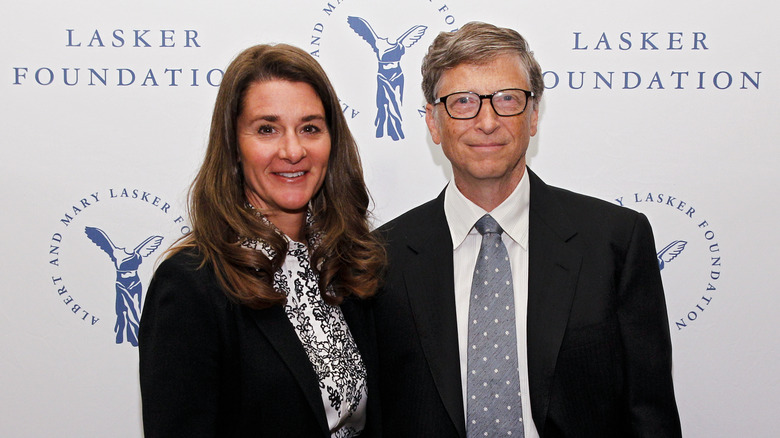
Given their 27-year marriage, many have questioned how much Melinda French Gates knew of Bill Gates' problematic behavior. It seems she had at least some idea, as she was so troubled by his handling of a sexual harassment case involving an employee that she took matters into her own hands. In 2017, Melinda and Bill Gates received a letter from the lawyer of a woman who managed a bike shop.
The letter alleged that the woman had faced sexual harassment from someone close to the Gates: Michael Larson. Larson is Gates' longtime money manager, overseeing Cascade Investment, the asset that holds much of Gates' fortune. Through Cascade, the money manager invested in other ventures, including a firm called Rally Capital, which held a stake in a local bike shop. According to the letter the Gates received, Larson sexually harassed the bike shop manager, leading her to seek the Gates' help in the matter.
The woman eventually settled, signing a non-disclosure agreement for an undisclosed payment. However, Melinda Gates was critical of her then-husband's dismissal of the case after the settlement. It was ultimately she who sought the help of an outside law firm to thoroughly investigate the claims before reinstating Larson at Cascade.
Bill Gates had a reputation for pursuing women he worked with
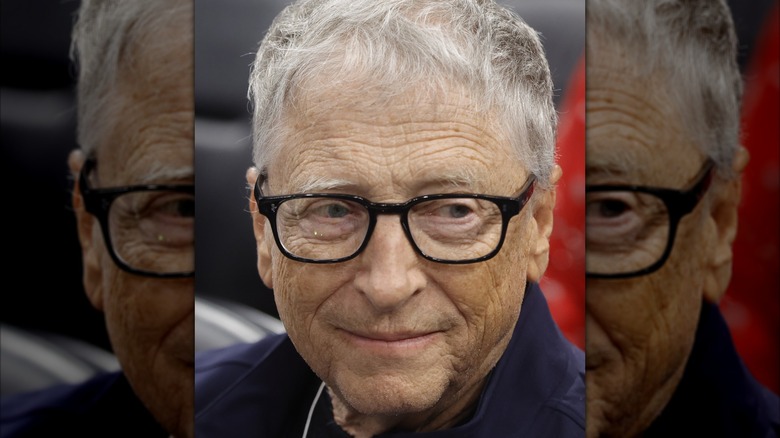
Bill Gates' affairs during his marriage to Melinda French Gates have garnered scrutiny. However, what makes his philandering even more problematic is that he allegedly frequently pursued women he worked with. One of his work affairs sparked an investigation from Microsoft's board, but his work relations allegedly happened more than once.
His womanizing antics and pursuit of employees' dates date back as far as 1988. Former Microsoft employee Dan Graves told Business Insider that in the summer of 1988, Gates rented out an entire ski resort for his employees in the French Alps and partied with them late into the night, culminating in Graves finding the Microsoft CEO lying on top of a woman on the resort lawn the next morning.
Even after marrying Melinda French Gates, Gates continued pursuing employees. In 2006, after attending a presentation from one of his employees, he emailed her asking her to dinner. The e-mail, obtained by The New York Times, read in part, "If this makes you uncomfortable, pretend it never happened." In another instance, he asked a woman who worked for his charitable foundation to dinner, remarking, "I want to see you. Will you have dinner with me?" Sources for The New York Times denied that Gates was predatory in his advances. However, the blatant power imbalance between him and his employees complicates the issue.
His climate memo gave fuel to climate change deniers, including Donald Trump

In 2015, Bill Gates founded Breakthrough Energies, an initiative to reduce greenhouse gas emissions and fight climate change. Hence, it was quite surprising a decade later when Gates posted a climate change memo to his blog, Gates Notes, in which he seemed to reverse his stance on the issue. The memo begins by denouncing the "doomsday view of climate change," and claiming that, while it will have serious consequences, climate change won't "lead to humanity's demise." The Microsoft CEO goes on to argue that America should pivot away from fighting climate change and reducing emissions and instead direct the resources it has devoted to these efforts toward human welfare.
While he makes it very clear that he believes climate change is a serious issue that should be addressed, he continues to argue for changing society's approach to it and to push the "truth" that climate change won't end civilization. Unfortunately, a lot of climate change deniers pounced on the memo, twisting it to fit their narrative that climate change doesn't exist. Among these deniers was Donald Trump, who gloated on Truth Social that he "just won the War on the Climate Change Hoax" because Gates allegedly "admitted that he was completely WRONG on the issue" (via The Conversation).
While climate change deniers were grossly simplifying Gates' climate memo, it still drew some scrutiny from scientists, who questioned why he was attempting to make solving climate change and solving poverty an either/or situation. Additionally, he spent a lot of time deconstructing an argument that very few climate activists have made. Many already know that climate change won't end civilization and are instead focused on reducing the human suffering it will contribute to.
Bill Gates' deposition in Microsoft's anti-trust case garnered ridicule
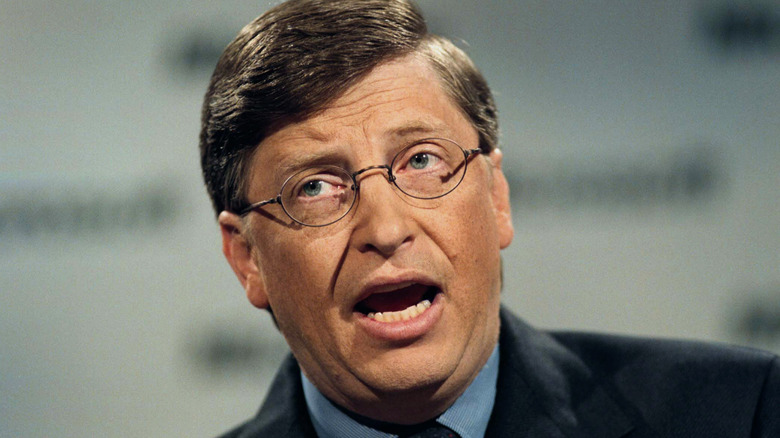
In the 1990s, Microsoft found itself at the center of an antitrust case. In United States vs. Microsoft Corp, the U.S. government sued Microsoft for allegedly monopolizing the personal computer market through its bundling strategies and by making it difficult for PC users to uninstall Internet Explorer. The highly publicized court case included a deposition from then-Microsoft CEO Bill Gates. Not only did Microsoft ultimately lose the antitrust case, but Gates' deposition was so bad that it drew ridicule from the presiding judge.
During the deposition, he faced intense questioning from the U.S. Justice Department attorney David Boies and chose the questionable tactic of dodging answers by arguing over technicalities or feigning ignorance. At multiple points, the nonsensical back-and-forth Gates participated in garnered laughter in the courtroom.
Presiding judge Thomas Penfield Jackson audibly laughed and shook his head at Gates' antics, such as when the Microsoft CEO claimed he had no competitor companies in mind when writing about "winning Internet browser share," or when he denied he meant "Microsoft" when he used the word "we" in emails when discussing the company's strategies and goals. Gates' deposition took three full days largely because of his evasiveness and question-dodging, which many considered a massive failure for the Microsoft CEO.
He was a notorious 'office bully' in his younger years

Especially during his early years as Microsoft's young CEO, it was easy to take an idealized look inside Bill Gates' life. With his boyish appearance and sometimes socially awkward mannerisms, many believed he was just like any other likeable, brilliant computer enthusiast with a dream. However, his public image didn't quite match his behind-the-scenes behavior as CEO. In fact, he had a reputation as an "office bully."
Two former employees told Business Insider that Gates "yelled" at his employees frequently. While some appreciated his honesty, others dreaded meetings with the CEO, where getting yelled at seemed inevitable. Gates himself admitted to being a bit of a workaholic and pressuring his employees to be the same way, going as far as to memorize his employees' license plates so he could drive around the Microsoft parking lot and figure out who was or wasn't going in on the weekends or working overtime.
Microsoft co-founder Paul Allen also spoke to Vanity Fair about Gates' behavior, describing him as someone who loved conflict and sarcasm. He created a "high-stress environment" by pushing his employees to the limit and constantly putting others down, sometimes for no other reason than that he was in a "lousy mood."
The Gates Foundation has been accused of hurting Africa through its agricultural strategy

While he may have ties to Jeffrey Epstein and a history of problematic behavior, many still struggle to get past the fact that Bill Gates has done much good through the Gates Foundation. However, at times, the foundation may have actually done more harm than good. In 2024, several African leaders penned an open letter to the Gates Foundation and other charitable foundations, demanding "reparations" for the damage the Alliance for a Green Revolution in Africa (AGRA) has done to Africa's ecosystems.
The Gates Foundation is the biggest funder of AGRA, which seeks to revolutionize agriculture in Africa. On the surface, it sounds like a good initiative aimed at improving food security and farmers' incomes. However, years after its founding, AGRA has yet to achieve results. Studies have even found that hunger has increased in AGRA countries since its founding. In their open letter, African leaders argued that the initiative has caused harm by promoting industrial models and synthetic fertilizers that disrupt Africa's agricultural traditions.
AGRA has had years and billions in aid from donors and the government to achieve its goals, and its failure has raised eyebrows. The Gates Foundation stands out as one of the primary funders of AGRA. However, it's certainly not the only one, especially since it launched the initiative in partnership with the Rockefeller Foundation.
Bill Gates has an enormous carbon footprint despite his climate advocacy

Bill Gates has long been considered a climate activist. He believes clean, sustainable energy is the key to reducing gas emissions and has put considerable effort into supporting research in this area through the Mission Innovation and Breakthrough Energy initiatives. Even before he wrote a divisive memo shifting his stance on climate change in 2025, though, many questioned how devoted he really was to it, especially since his carbon footprint paints quite a different story.
He may be a philanthropist, but Bill Gates sometimes still indulges in an out-of-touch and expensive lifestyle and differs little from the world's other billionaires when it comes to climate emissions. He is among the twelve billionaires who alone account for more gas emissions than those produced by 2 million homes. According to SimpleFlying.com, he also tops the list of celebrities with the largest private-jet carbon footprint. In just 2022, his staggering 393 flights accounted for over 3,000 tons of emissions.
Meanwhile, he's aware of the hypocrisy of using a private jet while advocating for the climate. Still, he insisted "part of the solution" (via CNBC) because his Breakthrough Energy spending offsets the harm from his emissions. Gates also questioned whether, just because he spends money on climate advocacy, that means he shouldn't take trips to Africa, where he can learn about farming and malaria and potentially use this knowledge for good.