
Everything We Know About Pete Hegseth's Controversial Tattoos
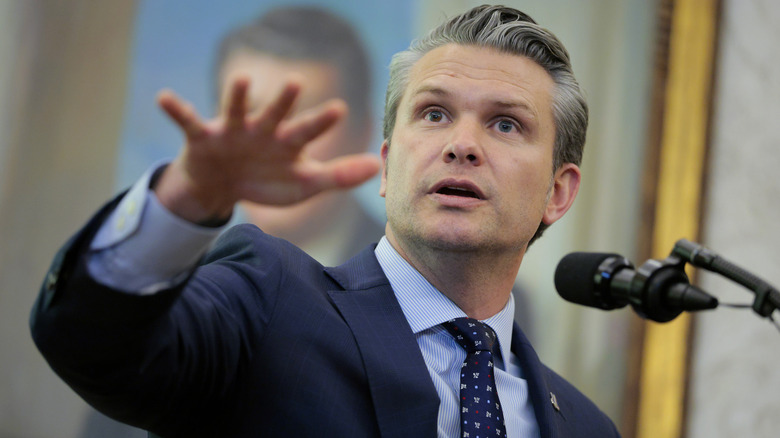
Tons of controversial things have come out about Pete Hegseth, both prior to and during his stint as President Donald Trump's Secretary of Defense War. Among them is something that has nothing to do with his military background or even Hegseth's contentious tactical decisions. The Army National Guard vet is decorated in more ways than one: In addition to his two Bronze Stars and other medals, Hegseth has quite a bit of skin art. The dozen or so tattoos on his chest and arms reflect his personal values, but some critics have called those values into question (no, these blasts have nothing to do with the brutal nicknames Hegseth has been given in relation to his past alcohol use).
There are some basic patriotic symbols on the Trump staffer's right arm, such as a modified American flag with an assault rifle taking the place of the bottom stripe. He also sports ink of the Roman numerals for the year 1775, possibly signifying the beginning of the War of Independence; the words "We the People" from the U.S. Constitution; and the familiar "Join, or Die" illustration of a segmented snake representing the original 13 colonies. Elsewhere, Hegseth honors his military service with two images associated with his regiment, including a traditional red torii gate found at Japanese Shinto shrines.
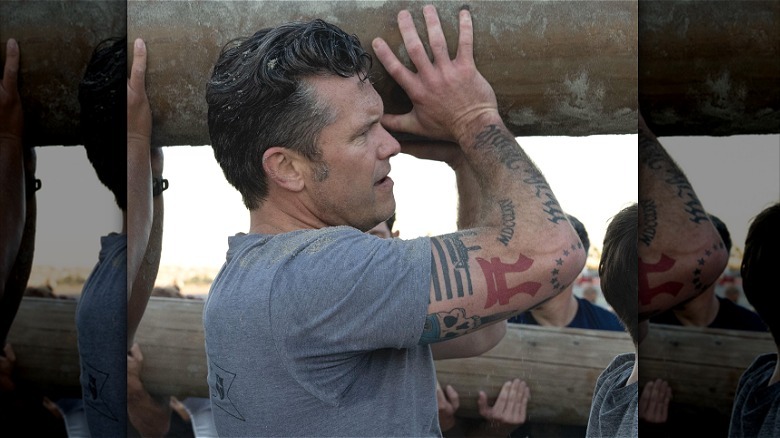
However, several of Hegseth's other tattoos are considered more problematic, such as the Arabic word "kafir," which he added to his right bicep in 2025. The term refers to a non-believer in Islam, and some see it as an anti-Muslim statement as a result. In fact, the executive director of the Council on American-Islamic Relations (CAIR) released a reaction sharply reminding Hegseth of his responsibility to protect all Americans, including Muslim citizens and military members, when the tattoo was revealed.
Pete Hegseth's ink cost him a key role in an important event
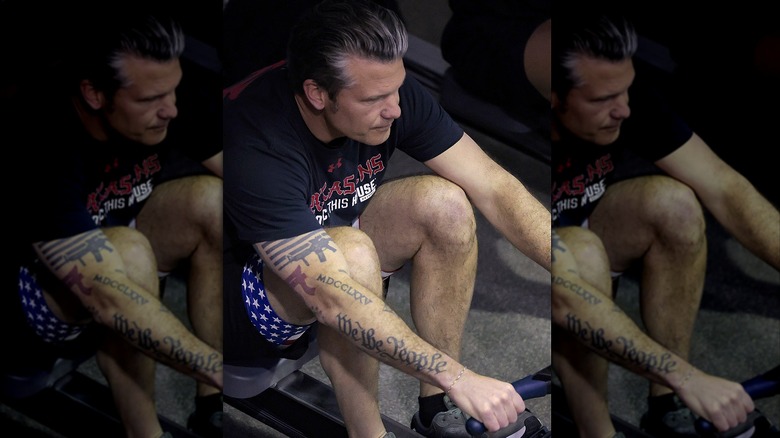
Pete Hegseth sports a large Jerusalem cross on his upper right chest and the Latin phrase "Deus Vult" (God Wills It) on his right forearm. These symbols notably date back to the First Crusades, but in more recent years, they've been appropriated by the Proud Boys and other white supremacist groups. Hegseth maintains that the tattoos are simply a statement of his faith, but the art was considered concerning enough for the National Guard to ask him not to participate in the inauguration ceremony for President Joe Biden in 2021. Infuriated, Hegseth left the military shortly afterward.
The Trump staffer's other religious tats include Jesus' name in Hebrew, the Greek letters χ and ⍴, also representing the name Christ, and a cross with a sword inside, a reference to a Biblical verse. Critics worry the symbols are a sign that Hegseth is a Christian nationalist; someone working to turn the U.S. into a nation based on conservative Christian principles. This could potentially affect the status and rights of non-Christians, women, people of color, and others who don't fit into a particular mold. Hegseth hasn't done much to dispel that fear either. More than once, he has invoked Jesus' name, rather than the more neutral "God," when asking Americans to pray for the troops.
As of this writing, the Secretary of War doesn't have any tattoos on his knuckles or fingers, for which his artists can be grateful. Hegseth has admitted to the gross habit of never washing his hands, claiming he builds up a natural immunity to germs that way (Note to self: Bring sanitizer to Hegseth's next meet-and-greet).