

Ron Howard Developed One Of His 'Signature Life Skills' On The Set Of American Graffiti
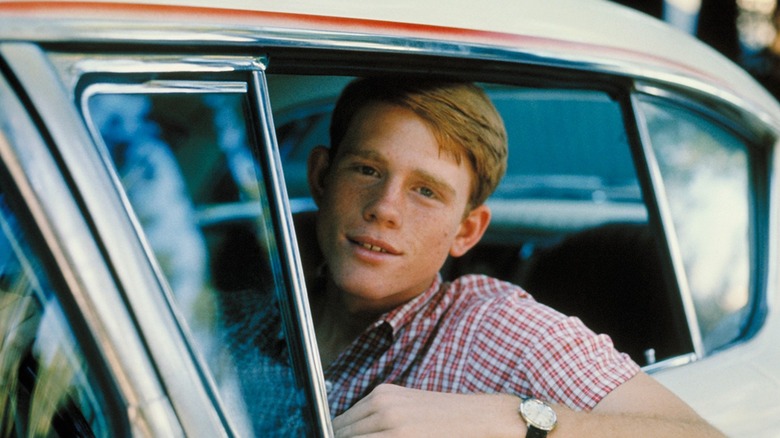
Ron Howard has one of the greatest careers in movie history. After making his cinematic debut in 1956's "Frontier Woman" when he was just 2 years old, he went on to become a child star, appearing in "The Twilight Zone," "Playhouse 90," and, most notably, "The Andy Griffith Show," where he played Opie Taylor. Today, Howard is best known for his directorial endeavors, including the Oscar-winning film "A Beautiful Mind." Yet, while understanding staging, lighting, and how to work with actors are important traits of a great director, the most important lesson Howard learned about filmmaking may have come from his time on the set of George Lucas' "American Graffiti" — how to take a nap.
Howard was 18 when he starred in "American Graffiti" and the movie, set over the course of a single night, was shot almost entirely at night, which meant the actors and crew would have to sleep during the day. For Howard, this proved difficult. As he detailed in "The Boys," the autobiography he wrote with his brother, Clint, when it came to catching some Zs, "Generally, I could only go from 7am to 11am, which compelled me to take catnaps later in the day and night in order to keep my wits about me."
The famed filmmaker went on to add, "This developed into one of my signature life skills: the ability to conk out for 15 minutes at any given moment in any given place. It has served me well." While movies are exciting to watch, making them can be a slow process with a lot of time between takes as lights, cameras, and everything else under the sun are moved around. Like many directors and actors, Howard has clearly learned how to slip in a few restful minutes between shots.
American Graffiti helped Ron Howard prepare for adulthood
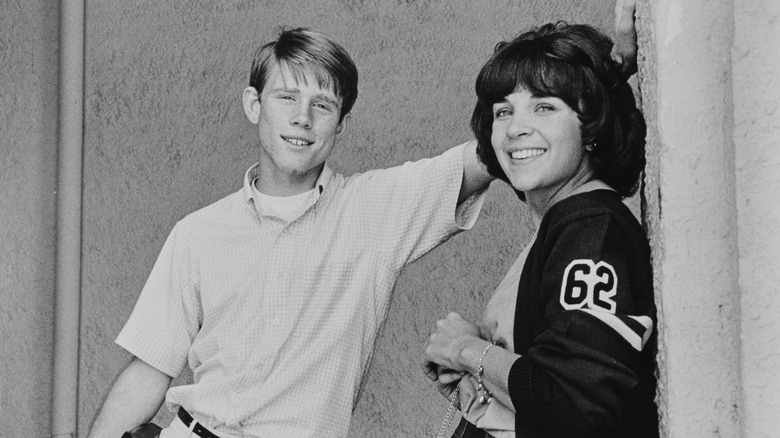
When he was still underaged, Ron Howard's parents had to approve the roles he took on. But having turned 18, the young star was making the decisions and, in this case, he chose very well. "American Graffiti" went on to be a box office smash and a critical darling, landing five Oscar nominations. The movie's success also helped Howard land his next big role as Richie Cunningham in "Happy Days," which he almost walked away from. But behind the scenes, making "American Graffiti" was when Howard stopped being Opie Taylor and grew up.
Just as he was preparing to shoot the movie, Howard received a letter from the Selective Service informing him that he had to go in for a physical. This meant that he could be drafted into military service at any moment. And as the youngest male member of the cast, Howard looked at his cast mates as people who could teach him more about the world. Richard Dreyfuss helped Howard learn how to improvise on set, took part in shaping the young actor's political beliefs, and listened to Howard's worries about being forced into military service.
Cindy Williams, who went on to star in "Laverne & Shirley" (after guest-starring on "Happy Days," no less), taught him how to kiss on camera, explaining to People, "I had my first kissing scenes with her, but they weren't very romantic because she knew that she had this nervous kid on her hands and she had to take charge of the situation. And so she was like, 'Here's how we got to kiss for the camera. Here's what we have to do.'" Now a filmmaking veteran, Howard gets to watch as his daughter, Bryce Dallas Howard, carries on the family tradition.