

The Once Controversial Game That Green Acres' Eva Gabor Made Popular
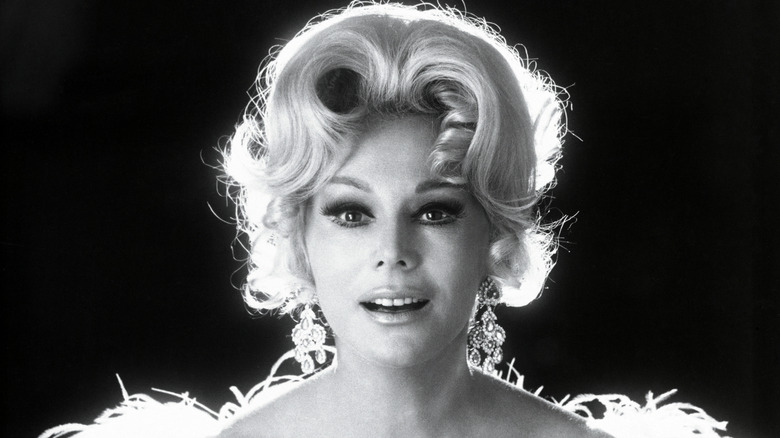
You can't talk about the socialites who ruled the Old Hollywood era without bringing up Eva Gabor. The Hungarian-born actor certainly seemed to be born to play that role, being the daughter of fellow socialite Jolie Gabor and the younger sister of Magda and Zsa Zsa Gabor. Eva's career began in the 1940s, and the starlet continued rising to prominence throughout the '50s. However, it wasn't until 1965 that Eva landed the role that would define her career in the eyes of many: Lisa Douglas on the hit CBS sitcom "Green Acres" (which was cancelled for an odd reason).
But while the actor is perhaps best known for playing an iconic, and super fashionable, '60s TV character, arguably her second-biggest claim to fame is helping to popularize a party game that was once seen as rather scandalous. Much like how "Eva Gabor" is a name that will forever be synonymous with Old Hollywood, Twister is a timeless staple of family game shelves, often sitting right alongside longtime favorites such as Monopoly or Clue. And yet, while the game's status as a classic is considered nigh-on unimpeachable these days, Twister's April 1966 launch was severely hindered by the social taboos of the era, with some stores outright refusing to stock it.
Fortunately for the game's creators, though, one late-night segment changed everything. It was on May 3, 1966 — about eight months into the original run of "Green Acres" — that Gabor played a game of Twister with the iconic host on Johnny Carson's "Tonight Show." Immediately afterwards, the game went from teetering on the edge of disaster to becoming an overnight success. As Milton Bradley president James Shea recalled to the Boston Herald, in 1978, "The next day, the famous FAO Schwarz store in New York was deluged with customers," (via History.com).
Why was Twister so controversial at first?

Twister was a total game-changer for the board game scene when it initially launched under Milton Bradley in 1966, as it was the first major game that required players to use their actual bodies as the pieces. But as revolutionary as this was, it also gave a lot of people pause. The '60s, after all, were a very different time. So, a game like Twister that inherently involved close physical contact with other players was bound to ruffle a few feathers. Those who took issue with the game even went as far as to label it: "Sex in a box." However, as game inventor and historian Tim Walsh opined in a 2019 interview with Smithsonian magazine, the original Twister box art seemed specifically designed to push back on the notion that the game was meant to be sexual.
"The men are in full suits and ties, all the way up to their necks. The women have sweaters, buttoned up to their necks. There was no skin showing at all," Walsh pointed out. On that note, while it was mostly Milton Bradley's competitors and critics who used the "sex in a box" moniker to decry Twister, the game also had some detractors within the company itself. Fortunately, Twister had company executive Mel Taft firmly in its corner. "[Taft] got quite a bit of flak from people internally at Milton Bradley," Walsh confirmed. "He did share that there were some people internally that thought it was a little risqué for kids." It wasn't until Eva Gabor and Johnny Carson's lighthearted demonstration of the game went out over the airwaves that most people finally realized Twister was intended as nothing more than good, clean fun — funny, not sexy.