

Wild State Of The Union Moments Throughout History
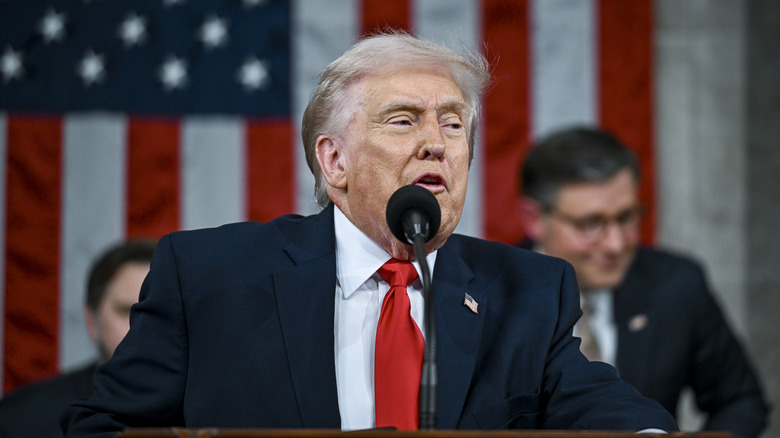
The 2026 State of the Union made history for being the longest speech of its kind. President Donald Trump spoke for over a 100 minutes detailing his perceived wins over his previous year in office. It is a tradition that has grown in length and purpose since George Washington delivered the first "President's Annual Message to Congress." The State of the Union originated from Article II of the Constitution, which outlines the President "shall from time to time give to the Congress Information of the State of the Union, and recommend to their Consideration such Measures as he shall judge necessary and expedient" (via Congress.gov).
Both George Washington and the second president, John Adams, spoke in front of Congress. Thomas Jefferson ended the practice and opted to send a formal letter instead. In 1913, President Woodrow Wilson restarted speaking to Congress directly and set the standard for modern presidents, who now use the time to also speak to the American people and build support for next things to come. For something often considered political theater, many wild State of the Union moments have happened over the years.
Lyndon B. Johnson declared war on poverty (1964)
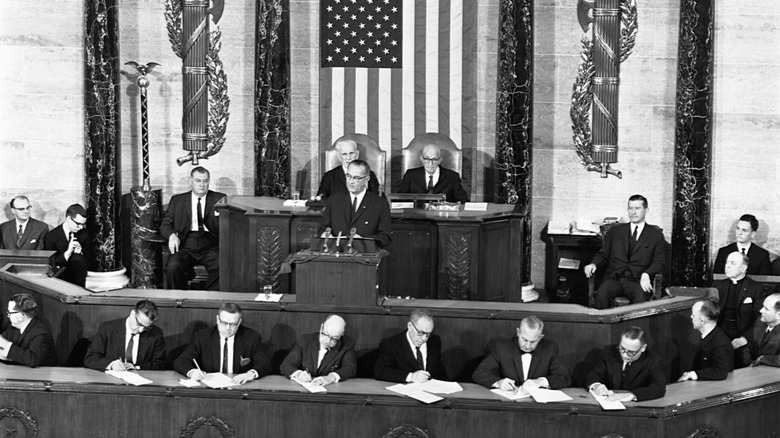
After President John F. Kennedy was assassinated in November 1963, Lyndon B. Johnson was sworn in as president. Although he hadn't planned on being the commander-in-chief at that point in his career, Johnson wasted no time putting policies in place that separated him from the former president. The cornerstone of Johnson's presidency would become known as the "Great Society," where he aimed to turn the United States into a society where all people had the same opportunities and access.
Only a few months after becoming president, Johnson laid out much of his new plan during the State of the Union in 1964. At his first address to Congress, Johnson declared "War on Poverty." Johnson argued that poverty held Americans across the country back more than any other issue and that, unlike the conservative view of poverty being a moral failing, Johnson framed it as a systemic issue.
"The cause may lie deeper in our failure to give our fellow citizens a fair chance to develop their own capacities, in a lack of education and training, in a lack of medical care and housing, in a lack of decent communities in which to live and bring up their children," Johnson declared. The War on Poverty created new laws to help combat income inequality on the federal and local levels during Johnson's presidency. It also became a platform on which Democrats still run today, fueling many laws and campaign points from progressive candidates and lawmakers.
The first opposition to the State of the Union opposed Lyndon B. Johnson (1966)
Many politicians snubbed Donald Trump's State of the Union in 2026, but having an issue with something the president said is nothing new. After the modern State of the Unions finish, an opposition speech is usually broadcast. A member of the party opposite the president speaks to the points the president said or missed during the State of the Union. It is a way for the other party to outline their own priorities or state how the president has failed on key issues. Although it may seem like a practice that has been around for a long time, it was a tradition that didn't begin until 1966.
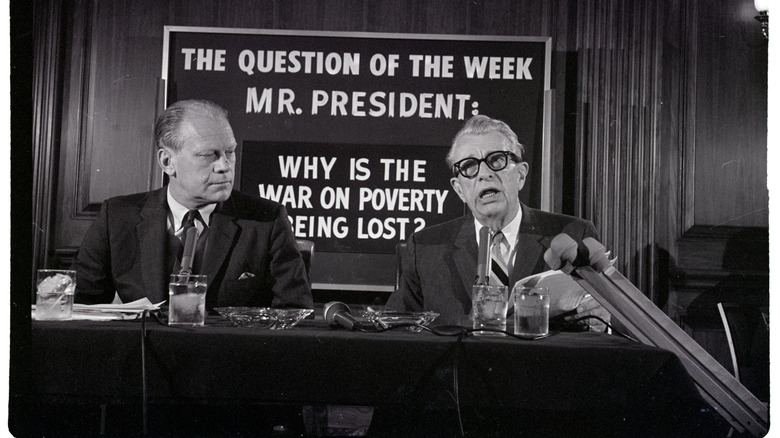
President Lyndon B. Johnson, a Democrat, gave the 1966 State of the Union on January 12. Five days later, Republican Senator Everett Dirksen (IL) and Representative Gerald Ford (MI) gave their response to the State of the Union in a televised segment on several channels. They called the rebuttal, "The State of the Union – A Republican Appraisal." Dirksen discussed foreign and global affairs, while Ford focused on the domestic issues. Interestingly, both Republicans seemed to agree with President Johnson's position on the Vietnam War. Ford did say some of the Great Society programs enacted by Johnson could be run better to ensure everyone has access to programs without political influence. Ford also pushed for more emphasis on the importance of education and making college more affordable.
Richard Nixon tried to stop the Watergate investigation (1974)
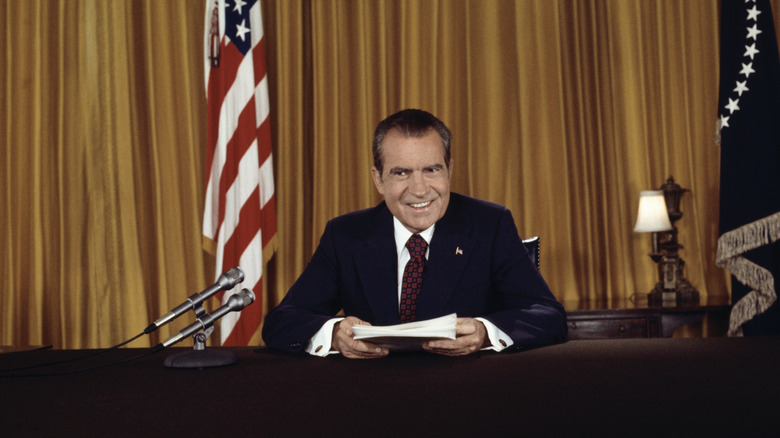
During the 1974 State of the Union, President Richard Nixon tried to get the heat off himself by trying to end the investigation into the Watergate scandal. In June 1972, several people broke into the Watergate building that housed the Democratic National Committee. The burglars, who were connected to Republican Richard Nixon's reelection campaign, stole documents and wiretapped the phones. Nixon, as the sitting president, used extreme measures to cover up the crimes and his connections to them. For a while, his ploy worked, and Nixon was re-elected in 1972 by an overwhelming majority.
Nixon gave the State of the Union on January 30, 1974, and briefly talked about how the "Watergate affair" had run its course and nothing further should be said. He concluded, "I believe the time has come to bring that investigation and the other investigations of this matter to an end. One year of Watergate is enough" (via YouTube). When investigative reporters Bob Woodward and Carl Bernstein of The Washington Post revealed the links to Nixon and the corruption that went with it, the tide against Nixon shifted.
On August 8, 1974, less than seven months after the State of the Union, Nixon resigned from the presidency. Although many people connected to Nixon went to prison for the Watergate crimes, Nixon was pardoned by his former vice president, Gerald Ford, after he was sworn into office.
Gerald Ford said the Union was 'not good' (1975)
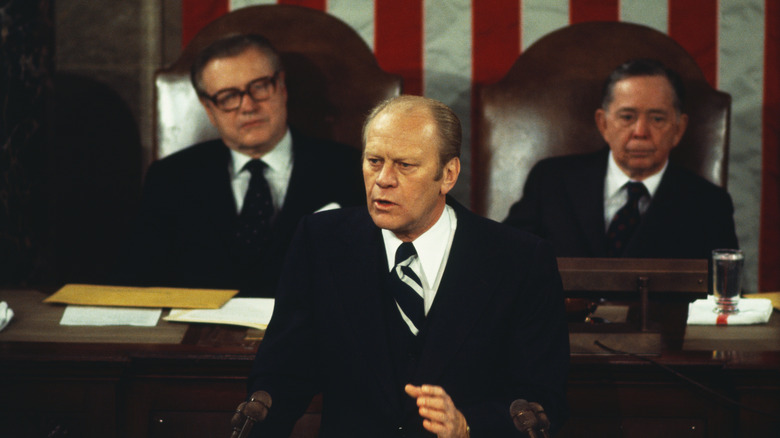
Most of the time, presidents talk about how much they've improved the "state of the union" through policies and laws over the previous year. It is a time to highlight their accomplishments. But President Gerald Ford took a different path in 1975.
Ford didn't mince words when he delivered his first State of the Union. Ford recalled his first time watching a State of the Union as a freshman member of Congress when President Truman said, "The state of the Union is good." Continuing off of that thought, Ford said, "I must say to you that the state of the union is not good."
Having unexpectedly become president only five months before, when Richard Nixon resigned, Ford had inherited a litany of problems. In his speech, Ford outlined the high cost of goods, rampant unemployment, and slow economic growth. Ford used the speech to set himself apart from the former president and start a new direction for the administration. He spoke bluntly and knew he wouldn't be praised for it, but his words got the point across to those watching.
Ronald Reagan started the Lenny Skutnik tradition (1982)
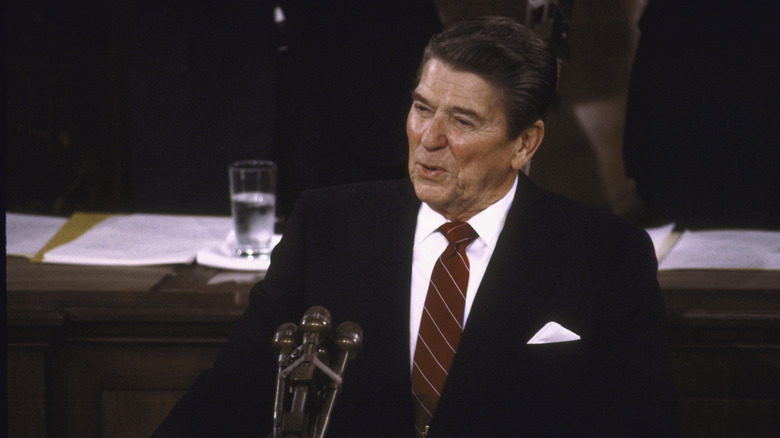
Presidents often invite guests, people of some cultural or political importance, to the State of the Union. It shows that the president is invested in the American people and pays attention to what is happening in the country outside of Capitol Hill. Oftentimes, the people highlighted also connect to or exemplify what the presidents are discussing in their speeches. In 2026, Donald Trump had most of the Olympic gold medal-winning United States men's hockey team as some of his guests. The practice is one that was established decades ago.
While giving the 1982 State of the Union address, President Ronald Reagan added a new tradition. Reagan invited Lenny Skutnik as his guest to the State of the Union. As part of the speech, Reagan introduced Skutnik to the audience as a low-level government employee turned hero who had jumped into the Potomac River to save people after a plane crashed into the water. Reagan used Skutnik to show that the government, and everyday Americans, can be heroic.
Bill Clinton didn't talk about what everyone wanted him to talk about in his State of the Union addresses (1998 and 1999)
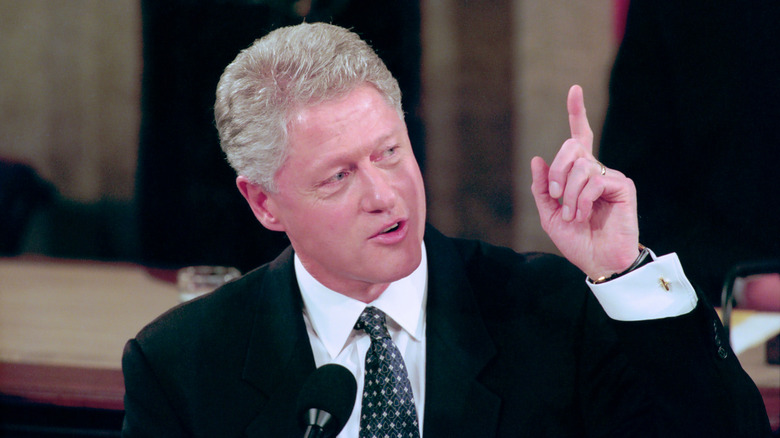
The State of the Union normally highlights the good points over the last year, but Americans also want to hear about how the president will deal with negative situations. In President Bill Clinton's State of the Union addresses in 1998 and 1999, he chose to omit discussing the ongoing scandal and investigation centered on his own conduct while in office.
In early 1998, rumors swirled about an affair between Clinton and a much younger White House intern, Monica Lewinsky. Throughout 1998, more details emerged while Clinton denied any inappropriate connection with Lewinsky. By the end of the year, Congress voted to impeach Clinton over the affair.
When Clinton gave the 1999 State of the Union, he never mentioned the affair or the impeachment. It was what everyone discussed at the time, yet Clinton didn't mention it. The move proved odd and became the most memorable part of his speech because he didn't talk about it. In a way, it is similar to the 2026 fervor over the Jeffrey Epstein files, yet Donald Trump didn't discuss those in his State of the Union either. The scandal caused issues with Clinton's presidential legacy, but it destroyed Lewinsky's life as all of her private business was public, and she was the punchline of many jokes. Fortunately for her, Monica Lewinsky's post-Bill transformation goes beyond looks because she faced a lot of undue hate during the time of the scandal.
Democrats booed George W. Bush (2005)
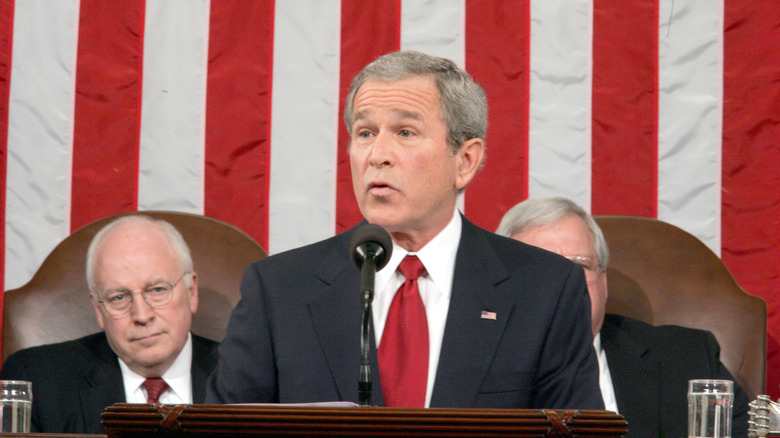
President George W. Bush won his bid for re-election in 2004, but the ongoing Iraq War and never-ending "War on Terror" made him unpopular with a lot of people, especially Democrats. In the past, even if a party disagreed with what the president said, they would keep silent and, at most, walk out of the event. The State of the Union in 2005 brought an end to that quiet decorum when Democrats loudly booed Bush while he spoke.
Before the State of the Union, Bush had made clear his idea was to privatize at least part of Social Security, something Democrats strongly opposed. During the speech, Bush discussed his plan to propose changes to the Social Security system. Bush said Social Security would be bankrupt by the year 2042 if massive reforms weren't put in place soon. While saying that, Democrats booed and said "No" loud enough for the president and the audience at home. It showed a growing frustration between the parties.
Barack Obama challenged the Supreme Court (2010)
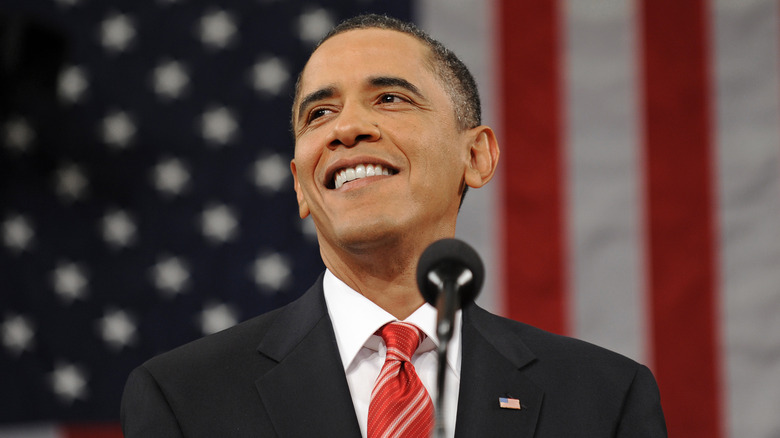
Barack Obama gave his first official State of the Union in 2010, after his historic win in 2008. After giving several speeches in front of Congress and to the American people as president, the State of the Union was something to sum up the work he'd been doing during his first year in office. Although Barack Obama may have had several scandals while in office that seem ridiculous now, he was always ready to stand his ground when he needed to. In an extremely rare move, Obama confronted the Supreme Court with a recent ruling he disagreed with.
The decision concerned the ruling of Citizens United v. Federal Election Commission, where the court ruled corporations could donate as much money as they wanted to elections. Obama argued in the State of the Union that he thought the ruling would "open the floodgates for special interests — including foreign corporations — to spend without limit in our elections" (via Politico). Justice Samuel Alito, who sat with the other Supreme Court justices in front of the dais, shook his head and seemed to mouth "not true" (via CNN). Obama called on Congress to override the Supreme Court ruling and make a law regarding fundraising in elections. Alito seemed to think Obama was overreacting; however, time has shown that Obama may have been correct, as the 2024 presidential election reportedly raised $15.9 billion between the two candidates, making it the most expensive in United States history.
Nancy Pelosi gave her State of the Union clap (2019)
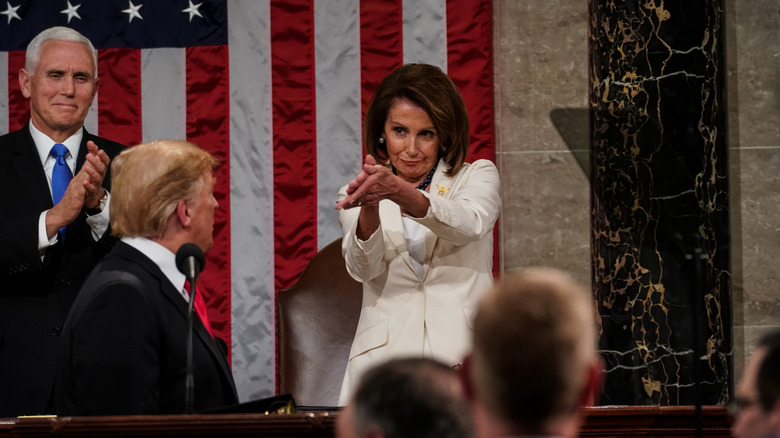
Nancy Pelosi and Donald Trump's bitter feud has been going on for years. It's difficult to imagine the two politicians having a civil discussion, let alone working together. The animosity between them developed into a bit of a power struggle during Trump's first term as president. After the 2018 midterm elections, Pelosi became the Speaker of the House and leader of the Democrats in the House of Representatives. During the State of the Union, customarily the president stands in the front with the vice president and the speaker behind them.
In the 2019 State of the Union, Trump said, "We must reject the politics of revenge, resistance, and retribution, and embrace the boundless potential of cooperation, compromise and the common good" (via Associated Press). A round of applause broke out in the chamber, and Trump turned to look at Pelosi seated behind him. She, along with Vice President Mike Pence, applauded Trump. While Pelosi clapped, she made an effort to show Trump that she was clapping. Pelosi later told reporters she was in genuine agreement with the statement. Although she may not have meant it to be a sarcastic gesture, the photo of the moment has become a meme of sarcastic congratulations.
Nancy Pelosi ripped up Donald Trump's speech (2020)
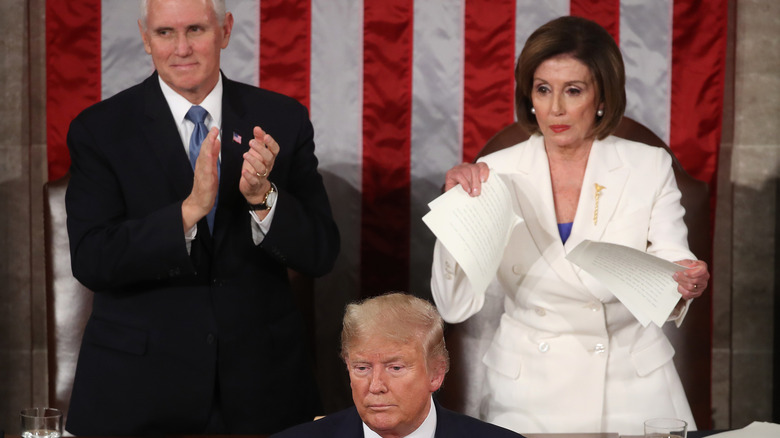
Nancy Pelosi had big controversies while serving in Congress, but during Donald Trump's first presidency, the Democrat party rallied behind her. By the time Trump's 2020 State of the Union rolled around, the climate between Trump and Pelosi was icy to put it kindly. In the speech, Trump boasted about the strong economy and decried the "radical left." He also presented Rush Limbaugh, a right-wing political commentator, with the Presidential Medal of Freedom, the highest honor a civilian can receive. Usually, the award is given to people who have made great contributions to culture or peace.
During the event, like in 2019, Nancy Pelosi sat behind Trump wearing all white. Many women in Congress joined Pelosi by dressing in white to show a unifying front in fighting for women's rights. At the conclusion of Trump's remarks, Pelosi stood and promptly ripped the printed speech to shreds. In a 2025 interview with ABC News, Pelosi said she didn't go into the speech wanting to make a statement. "I thought it was a manifesto of lies all throughout, so I better just tear up the whole speech," Pelosi stated. Much like her clapping moment the previous year, Pelosi ripping up the speech became a viral moment that summed up the partisan divide and frustration. Pelosi also told ABC News the picture of her tearing up the speech is one that people like for her to sign, as it was such an iconic moment.
Lauren Boebert and Marjorie Taylor Greene shouted at Joe Biden (2022)
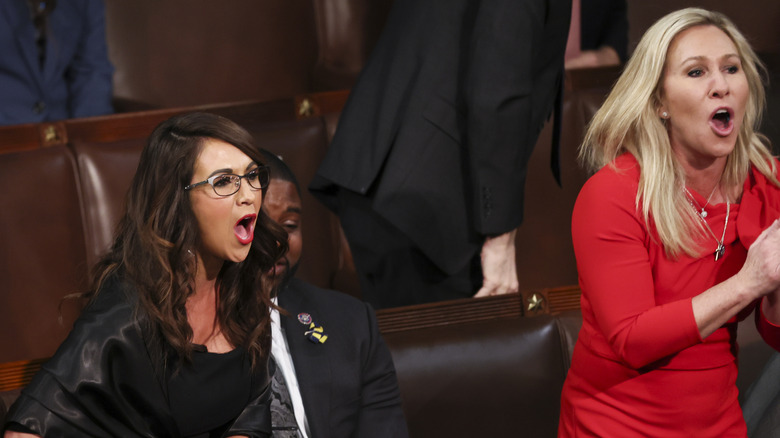
Republican Representatives Lauren Boebert and Marjorie Taylor Greene have participated in toxic politics several times during their time in Congress, yet the time they heckled President Joe Biden during his 2022 State of the Union was something many people openly condemned. The heckling and loud commentary went throughout the speech. Biden, and almost everyone else in the chamber, tried to ignore them while the two representatives kept getting louder.
While Biden discussed his plans for moving forward from the COVID-19 Pandemic, Greene voiced her dissent. When the topic switched to immigration, Greene and Boebert chanted "build the wall," referencing their continued support for former President Donald Trump's failed wall between the United States and Mexico.
The most egregious outburst came when Biden stated he wanted to ensure veterans had access to healthcare, as many of them are exposed to toxic cancer-causing chemicals while fighting. Biden said in the State of the Union, "They come home, many of the world's fittest and best-trained warriors in the world, never the same: headaches, numbness, dizziness, a cancer that would put them in a flag-draped coffin. I know. One of those soldiers was my son, Major Beau Biden" (via YouTube). The heartfelt and personal statement was interrupted by Boebert yelling, "13 of them." Boebert was bringing up the 13 members of the U.S. military who died in 2021 when America withdrew from Afghanistan. Several Congress members hushed Boebert after her comment.
Al Green held a protest sign (2026)
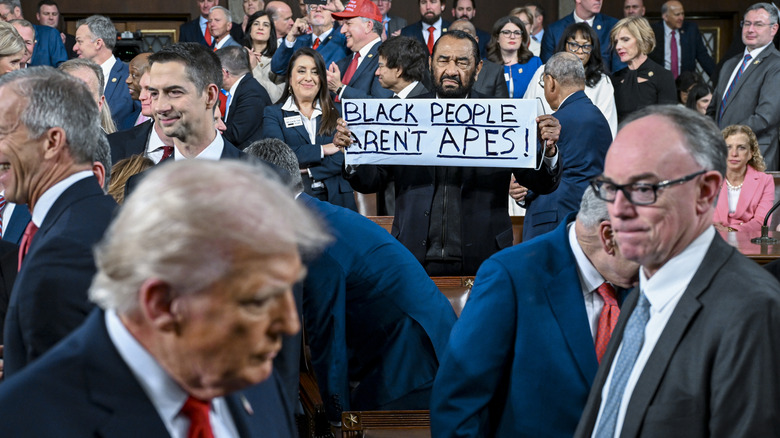
In 2026, the partisan divide seems to be at a fever pitch. While President Donald Trump gave his State of the Union, those who watched the speech saw that right away. Early in the State of the Union, a Democrat Representative from Texas, Al Green, was removed from the Chambers. Although Green didn't say anything, he held a sign that caused a distribution.
The sign, in big bold letters, said "Black People Aren't Apes." It was a statement against a controversial video Trump posted on social media, where former President Barack Obama and former First Lady Michelle Obama were depicted as apes. As of now, Trump has not apologized for posting the racist video.
Green wanted to take a stand against the vitriolic video posted by Trump. After his removal, Green stood outside in the hallway and spoke with reporters while still holding the sign. "Judging from the expression on his face, he got the message," Green told reporters (via NBC News). "I wanted to make sure that I got a message to him. That's why I took the seat where I was on the aisle, so that I could give it to him personally." Green was also removed from Trump's address to Congress in 2025 for shaking his cane at Trump.