
Gunsmoke: What Only True Fans Know About The Landmark Western Drama
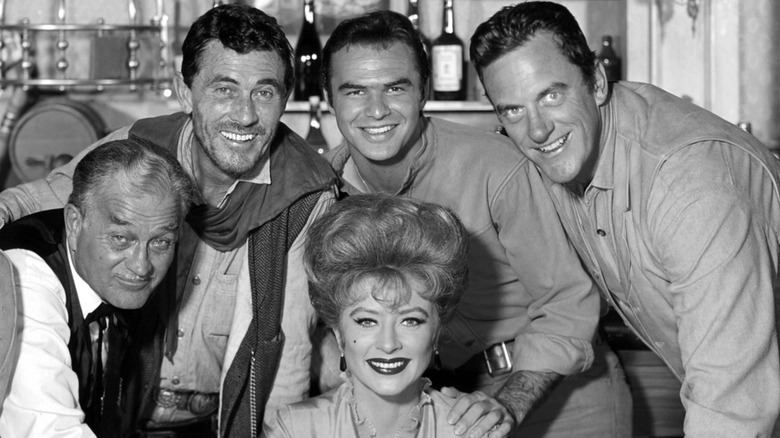
The trailblazing Western "Gunsmoke" dominated the small screen throughout its 20-year reign, the fan-favorite series focusing on the rugged and resilient U.S. Marshal Matt Dillon as he fought to keep order and peace in the rural town of Dodge City, Kansas. With a stacked ensemble cast led by James Arness, Amanda Blake, and Milburn Stone, the show aimed to tell captivating stories about life on the frontier in the 1870s. During its TV tenure, "Gunsmoke" spawned a whopping 635 episodes and became a must-see for audiences everywhere.
The Western classic featured appearances by some of the industry's most beloved actors, with famous faces like Hollywood legend Clint Eastwood, Burt Reynolds, Bette Davis, and leading man Harrison Ford all finding themselves on an adventure in Dodge City. "Gunsmoke" won five Primetime Emmy Awards during its run and helped add depth and heart to the Western genre, every episode of the drama featuring intriguing characters and thrilling storylines.
In the decades since its conclusion, "Gunsmoke" continues to attract new viewers and remains a crucial part of Western history in television and beyond. Many longtime fans of the Western drama enjoy discovering new and exciting facts about "Gunsmoke" and its legacy.
John Wayne helped James Arness land the lead role
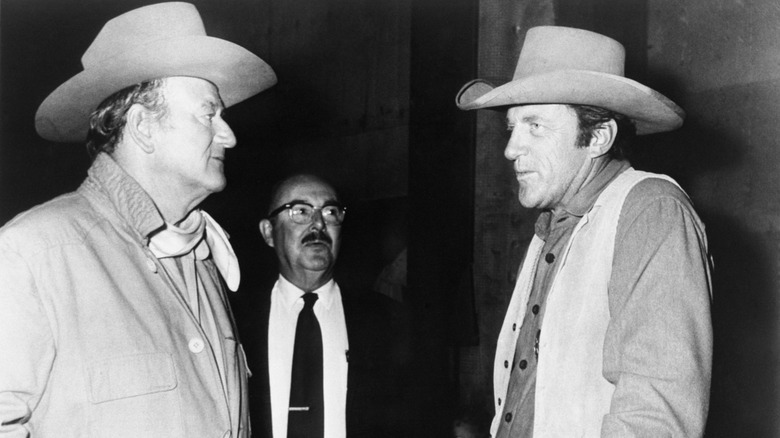
Hollywood legend John Wayne was said to have been offered the lead role of Marshal Matt Dillon in the TV adaptation of "Gunsmoke," but he turned it down and instead recommended fellow star James Arness. Arness had notably appeared in films like "The Thing" and "Island in the Sky," the latter of which also featured Wayne. Though he never donned Dillon's Marshal badge and cowboy hat, Wayne did play a hand in the beloved series and introduced the very first episode of "Gunsmoke" in 1955.
"I had been in about four pictures for his company with him. When the 'Gunsmoke' offer came in, he said, 'I wouldn't be able to do it, but I have a young man here under contract who I think would maybe fit the bill,'" James Arness said in a 2006 interview with "Newsmaker of the Week" (via jamesarness.com) how Wayne helped him nab the role. "So he very graciously offered to introduce the first episode. And it was great. It was a wonderful thing. He was a one-of-a-kind guy. There just was never anybody else like him."
The tall and rugged Arness, who had to dye his naturally blond hair dark for the character, shaped the image of the modern Western cowboy on screen. He became synonymous with the role and helped make TV history by playing Matt Dillon throughout five decades, including the hit series and five subsequent films.
James Arness' old battle wounds became a part of his character
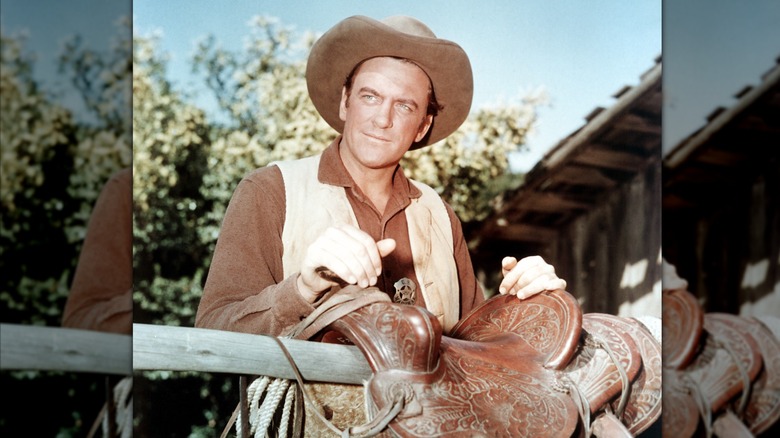
James Arness was drafted into the US Army in 1943 when he was just 20 years old and during his service he participated in the Battle of Anzio, where his right leg was severely shot. Arness was awarded a Purple Heart and honorably discharged in January 1945, though he dealt with chronic leg pain from his wound for the rest of his life and while shooting "Gunsmoke" a decade later.
"They trained us right over there in Naples to do amphibious landings and all of that, and the next thing we knew we were on the beach head at Anzio there," Arness told the Archive of American Television in 2002. "I was wounded there. I was there about 2 weeks and then I got hit in the leg and it was serious enough that it got me shipped back home. I felt very fortunate to have gotten out that lucky when you think about all the guys who didn't."
For the next year and a half, Arness underwent multiple surgeries. Though his leg was saved, he experienced chronic pain for the rest of his life. The actor's lingering limp became a part of his "Gunsmoke" character's story, too; it ultimately helped sell the idea that Marshal Matt Dillon was a veteran gunslinger who had seen his fair share of action while pursuing justice.
The original radio cast auditioned for the TV adaptation
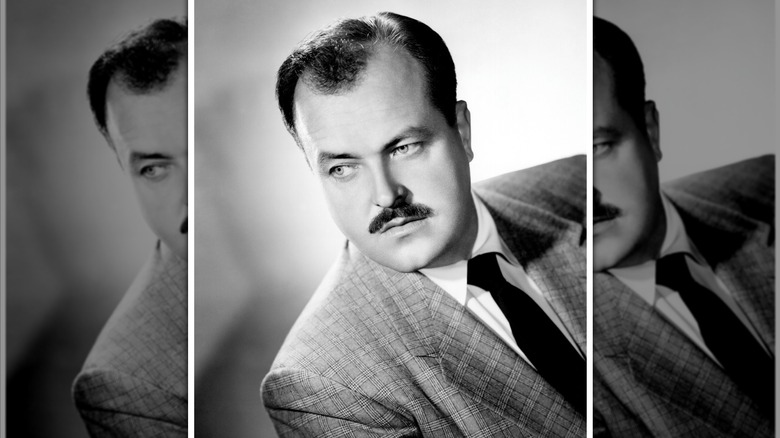
Before "Gunsmoke" became a trailblazing Western and one of the small screen's longest-running shows of all time, the classic actually started out as a radio series in 1952. Director, narrator, and actor William Conrad headlined the program as Marshal Matt Dillon, while Howard McNear played Doc Charles Adams and Georgia Ellis Kitty Russell. Conrad was known for his gravelly, imposing voice and like his fellow cast members, auditioned to portray the TV version of his famed character.
Conrad was ultimately turned down for the role because he didn't have the look the network wanted for the TV version of Matt Dillon. According to John Dunning's book "On the Air: The Encyclopedia of Old-Time Radio," Conrad losing out to James Arness for the role he originated was "a bitter loss" that caused him to become "unavailable to interviewers, especially when they wanted to talk about his radio career."
Many fans of the original radio series refused to watch the TV adaptation after Conrad and his castmates weren't brought on to star. As Dunning wrote, "That radio fans considered the TV show a sham, and its players imposters, should surprise no one." After being turned down for "Gunsmoke," Conrad bounced back and notably starred in the '70s detective series "Cannon," which ran for five seasons from 1971 to 1976 and earned the actor an Emmy nomination.
Doc Adams' first name remained a mystery for 16 seasons
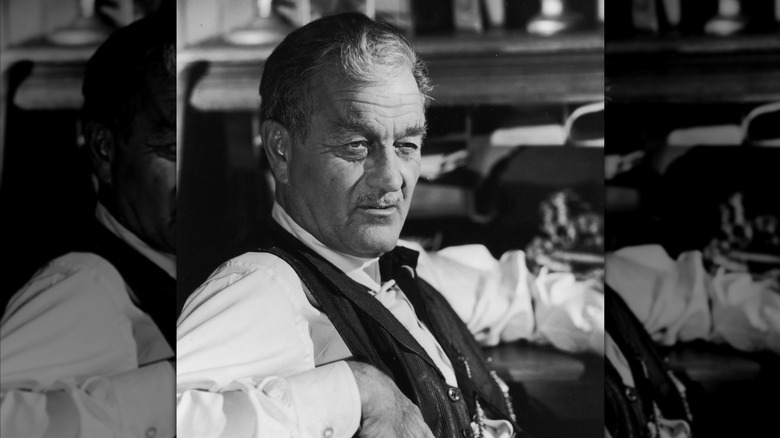
For 16 seasons, Milburn Stone memorably portrayed Galen "Doc" Adams, the actor beating out radio star Howard McNear for the role in the live-action TV series. The grumpy, quick-witted character's first name remained an ongoing mystery during much of its run, as Stone was given creative rights over choosing his first name. Stone also helped shape the character and his backstory, Doc becoming like an alter ego to the actor; he based his counterpart on his grandfather and family doctor.
"Not much has been said in the more than 100 episodes of the show about Doc's past. But a man's past, his roots and his history are what make him the man he is, and Doc Adams can't be an exception. So, I made one up for him," Stone told The Miami Herald in 1959 (via MeTV). "He isn't the pioneer type, and I can't believe he went to Dodge City to set up practice by choice. I think he went because he had to, and stayed only because he was needed and because of the friends he found there."
After years of wondering, audiences finally learned what Doc Adams' first name actually was when producers allowed Stone to choose an alias for his character. He settled on Galen, after the ancient Greek physician, philosopher, and surgeon.
The cast members loved playing pranks behind the scenes
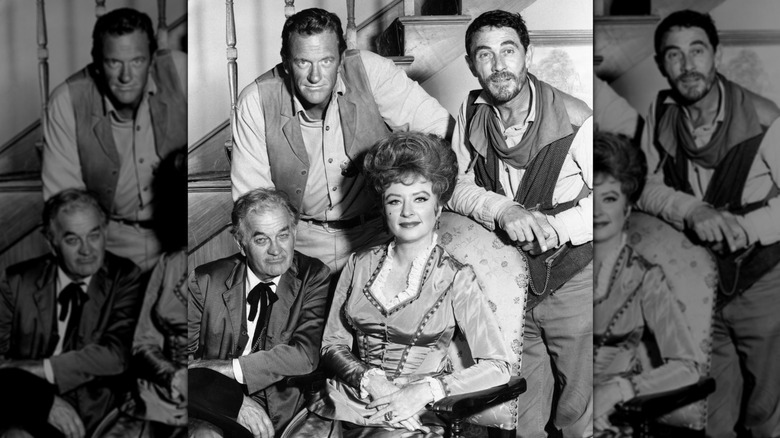
It's easy to imagine the potential for a lot of egos and clashing personalities on the set of a hit TV show, yet the cast of "Gunsmoke" actually got along quite well. Star James Arness developed a meaningful and close bond with his co-stars like Amanda Blake, Dennis Weaver, and Milburn Stone, though it took some warming up before Arness and Stone truly hit it off.
"I spent the first two years on 'Gunsmoke' despising Jim's lack of professionalism. Now I say his acting has reached classical proportions," Stone said of Arness (via INSP). "Jim is the star on and off the set and we never had a serious quarrel or impasse." Arness was also notorious for playing pranks on set and enjoyed scaring its guest stars by popping out of random places, the cast all having fun in between takes.
The cast's wholesome camaraderie both on and off set helped deepen their chemistry on-screen and made "Gunsmoke" the beloved TV staple it became. "We're almost like family now. We have parties on the set with the crew members whenever there's a special occasion. As far as I know, there is nothing like it in show business," Blake said in a 1963 interview with The Toronto Star (via MeTV).
Amanda Blake was not the first choice for Miss Kitty
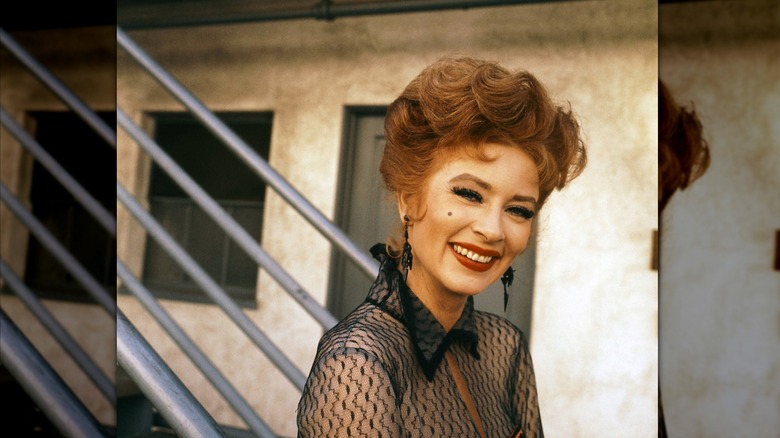
After appearing alongside Judy Garland in the acclaimed cinema classic "A Star Is Born," Amanda Blake made the jump to the small screen when she was cast as Kathleen "Miss Kitty" Russell in "Gunsmoke." Her independent, fiery character helped shape the way female roles were written for television, and she garnered widespread praise for her performance. However, Blake was not the original choice to play Miss Kitty. Polly Bond was initially offered the part and when she turned it down, Blake fought for it.
"Everybody in town wanted to play Kitty, the original 'w***e with a heart of gold.' I think every actress in Hollywood, even a few drag queens in the right age range, tested for the part," Blake revealed in "Gunsmoke: An American Institution: Celebrating 50 Years of Television's Best Western" (via Do You Remember?). She also revealed how the network was initially hesitant to let her audition, prompting her to sit outside the casting office every day until she was seen.
Blake's determination paid off and she went on to become a beloved fixture on the small screen; the actor was even inducted into the Hall of Great Western Performers at the National Cowboy and Western Heritage Museum in 1968. This distinct accolade further cemented Blake's status as one of the genre's most celebrated performers.
Gunsmoke adapted to the changing times
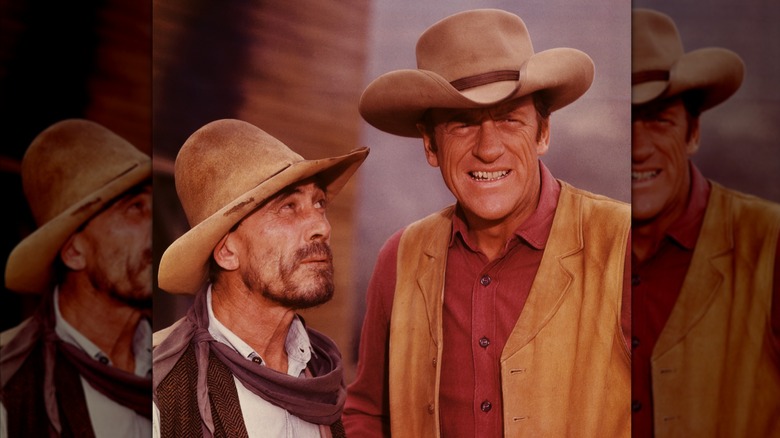
"Gunsmoke" the series saw three separate decades, dominating the world of TV from 1955 to 1975. In 1966, the Western series took the plunge and made the decision to transition from black-and-white to vibrant color. The television landscape saw a major shift at the beginning of the '60s and specifically during the 1961-1962 season, though "Gunsmoke" initially resisted the transition until Season 12.
The first episode in color aired on September 17, 1966, and was entitled "Snap Decision," which followed Matt Dillon as he faced a crisis of conscience after killing a former friend-turned-horse thief. Audiences were able to witness Dodge City in all its glory and become immersed in the Western staple like never before.
Amanda Blake's character, Miss Kitty, was the one who underwent the biggest changes when the show made the pivot to color. As The Independent Tribune (via Facebook) wrote in 1966, "On the black and white show, she wore a lot of red, but in color, her wardrobe will feature, in addition to the burnt orange dress, quite a few in plum, lavender, and green." Similarly, Blake's natural auburn hair color was made a bit "brassier" for the color version.
Gunsmoke led to the cancelation of Gilligan's Island
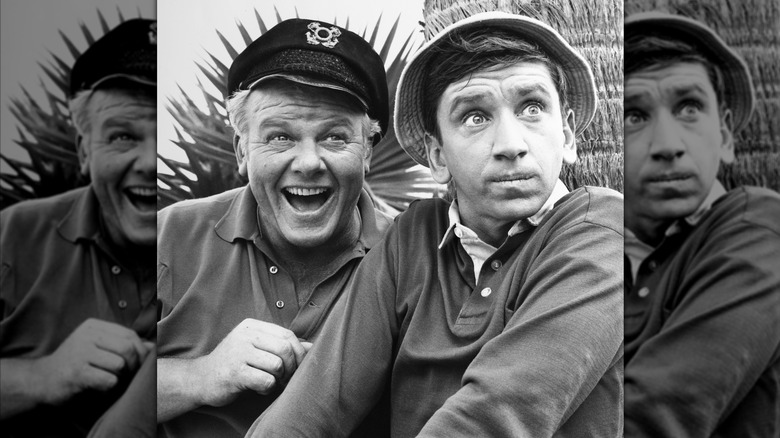
After enjoying a successful 12 years on air, "Gunsmoke" was surprisingly plagued by rumors of an impending cancelation in 1967 — despite delivering stellar ratings for the network and amassing a passionate fan following. CBS network president William Paley lobbied to keep the TV juggernaut going and even then-President Lyndon B. Johnson reportedly made a request to keep the show around as he was a massive fan.
CBS ended up saving "Gunsmoke," but in an unfortunate twist of fate, its continuation ultimately led to the demise of "Gilligan's Island." The hit series was unceremoniously canceled after three seasons once "Gunsmoke" was given its Monday night time slot; the Western previously aired on Saturdays. Bob Denver, who portrayed the bucket hat-wearing titular character in the '60s classic, was reportedly both disappointed and relieved when the show got the axe. "I've had only one day off in three years," he told UPI at the time (via Catchy Comedy).
Denver's "Gilligan's Island" co-star Dawn Wells commented on the network's shocking decision in a 2013 interview with Esquire. "What happened was 'Gunsmoke' was canceled and we were moved into their time slot. Mrs. Paley — the wife of the board chairman — had been on vacation when 'Gunsmoke' was canceled, and when she got home, she said, 'You can't cancel 'Gunsmoke.' It's my favorite show,'" Wells said. "So they canceled us."
Ken Curtis played multiple characters on the show
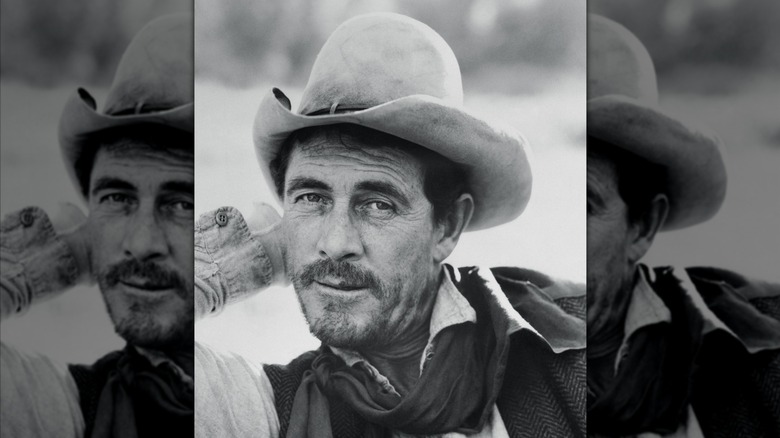
For a whopping 304 episodes, Ken Curtis starred as the cranky deputy Festus Haggen, joining the series as a replacement for Dennis Weaver after he left the show. Before he became a series regular in 1964, Curtis actually portrayed six other characters on "Gunsmoke" throughout its run including a ranch hand, con artist, and a spy. Festus subsequently became a beloved presence in Dodge City and during his stint on the trailblazing series, Curtis performed around the country in Western-themed stage shows.
"I love playing Festus. I don't care if you tattoo it across my forehead," he told The Kalamazoo Gazette in 1973 (according to MeTV), before discussing his character's trademark unkept appearance. "I've worn the same clothes for 11 years. I have a couple of changes, but the clothes are alike. Now it's getting kind of difficult to find Festus-like clothes. If we do come across something like that old vest I wear, we have to beat it up."
The actor was in negotiations to reprise the role for the 1987 film "Gunsmoke: Return to Dodge" but ultimately rejected the project over pay and script disputes. Curtis never returned to the "Gunsmoke" franchise following the behind-the-scenes-drama and he passed away just four years later in 1991 at 74 from a heart attack.
Amanda Blake left Gunsmoke due to grief and her own health
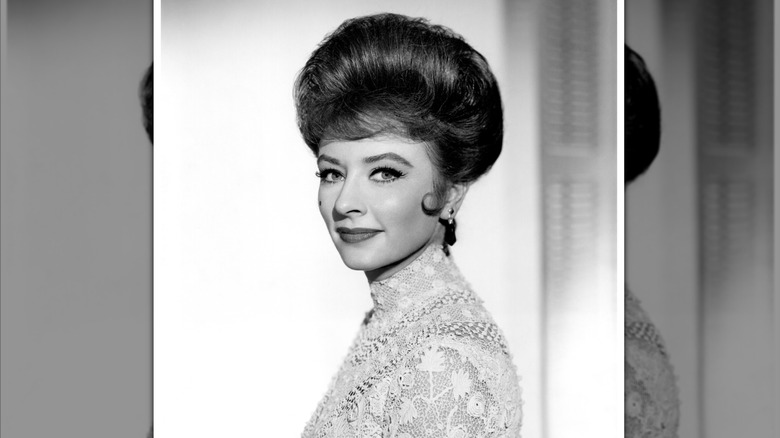
After 19 years of playing the feisty Miss Kitty, Amanda Blake shocked audiences when she departed the hit series ahead of its 20th (and ultimately final) season. The fan-favorite performer had multiple reasons for walking away from the show, with the two biggest being her own health issues and the devastating loss of her co-star and close friend Glenn Strange, who played Sam Nunan until his death in 1973.
Blake expressed how her commute to Los Angeles — she lived in Phoenix at the time — took a toll on her and affected her health, and she simply felt it was time for her to move on. "I'll miss many things about it. It was a wonderful 19 years. Close friendships with my fellow actors and crew, for one thing. They are family," she said to The Daily Journal (via MeTV). "But I've spent half of my adult life as Kitty, owner of the Long Branch saloon in Dodge City. I felt I needed a change. I can really do anything I want to now."
Blake and her then-husband Frank Gilbert had long devoted themselves to animal welfare and wildlife conservation, and she helped run a program that bred cheetahs in captivity. She even caused a frenzy when she brought her pet lion, Kemo, to the "Gunsmoke" set in 1974. The TV legend was diagnosed with oral cancer in 1977 and died in 1989 from AIDS-related hepatitis at 60.
The cast found out the show was canceled through trade papers
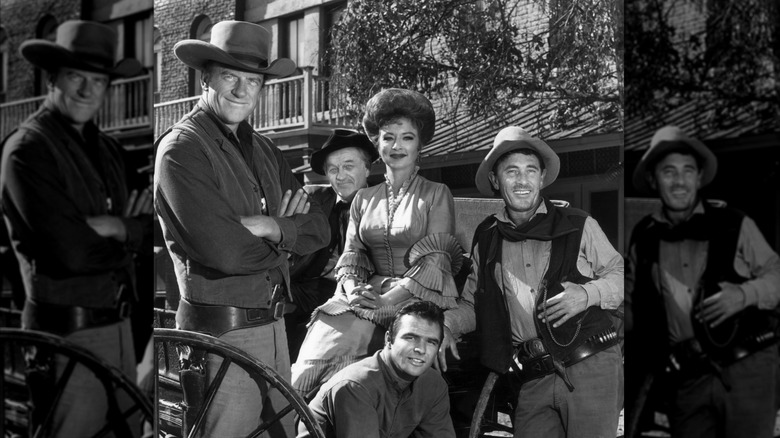
Though it dominated the small screen for a whopping 20 seasons and became a beloved TV staple, "Gunsmoke" was shockingly canceled in 1975 without any public announcement made by the network. In fact, James Arness revealed that the cast members fully anticipated coming back for more seasons and were completely blindsided by the news, which they learned through media publications.
"We didn't do a final, wrap-up show. We finished the twentieth year, we all expected to go on for another season, or two, or three. The [network] never told anybody they were thinking of canceling," James Arness told the Associated Press (via The Hollywood Reporter) of the show's abrupt cancelation. In the decades since its TV reign, it has been revealed that the Western got the ax thanks to the "rural purge," a period in which networks got rid of shows set in rural environments in favor of more modern fare.
Though the show ended on a less-than-desirable note for Arness and his fellow cast members, the actor is still appreciative of the life and legacy of the Western. "'The Gunsmoke' family was the thing that people got used to, and (they) wanted to see that in their homes on Saturday nights, you see. That was a big factor," he told "Newsmaker of the Week."
Gunsmoke made television history during its sensational run
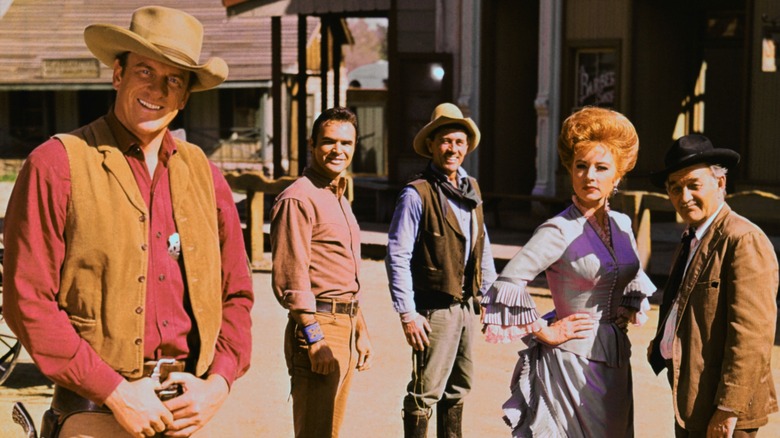
During its phenomenal 20-year run, "Gunsmoke" opted to tell provocative stories and featured complex characters that added depth and dimension to the Western genre. The series spawned a total of 635 episodes and subsequently became the longest-running dramatic series in network history until it eventually tied with the procedural drama sensation "Law & Order" in 2010 before ultimately being surpassed.
"With 'Gunsmoke,' we had an outstanding quality of writing. The show had been on radio for three years, so they were able to fine-tune the characters," James Arness told the Deseret News of the show's lasting legacy. "What made us different from other Westerns was the fact that 'Gunsmoke' wasn't just action and a lot of shooting; they were character-study shows. They're interesting to watch all these years later."
"Gunsmoke" amassed a passionate fan following and was nominated for 15 Primetime Emmys throughout its tenure, becoming one of the most enduring and influential shows in its genre. Following its conclusion, Arness headlined five TV movies centered around the Western, including the 1987's "Gunsmoke: Return to Dodge City" and the final installment, 1993's "Gunsmoke: One Man's Justice." "I've always felt proud that we were in five decades with 'Gunsmoke': the '50s, '60s, '70s '80s, and '90s. That's a 50-year period. What a record," Arness said in his 2002 interview with the Archive of American Television.