
9 Times Donald Trump's Ego Took The Wheel When Naming Things
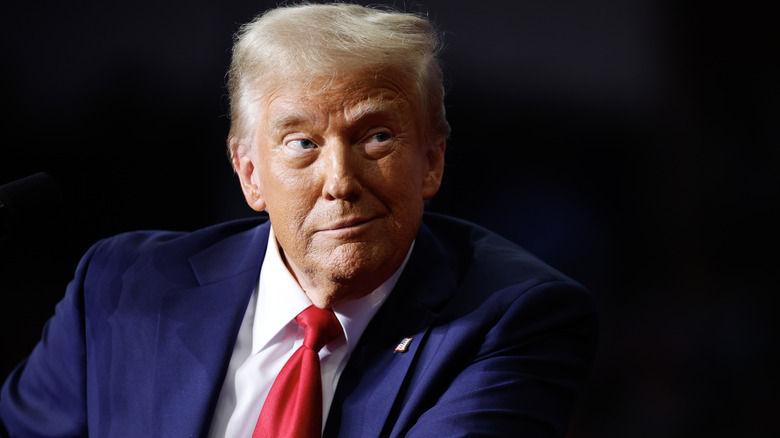
It probably wouldn't surprise anyone if President Donald Trump tried to rename the White House the "Trump House" before he leaves office. The president has a long history of slapping his name on things, and it's hard to find any instances in which he hasn't done so purely to boost his ego. The divisive politician has had years of practice christening steaks, vodka, bottled water, board games, golf courses, and neckties with his moniker. Now, he's planning on adding his likeness to $1 coins set to be minted in celebration of the United States' 250th anniversary in 2026. Trump, it seems, won't stop until he has put his name on every inch of the country.
Rumors have been rife that the president's ballroom project has been just another opportunity for Trump to plaster his name on a White House building. In fact, Trump has admitted that his ego is the reason for the ballroom. Fox News host Jesse Watters confirmed this when he recalled a conversation he had with Trump about the project during his speech at AmericaFest in December 2025. "I said, 'Mr. President, the ballroom is four times the size of the White House.' He said, 'Jesse, it's a monument. I'm building a monument to myself because no one else will,'" Watters told the crowd, who thought it hilarious, per RSBN. Trump previously insisted in October 2025 that the ballroom would not bear his name, calling the rumors "fake news." And yet, senior administration officials told ABC News that staffers are referring to the ballroom as "The President Donald J. Trump Ballroom."
The president went on a naming spree after retaking office in January 2025. He left behind his penchant for naming everyday user items after himself and instead went after government buildings, programs, and (possibly) the White House. This shouldn't be surprising; he is, after all, repeating a well-documented pattern.
Trump has slapped his name on several buildings

Trump Tower might be the most prominent example of Trump's obsession with naming buildings after himself, but it's hardly the only testimony to the president's vanity. In 2015, 17 Manhattan buildings bore his name, even though he didn't own them all. Trump, who found himself drowning in debt more often than not, managed to convince several real estate developers to slap his name on their buildings, making him appear more of a prominent real estate mogul than he really was. With the Trump family, almost everything is smoke and mirrors, and this is a prime example. The developers who licensed his name got to capitalize on it, and Trump received money — and prominence — in exchange.
The number of buildings bearing his name started to dwindle as he launched his first bid for the White House in 2016. In November of that year, news broke that Trump Place, which encompassed several apartment buildings in New York, was abandoning his name. "The goal is to assume a more neutral building identity that will appeal to all current and future renters," a spokesman for Equity Rental, who owned Trump Place, told The Guardian. The change came after residents signed a petition to have the divisive politician's name removed. By 2019, Trump's name had been scrubbed from a total of six New York buildings as his conduct continued to infuriate many American citizens.
He named his now-defunct university after himself

One would think that, early in his career, Trump would have realized that adorning things with his name doesn't necessarily make them successful. Alas, he named the university he founded in 2005 after himself. As with many things bearing the Trump brand, it was a grand swindle.
First of all, Trump University didn't meet the legal requirements to call itself a university. It illegally called itself so, according to New York state law. Trump was made aware of this repeatedly, but, unsurprisingly, considered himself above the law and continued operating the scheme under the university moniker. The institution existed purely to sell students seminars, and, after that, upsell them mentorship programs, which cost up to an eye-watering $35,000. The university's appeal was that students would learn directly from the real estate mogul, but Trump never lifted a finger to educate any of the students, and a third-party company wrote the coursework and conducted seminars. No one who attended the university ever learned anything from Trump.
The fraudulent university became one of Trump's biggest controversies in New York and is probably high up on the list of things Trump hopes people don't remember (but we do, Mr. President!). The scandal was first laid bare in 2016 when Trump set his sights on the presidency, and in 2018, he parted with $25 million after settling a class-action lawsuit filed by disgruntled Trump University students. Needless to say, Trump University, like so many other of the president's ventures, went up in a scandalous cloud of smoke.
Trump tried to get one over on Barack Obama by attempting to launch Trumpcare
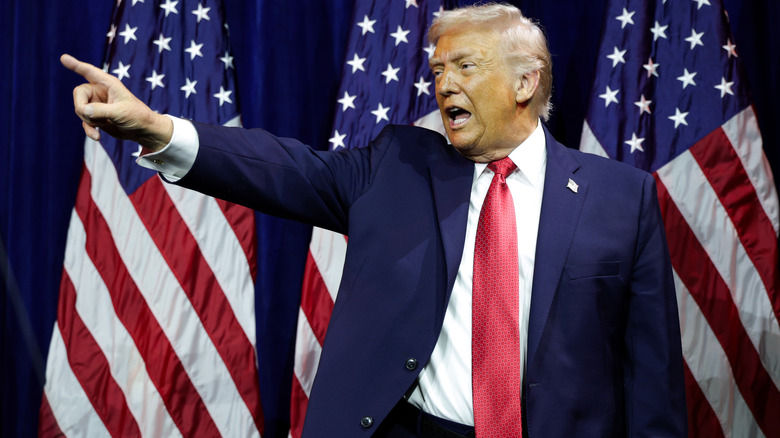
In 2016, Trump had a dream to replace Obamacare (the Affordable Care Act) with Trumpcare. He made big promises about it on the campaign trail, but when push came to shove, Republicans didn't stand with the divisive leader, and the bill never even made it to the House for a vote in 2017. Trump's fragile ego was on full display as he blamed Democrats for the flopped bill, even though Republicans held the majority in the House and the Senate.
In retrospect, it's no surprise that Trump's plan to replace Obamacare with a new program bearing his name failed. Trumpcare was much like everything else the president has ever put out into the world — it didn't cater to Americans who'd need it the most. Under Trumpcare, those who live with chronic illness would have likely found themselves paying more for health insurance because it permitted companies to charge these individuals higher premiums. Additionally, Trumpcare would have allowed insurers to deny coverage to sick people altogether. Furthermore, over 60 million people with pre-existing health conditions stood to lose their health insurance.
Trump has plans to name future battleships after himself

Trump firmly believes that bigger is always better, and he's hellbent on building new battleships that will be named — you guessed it — after himself. Trump-class battleships will form part of the Golden Fleet (when Trump doesn't name something after himself, he likes to employ the word "gold" to enhance its grandeur), and they will, in the president's own words, be "the fastest, the biggest, and by far, 100 times more powerful than any battleship ever built," per CNBC. Trump has declared that he will give his personal attention to building the ships, which comes with an eye-watering price tag of $15 billion. For reference, classic destroyers typically cost around $2 billion.
Experts have said that the idea of building these battleships is laughable because they are no longer relevant in modern warfare. Aircraft carriers replaced them decades ago. Trump, whose outdated habits show every sign that he's stuck in the '80s, likely won't see his naval fleet come to fruition. "There is little need for said discussion because this ship will never sail," Mark Cancian, a senior adviser at the Center for Strategic and International Studies, told CNBC, noting that it will be way too expensive. Senior fellow at Singapore's Rajaratnam School of International Studies, Bernard Loo, concurred, calling it "a prestige project more than anything else," adding that the sheer size of the proposed ships will ensure they are nothing more than a "bomb magnet."
Trump added his name to the U.S. Institute of Peace Building

Trump can't keep his ego in check and appears to require constant validation that he is the most influential man who's ever lived. The president plastering his name on the United States Institute of Peace (USIP) building in December 2025 is proof. The White House has boasted that Trump ended eight wars within a year (this isn't technically true), and therefore rightfully deserves to have his name on the building. Trump only managed to name the building after himself because his administration strong-armed its way into taking control of USIP, which, as an independent organization, is not supposed to be influenced by the government, let alone bear the president's name. Attorney George Foote said in a statement that the hostile takeover had been ruled illegal by a federal judge, per Newsweek, and expressed hope that Trump's name could ultimately be removed in the future.
While criticism abounded, the Department of State took to X to celebrate the change. "This morning, the State Department renamed the former Institute of Peace to reflect the greatest dealmaker in our nation's history. Welcome to the Donald J. Trump Institute of Peace. The best is yet to come," the post read. Even Secretary of State Marco Rubio, who used to be an ardent Trump critic, offered his congratulations, penning on X, "President Trump will be remembered by history as the President of Peace. It's time our State Department display that." Trump, too, took a moment to revel in his victory at the signing event for the Rwanda-Congo peace deal, telling Rubio, "Thank you for putting a certain name on that building. I came, I said, 'Boy, that is beautiful... It's a great honor." Trump told those gathered, per Forbes.
Trump named a federal savings account for children after himself

It has become clear during Trump's second term that, when it comes to naming things after himself, he's just getting warmed up. In 2025, he announced the Trump Accounts program, which consists of a $1,000 contribution from the government into a savings account for children born between January 2025 and December 31, 2028. Parents, friends, and family can then grow this account by depositing up to $5,000 per month. Additionally, the tax form parents have to complete to open said account is named IRS Form 4547, an homage to Trump being the 45th and 47th president of the United States. Treasury Secretary Scott Bessent praised the title of the form, proclaiming it the "most aptly named tax document of all time," per Newsweek.
The initiative has been met with mixed reviews. While, in many ways, it appears to be one of the better ideas Trump has had, skeptics have pointed out that Trump Accounts very much seem like a thinly-veiled scheme to encourage Americans to have more kids, while excluding children from immigrant families from the program. "As currently structured, these accounts will just become another tax shelter for the wealthiest, while the overwhelming majority of American families, who are struggling to cover basic costs like food, childcare and housing, will be hard pressed to find the extra money that could turn the seed money into a meaningful investment," vice-president of income security and childcare at National Women's Law Center, Amy Matsui, said in a statement, per The Guardian.
Then there's also the matter of taxes. By the time the children turn 18, they will be allowed to access the savings accumulated in their Trump Account. However, whatever amount has been saved up until that point will be taxable.
A premium visa program also boasts Trump's name

Trump is not a fan of immigrants, but he's happy to take their money in exchange for expediting their visa application process. It should come as no surprise that the president's premium visa program is named after himself and his favorite color: the Trump Gold Card. It also isn't remotely shocking that the program is only available to the ultra-rich.
If you can bear to part with $15,000 and pay the government $1 million for its trouble, you could become a U.S. resident in record time. But that's not all, folks! There's also the soon-to-be-released Trump Platinum Card, which requires the same $15,000 DHS processing fee but demands a $5 million contribution in exchange for getting a tax exemption on income generated outside of the United States for the first 270 days of your residence in the country. Sweet — if you have millions of dollars just lying around, that is. It's worth noting that, for all that money, you still don't have U.S. citizenship, though you have the option to apply.
The Trump Gold Card is, in part, an attempt to make a dent in the national debt, which, in December 2025, was over $37.22 trillion — and rising by the day. Commerce Secretary Howard Lutnick has estimated that the eye-watering Trump Gold Card fees will be accessible to around 37 million people globally.
The new government-run prescription drug website also bears the Trump moniker
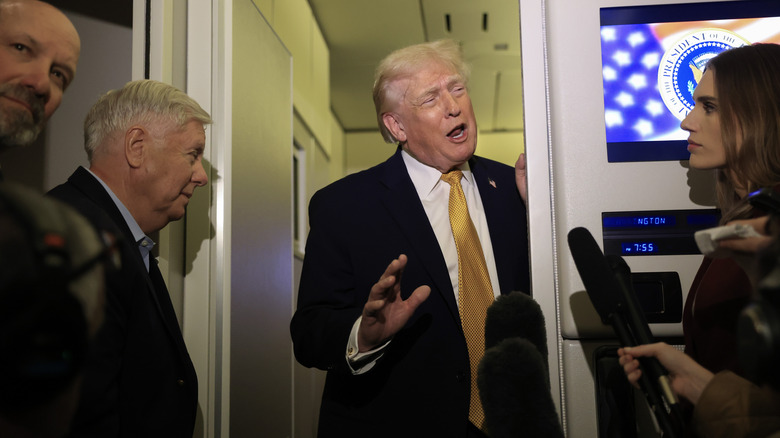
Trump adorned yet another government program with his name in 2025. TrumpRx was announced in September 2025 as Americans increasingly suffer under high drug prices, and, according to the president, the initiative will make medication much more affordable. Per the website, TrumpRx is "a breakthrough for Americans." The program is yet to officially launch, but experts say it won't be nearly as impactful as the president claims.
"Generally speaking, most people with insurance coverage will continue to be better off using their insurance to obtain medications rather than purchasing through the TrumpRx direct-to-consumer portal," Juliette Cubanski, deputy director of the program on Medicare Policy at KFF, a nonpartisan health policy research group, told NBC News. Much about the program and how it would benefit struggling Americans remains unclear. Head of the medical ethics division at NYU Grossman School of Medicine in New York City, Art Caplan, told NBC News that many of the drugs that will be available at a discount through TrumpRx aren't necessarily the ones people can't afford.
Health policy professor at Vanderbilt University in Nashville, Tennessee, Stacie Dusetzina, concurred, explaining that many people would likely still not be able to afford to buy medication through TrumpRx with current drug price rates, even with the promised discounts. Dusetzina did not, however, dismiss the fact that, despite its flaws, the program could help people save a decent amount of money on prescription drugs.
Trump's ego reigned supreme when he moved to have the Kennedy Center named after him

Before 2025 ended, Trump managed to adorn yet another building with his name — the Kennedy Center. After replacing the center's board members with his sycophants and appointing himself as the chairman, the divisive politician managed to get his name on the wall, and the building became the Trump-Kennedy Center (of course, his name is first). It's worth noting that Trump and the board didn't technically have the legal authority to change the name of the building — only Congress can do that, and they haven't yet, as of this writing. The president's name was added to the building anyway.
Trump's Kennedy Center rebrand cost the venue more than just its reputation, with various artists canceling their shows after the controversial president's name was added to its exterior. Ticket sales took a nosedive, plummeting by 50% compared to the same period the previous year. The White House painted the artists who chose to cancel their shows as problematic and overly concerned with politics, even threatening to sue jazz musician Chuck Redd after he pulled out of a Christmas Eve show in protest of the renaming.
The Trump-appointed manager of the center, Richard Grenell, took to X to criticize the artists who canceled their shows, implying that the Trump administration didn't want them to perform anyway (their proposed lawsuit against Redd suggested otherwise). He told the Associated Press, per NPR, that said artists clearly were never committed to performing at the venue and that the Trump administration was unbothered by the cancellations, asserting, "[We have been] flooded with inquiries from real artists willing to perform for everyone and who reject political statements in their artistry." Somehow, we have a hard time believing it.