

The Full Transformation Of Tulsi Gabbard
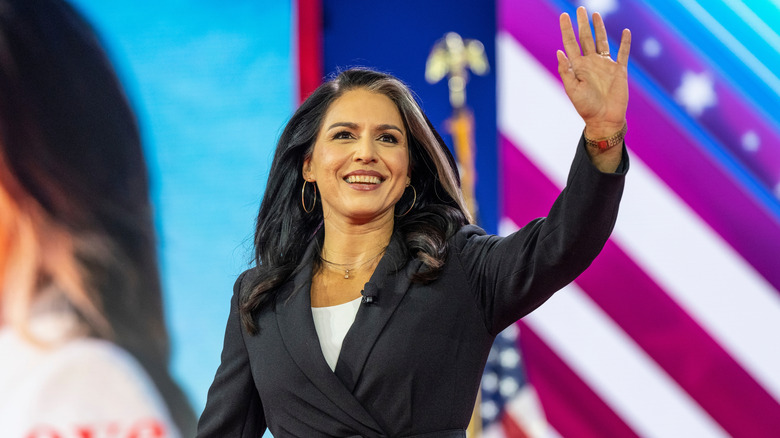
Tulsi Gabbard's career has taken a path few people could've predicted. She started out as a Democrat on the rise — serving as vice chair of the Democratic National Convention and later running for president in 2020. A few years after that, she was showing up at Donald Trump rallies, eventually landing one of the most powerful national-security jobs in the country. Along the way, she scorched bridges with Democratic leaders, openly battled with the party's establishment, and even sued Hillary Clinton.
Ask Gabbard about it, and she would probably say the through line has always been service. "I gradually realized that I was actually happiest when I was doing things for other people, doing things to protect our water, oceans, and beaches," she wrote on Medium, tracing it all back to her childhood in Hawaii. She's described that same pull as part of what led her to the Army National Guard, where she served for more than 15 years and rose to the rank of major.
What has stayed consistent, at least in her words, is her opposition to American military intervention. Frontline noted that she's long argued U.S. wars and regime-change efforts have made regions less stable and helped fuel terrorism. But words and actions have not always matched up. Under President Trump, military operations across the Middle East and Latin America have carried on, and Gabbard has not had much to say about it.
Tulsi Gabbard's upbringing was heavily influenced by spiritual principles

Tulsi Gabbard was born on April 12, 1981, in American Samoa, and was homeschooled for much of her childhood. With a father of Samoan and European heritage and a mother from the Midwest, she grew up with a mix of influences, but her parents stressed basic values in the everyday routines.
In a 2013 Hawaii News Now interview, her father, Mike Gabbard, recalled that even camping trips came with expectations. "Get the tent set up, and then it was, 'Okay, let's clean up.'" Carol Gabbard also added, "While we're looking for firewood, you pick up the trash, too."
Faith was also part of family life, shaped by two traditions. Carol practiced Hinduism, while Mike was Catholic and also practiced yoga and meditation. Tulsi later wrote on Medium that she and her siblings learned from both. "My siblings and I grew up studying from both the Bhagavad-Gita and the Bible; going to Mass, and then coming home to a yoga kirtan," she wrote.
The family's interest in public life began when Carol Gabbard ran for and won a position on Hawaii's Board of Education in the early 2000s. Reflecting on her first campaign, Carol described it as a turning point for the family: "It was like our first dipping our toe into elected politics" (Hawaii News Now).
Tulsi Gabbard earned the title of the youngest person to serve in the Hawaii State Legislature
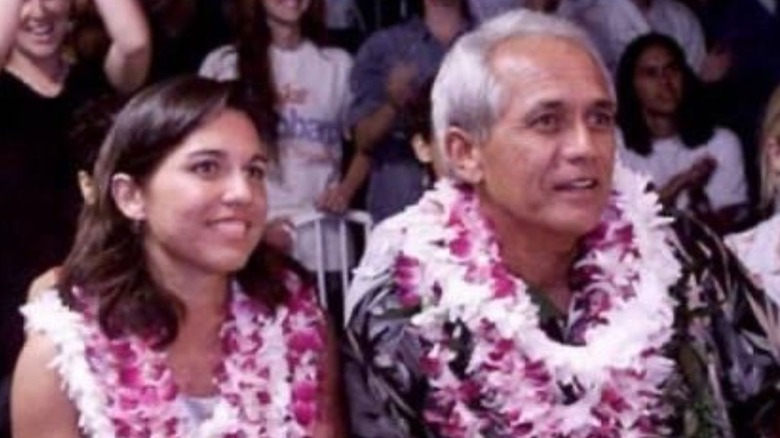
At just 21, Tulsi Gabbard became the youngest woman ever elected to a state legislature when she won a seat in Hawaii's House of Representatives in 2002, representing West Oahu. Her early political career, however, didn't come without controversy. As a teenager, Gabbard had been involved with her father's anti-gay marriage political action committee (PAC), which undoubtedly added complexity to her budding public image (via Washington Examiner).
In an interview with Cameron Hanes, Gabbard described how her guiding principle has always been finding where she could best be of service. That belief, she said, is what pushed her to run for office at a time when most of her peers were still in college or just starting their careers. According to National Review, she had dropped out of Leeward Community College earlier that year.
The Atlantic reported that Gabbard, in an earlier interview, said: "A lot of people told me I was crazy and too young, but I really felt the need and passion to do more with my life and be able to make a positive impact for others."
Her history of military service goes way back to 2003
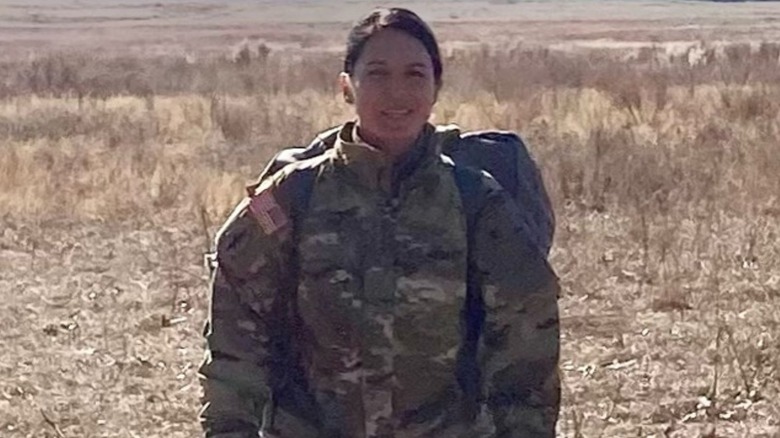
In 2003, Tulsi Gabbard chose to enlist in the Hawaii Army National Guard, even though she was not on the mandatory deployment roster. As she put it on "The Jeff Fenster Show," "I chose the National Guard so that I could serve my community and my home state during times of natural disaster."
A year later, in 2004, Gabbard volunteered to deploy to Iraq. According to CNN, she worked with a medical unit supporting the 29th Infantry Brigade Combat Team. She has described the job as demanding and specific. On the Lex Fridman podcast, she recalled, "We had approximately 3,000 soldiers who were operating in four different areas of Iraq. And my first task every day was to go through a list of every injury — combat-related injury — that had occurred the day before in the country."
On PodcastOne, she said those experiences helped shape her desire to have a say in how decisions are made in Washington. Her service continued after Iraq, including during her time in Congress. According to The Hill, she was promoted to major in 2015, and on July 4, 2021, she became a lieutenant Colonel.
Tulsi Gabbard is the first American Samoan and Hindu to serve in Congress
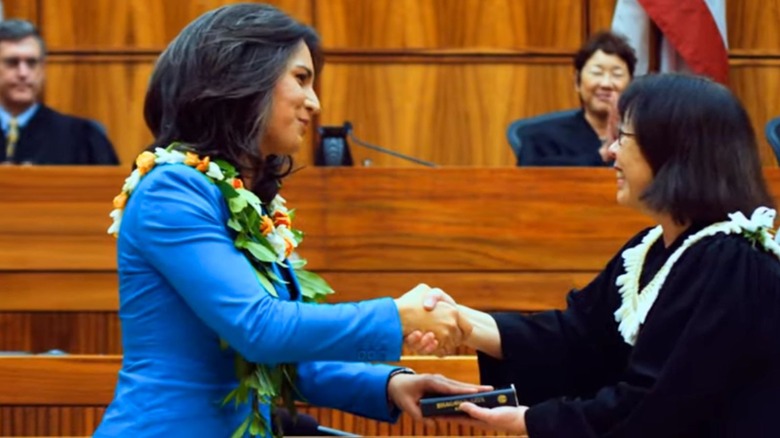
Tulsi Gabbard made history in 2013 as the first American Samoan and the first Hindu elected to Congress. But the excitement didn't last long. About six months into the job, she told CBS she was fed up with the nonstop bickering in Washington and wanted lawmakers to solve problems people actually feel. For her, two of the biggest were clearing veterans' claims and confronting military sexual assault, issues she believed Congress had overlooked.
In 2017, she introduced the Off Fossil Fuels (OFF) Act, a proposal to move the country to 100% clean energy by 2035. Speaking at the Hawaii Energy Conference, she said, "Hawai'i has led by example ... It's long past time for the federal government to take action." Clean energy wasn't her only focus, though. According to Track Bill, she continued to press on veterans' issues with proposals like the ACT Now for Veterans Act and the Veterans Higher Education Opportunity Act.
Gabbard took on a wide range of issues during her time in Congress. From 2013 to 2019, she served on the Foreign Affairs Committee. A shorter stretch on Homeland Security pulled her back to domestic concerns like border and maritime security. In 2019, she moved to Financial Services, where she dealt with issues connected to national security and international development (via Track Bill).
After a tough divorce, Tulsi Gabbard opened her heart again
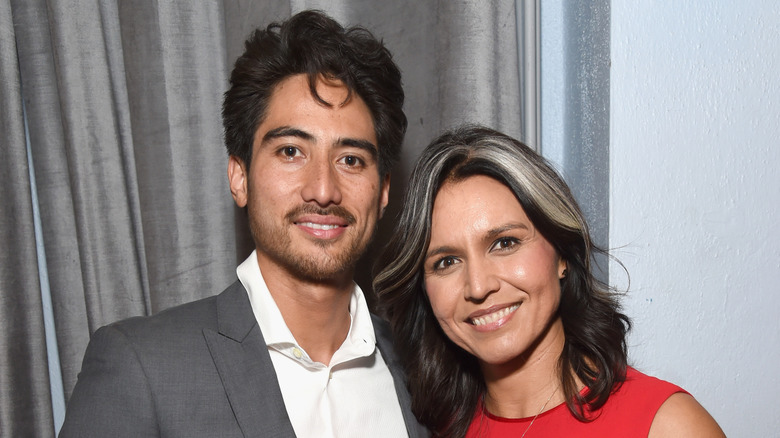
Tulsi Gabbard's personal life has had its share of heartbreak and second chances. Her first marriage was to Eduardo Tamayo, someone she had known most of her life. In a 2013 interview with Vogue, she called him her "childhood sweetheart." Gabbard recalled how close their families were, saying, "His family was like my family." Sadly, after an 18-month deployment to Iraq, the distance and pressure cracked something that could not be put back together. The couple divorced in 2006. "Sadly, Eddie and I became another statistic, another sad story illustrating the stresses war places on military spouses and families," she said at the time (via Honolulu Civil Beat).
She found her way back to love a few years later. Abraham Williams, a cinematographer, wandered into her life in 2012 as a volunteer on her congressional campaign. According to Newsweek, things didn't really spark until a mutual friend hosted a birthday party for Gabbard, giving the two of them a real chance to talk.
She told The New York Times they connected over their shared love of the ocean and water sports, which makes sense for two people living in Hawaii. Despite their age gap, the couple tied the knot in a traditional Vedic ceremony in Hawaii on April 9, 2015, and celebrated their 10th anniversary in 2025 by sharing memories on Instagram. But not everything has come easy for them. In May 2024, Gabbard opened up on her Facebook page during a conversation with her friend Meghan McCain about her struggles with fertility.
In a bold move, Tulsi Gabbard quit her DNC role in 2016
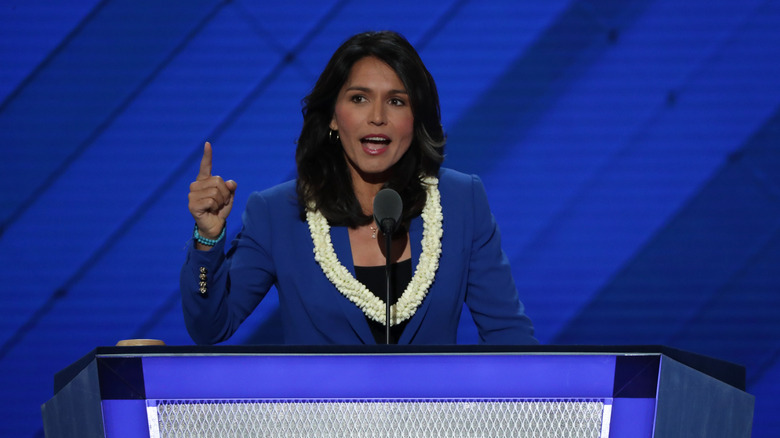
In February 2016, Tulsi Gabbard walked away from her role as vice chair of the Democratic National Committee — ending her four-year term a year early. On "Meet the Press," she announced her resignation and endorsed Bernie Sanders for president. Explaining her decision, she said, "I think it's most important for us, as we look at our choices as to who our next commander in chief will be, is to recognize the necessity to have a commander in chief who has foresight, who exercises good judgment." Her endorsement of Sanders was widely seen as a direct challenge to the DNC, sparking drama with Hillary Clinton.
In the same interview, Gabbard spoke about her time in uniform. "As a veteran and as a soldier, I've seen firsthand the true cost of war," she added, noting that some of her fellow veterans were still struggling to find their way back, even a decade after coming home.
The truth is, things had already been falling apart behind the scenes for her. CNN reported that in November 2015, after Gabbard pushed for more transparency in the primary process, she was disinvited from a Democratic debate. On the Lex Fridman podcast, Gabbard later said, "I saw a couple of things pretty quickly." She accused DNC chair Schultz of sidelining other party leaders and tilting the process in Clinton's favor.
Gabbard was slammed for meeting with former Syrian president Bashar al-Assad
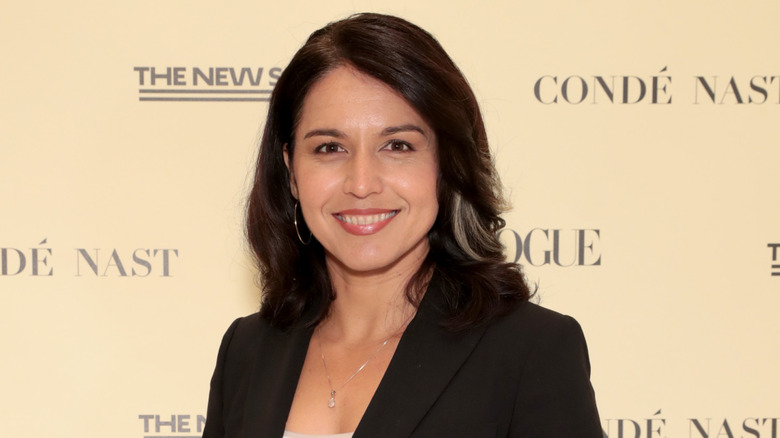
In 2017, Tulsi Gabbard made a low-profile trip to Syria that quickly turned into one of the most divisive moments of her career. The biggest flashpoint was her meeting with President Bashar al-Assad, a decision that, The Washington Post reported, caught even her own staff off guard.
When she defended the trip on CNN afterward, Gabbard said, "My reason for going to visit Syria was really because of the suffering of the Syrian people that has been weighing heavily on my heart. I wanted to see if there was in some small way that I could express the love and the 'aloha' and the care that the American people have for the people of Syria" (via Insider).
Critics, at the time, raised the Logan Act, which bars private citizens from negotiating with foreign governments during disputes with the United States. According to The Guardian, Gabbard's office insisted the visit had been cleared by the House Ethics Committee. Regardless, Democrats and Republicans alike condemned the meeting with Assad, whom the U.S. government considers a war criminal. Former Congressman Adam Kinzinger called it a "disgrace."
She launched her 2019 presidential bid with big promises
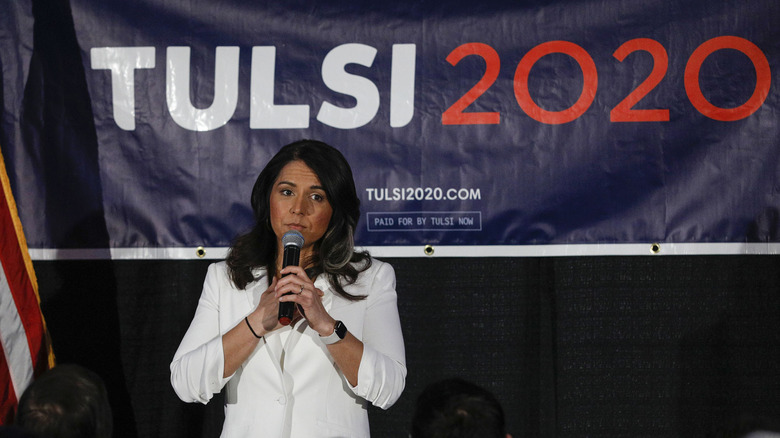
By early 2019, Tulsi Gabbard's political ambitions had gotten the better of her. She announced her presidential bid on CNN's "Van Jones Show," telling viewers, "There are a lot of challenges that are facing the American people that I'm concerned about and that I want to help solve." According to Politico, she ran on a list of big progressive promises: student debt relief, a ban on assault rifles, a $15 federal minimum wage, and up to 12 weeks of paid leave.
But the campaign never found much daylight on the national stage. Newsweek reported that she spent most of the race stuck at around 1% to 2% in the polls. Throughout the primary process, Gabbard's campaign showed little progress. She did attract a narrow following, mostly voters who admired her anti-war stance and her willingness to go after the Democratic establishment. As Insider reported, she finished the entire primary with just two pledged delegates, both from American Samoa, where she was born.
Gabbard, ultimately, folded her campaign in March 2020 and backed Biden. In a video on X, she said, "[T]oday, I'm suspending my presidential campaign and offering my full support to Vice President Joe Biden in his quest to bring our country together." She added, "I'm confident that he will lead our country, guided by the spirit of aloha, respect, and compassion, and thus help heal the divisiveness that has been tearing our country apart."
Critics have accused Tulsi Gabbard of sounding too much like Moscow
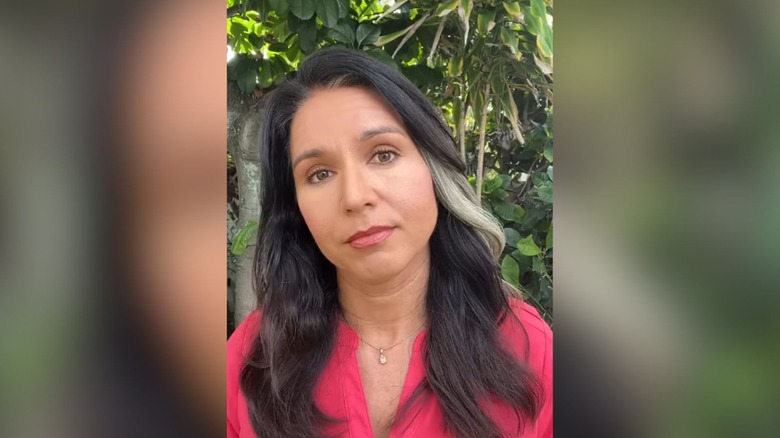
If there is one label Tulsi Gabbard has never been able to peel off, it is the accusation that she talks like Moscow wants her to. And over the years, she's handed critics enough examples to keep that argument alive. When Russia invaded Ukraine in 2022, most American politicians moved quickly to condemn Moscow. Tulsi Gabbard, on the other hand, argued the war could have been avoided if the Biden administration and NATO had listened to Russia's security concerns (via The Associated Press).
In a separate report, The Associated Press noted that Gabbard repeated Russian claims about U.S.-funded biolabs in Ukraine. She said, "These labs need to be shut down immediately, and the pathogens that they hold need to be destroyed." Later, she dialed that back, saying it was a misunderstanding (via The Independent).
The Associated Press reported that Russian state media has treated her warmly over the years, with one outlet branding her "superwoman." Ukrainian intelligence, by contrast, reportedly classified her as a Russian agent. Meanwhile, Gabbard seems to have decided that the best response is no response at all. When she appeared before the Senate Intelligence Committee in 2025, she offered seven words: "I don't pay attention to Russian propaganda" (via Kyiv Independent).
By 2022, she was done with the Democratic Party
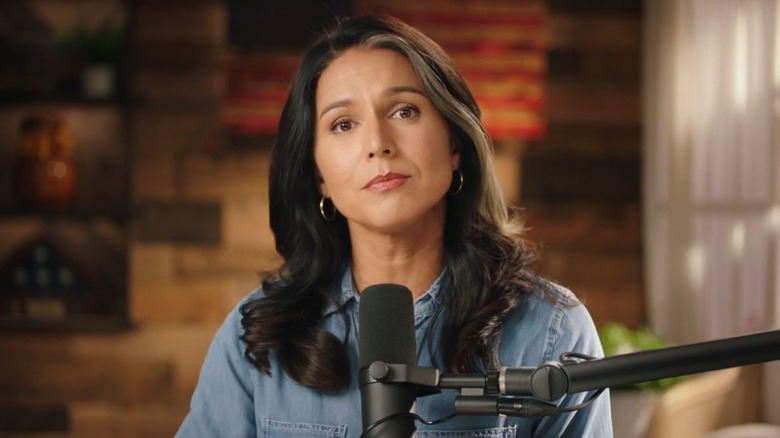
By 2022, Tulsi Gabbard stopped trying to square herself with the Democratic Party. Through a video on X, Gabbard announced, "I can no longer remain in today's Democratic Party that is under the complete control of an elitist cabal of warmongers who are driven by cowardly wokeness, who divide us by racializing every issue and stoking anti-white racism."
In a YouTube interview with Megyn Kelly, she accused Democratic leaders of working against her during her 2020 campaign and trying to smear her reputation. The biggest blowup came in 2019 when Hillary Clinton, according to Fox, publicly suggested that Russia was "grooming" Gabbard as a spoiler candidate to help Trump. Gabbard rejected that at the time as baseless and defamatory. As PBS reported, she even filed a defamation lawsuit over the remarks — then later dropped it.
The signs of her political migration had been showing up well before the formal exit. In December 2020, she introduced a bill that would effectively bar transgender women and girls from competing in women's sports, according to Time. She went on to suggest that Florida's "Don't Say Gay" legislation did not go far enough in restricting speech about sexual orientation and gender identity in schools, as GLAAD reported. By 2022, she was speaking at the Conservative Political Action Conference (CPAC) alongside openly anti-LGBTQ+ politicians (via Politico).
Her shift to the GOP was cemented in 2024 with her Trump endorsement
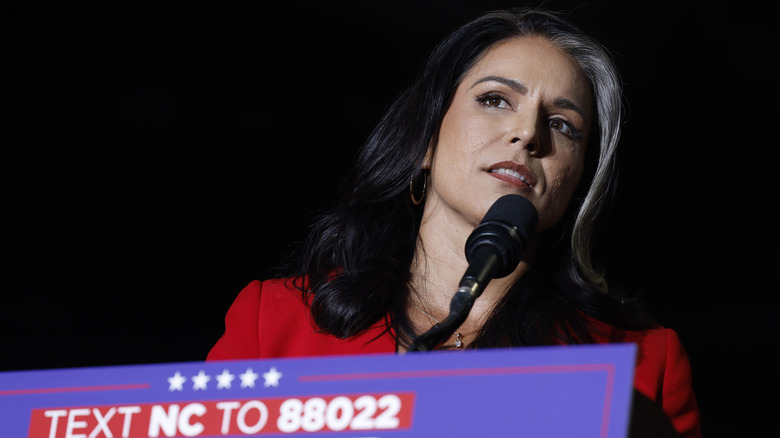
Tulsi Gabbard made her biggest break with her old political identity yet, and it came with a new, slightly awkward alliance. In August 2024, she endorsed Donald Trump for president while speaking at a National Guard Association conference in Detroit. "This administration has us facing multiple wars on multiple fronts in regions around the world and closer to the brink of nuclear war than we ever have been before," she said (via The Guardian). She promised to do everything she could to put Trump back in the White House, framing him as the only candidate serious about pulling the country back from the edge of conflict.
According to CBS, Trump's campaign announced the next day that Gabbard had been brought onto his presidential transition team, the group responsible for laying the groundwork for a potential second term. A spokesperson named her among the "powerful voices on the team." On October 22, 2024, at a Trump rally in North Carolina, Gabbard officially registered as a Republican.
"To those of you here or those watching at home, who are independent-minded people, like myself, who love our country and are committed to the Constitution, and to Freedom, the Democrat Party has no home for people like us," Gabbard said (via LiveNow from Fox). She declared the Republican Party to be a party that welcomes people like us with open arms, under the leadership of President Trump.
In 2024, Trump appointed Tulsi Gabbard director of national intelligence
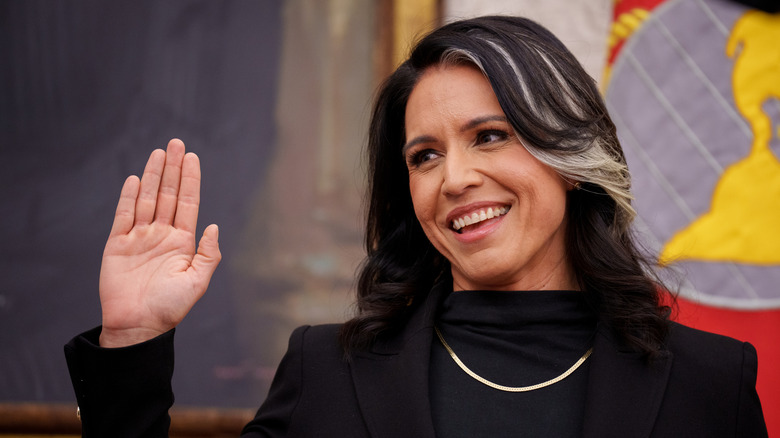
On November 13, 2024, Donald Trump picked Tulsi Gabbard to lead the U.S. intelligence community as director of national intelligence. Three months later, the Senate confirmed her by a close 52–48 vote, according to CBS — hardly an easy start.
While Gabbard has scaled back her media presence since stepping into the DNI role, she occasionally makes public statements that hint at her worldview. In an interview with ABC News before testifying in March, she repeated a familiar refrain: "War must always be the last resort, only after all measures of diplomacy have been completely exhausted."
Despite holding the top intelligence job in the country, Gabbard and Trump have not always seen eye to eye on foreign policy. In 2025, Gabbard told Congress that Iran was not a nuclear threat and did not possess nuclear weapons, directly contradicting the narrative the White House had been pushing. Trump, however, did not take it well. "I don't care what she said," he told reporters, according to The Associated Press.